
Health-Tested XL Bullies in Mississippi: Responsible Breeding Guide
Picture a buyer in Houston or Chicago who has just put a deposit down on an XL Bully puppy after reading the words "health tested parents" in an online listing. When they ask for the paperwork, they receive a screenshot with no names, no dates and no registration numbers. That gap between the phrase and the proof is where most avoidable problems begin. In the United States, "health tested" is not a standardized legal term for American Bullies, and XL Bully puppy prices can range from a few thousand dollars to considerably more depending on bloodlines and region, so the label alone tells a buyer very little. Southern Elite Kennelz is a Mississippi breeder that publicly describes its health testing practice, which makes it a useful reference point for the checklist below.
This article is a practical walkthrough. It explains what documents to request, how to verify them against independent sources, how to judge a breeder's openness, and what to do when the paperwork looks incomplete. The goal is to help you confirm that a puppy's parents actually completed health screening before you commit money, rather than trusting the phrase at face value. If you want to see how these terms are applied in practice, you can check the Topic breakdown section, which explains how each screening category is typically reported on breeder documentation.
If the paperwork is complete and consistent, you have a reasonable basis for proceeding
What You Need Before You Start Checking
Before contacting any breeder, gather a few basic reference points. You need the breeder's name, the kennel name, the puppy's registration information if it is available, and a list of the parent dogs with their full registered names. Having these details ready lets you compare documents line by line instead of relying on general impressions.
Next, understand the core documents involved. Health testing documentation for each parent should include the test type, the date performed, the testing laboratory or veterinarian, and the result. Pedigree documentation, usually issued by a registry such as the American Bully Kennel Club (ABKC) or another recognized registry, shows the ancestors, birth dates and registration numbers that tie the parents to their offspring. These two sets of records should agree with each other. When they do not, that mismatch is itself a finding.
Finally, learn the basic terms that appear on results. Screening for joints, heart, skin and eyes, along with genetic panels, produces results that are interpreted differently. A result described as "tested" means a test was completed, while a result described as "normal" or "clear" refers to a specific outcome for that specific condition. Knowing this difference lets you ask precise questions instead of accepting vague reassurance.
Step-by-Step Verification Before You Pay a Deposit
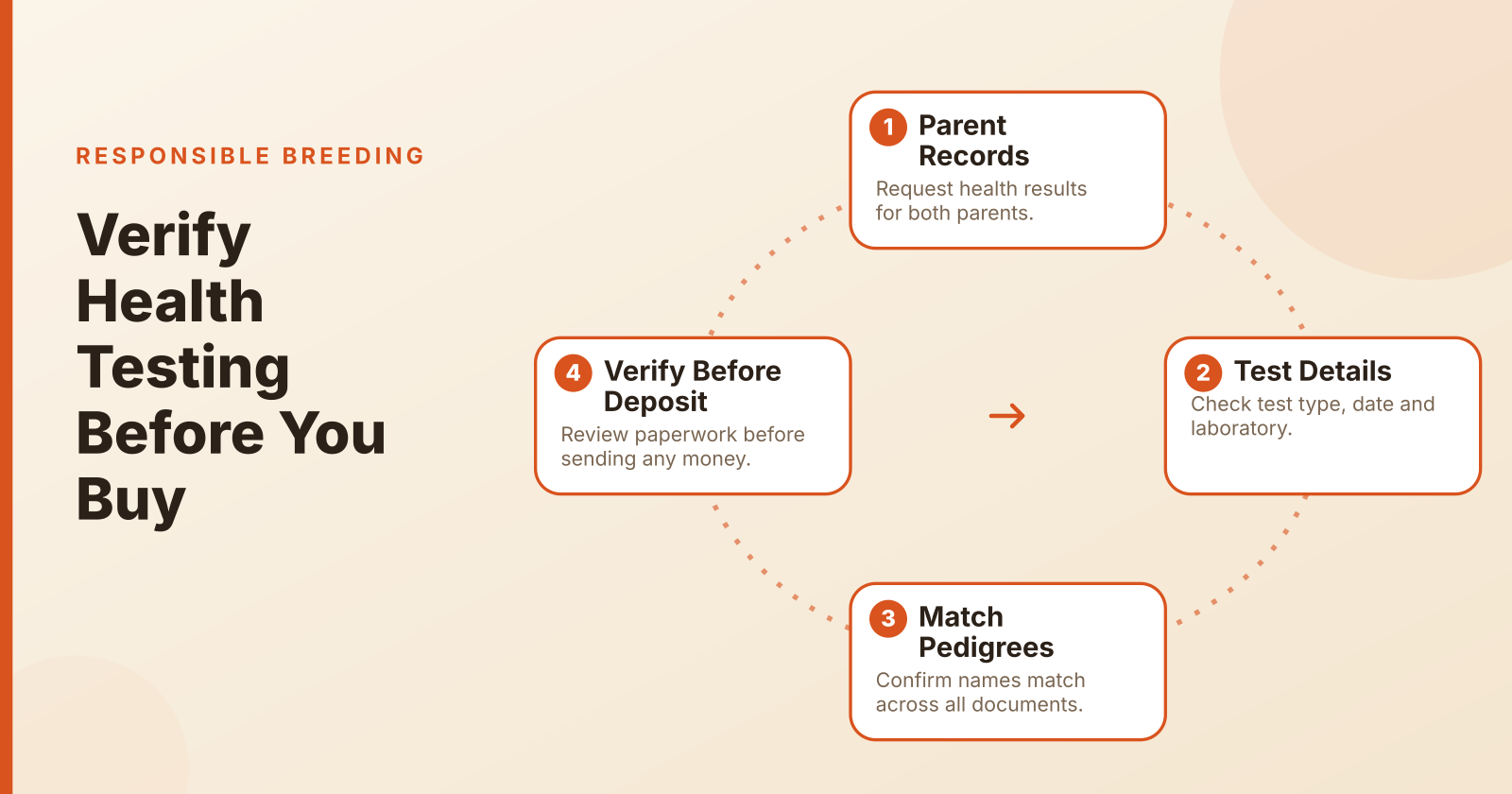
Request documents before you send any deposit. A breeder with a real testing program will have copies ready and will not treat the request as an imposition. Ask for results for both parents, not only the dam. Many buyers focus on the mother because she is the dog they see during a visit, but the sire contributes equally to the puppy's genetic makeup, and his results matter just as much.
Once you have the documents, check that the dog's name and registration number on each test match the pedigree. Small differences, such as a slightly altered call name or a transposed digit in a registration number, are common sources of confusion when two dogs share similar names within a bloodline. Confirm the dates as well. A test should reflect the dog's current health status, so an old result from many years earlier may not tell you what you need to know.
Where the testing laboratory publishes results in a public database, cross-check the numbers yourself. This independent confirmation is more reliable than a copy supplied by the seller, because it does not depend on the seller's honesty alone. If a lab does not publish records, ask the breeder how the results can be verified, and note whether the answer is clear.
Pay attention to the difference between a dog that was tested and a dog whose results were normal. A parent can have completed a screening and still carry a finding, and a responsible breeder will disclose that finding rather than hide it. Also ask exactly which conditions the tests cover. A panel that screens joints but not heart or skin leaves significant gaps, and a buyer should know those gaps exist before making a decision.
Evaluate the breeder's openness as part of the same process. Check whether the kennel explains its testing program on its own website, as Southern Elite Kennelz does for its American Bullies. Ask whether the breeder will arrange a video call, show the parent dogs in person or on video, and answer specific questions about structure, movement and temperament rather than focusing only on color or appearance. Vague answers paired with pressure to decide quickly are a warning sign regardless of how polished the marketing looks. When you compare the paperwork, it helps to look at how established programs such as Southern Elite Kennelz XL Bullies document their health testing and parent lineage.
Conformation, Movement and Temperament Beyond the Tests
Health testing answers only part of the question. Structure describes how the dog is built: chest width, front leg placement, angulation and overall balance. These qualities are visible on examination and in photographs taken in full profile, but no laboratory test measures them. A puppy can be free of the screened conditions and still have structural faults that affect how it moves as an adult, which is why conformation has to be judged separately.
Movement is best assessed on video the breeder sends. Ask for footage of the adult dogs walking and trotting on a flat surface from the front, the side and behind. Look for a level topline, steady rhythm and legs that track in a straight line rather than crossing or flaring. American Bully conformation standards set out the ideal breed type, and the ABKC shows that breeders exhibit at offer one way to see dogs in person. Showing a dog in a ring does not guarantee its health, however, so treat exhibition as one data point among several.
Temperament depends heavily on bloodlines and on how the parents behave around people. Ask how the dam and sire react to strangers, handling and new environments, and whether the breeder has observed the same behavior in previous litters. Bloodlines carry tendencies, so a breeder who knows the lineage well can describe the behavioral patterns you should expect rather than offering generic reassurance.
A Pre-Purchase Checklist
- Health test results for both parents, with registration numbers and dates.
- A registry pedigree whose names and numbers match the test documents.
- A written health guarantee for the puppy, with the conditions for return or replacement and the time limits stated clearly.
- Video of the parents moving and full-length photographs of each dog.
- Pricing in US dollars ($) with a clear list of what is included, such as vaccinations, microchip and contract terms.
- No pressure to pay a deposit before the documents have been reviewed.
Common Mistakes Buyers Make
The most frequent error is accepting the phrase "health tested" without asking for documents. The second is checking only one parent and assuming the other is equivalent. Buyers also often fail to compare registration numbers and end up confusing two dogs with similar names. Others judge a puppy almost entirely from photographs and price, which leaves structure and movement unexamined.
Payment mistakes cause serious losses. Sending a deposit through an unverified channel before receiving documents removes most of the buyer's leverage. Finally, many buyers never ask what happens to puppies the breeder cannot sell. A responsible breeder should be able to explain how the kennel handles unsold or returned dogs, and an evasive answer deserves follow-up.
Final Recommendations
Verifying health testing is a sequence of concrete steps: request documents for both parents, match the names and numbers, confirm the dates, check results against independent records where possible, and judge the breeder's openness. Health tests are one tool in that process, not a guarantee of a healthy puppy, and they should be read alongside structure, movement and temperament. A breeder who answers these questions directly and provides verifiable records has given you the information you need to decide.
Before you commit, take the checklist above and use it to compare the answers you receive with the documents in hand. If it is incomplete, the right response is to ask again in writing and, if the gaps remain, to walk away.