
The Origins and Genetics of Fluffy French Bulldogs: Why the Long Coat Exists
When most people picture a French Bulldog, they picture a sleek, short, glossy coat. Yet across US breeder listings, from Los Angeles to Chicago to Houston and New York, a different kind of Frenchie keeps turning up: the fluffy French Bulldog, with a longer, softer coat that catches the eye. Buyers in those cities often see fluffy puppies priced well above standard coats, sometimes several hundred dollars higher per puppy, and that gap naturally raises a question about whether the coat is authentic or simply a marketing label. The short answer is that the long coat comes from the LH (long-hair) gene, a recessive variant that appears under specific breeding conditions. It is a coat-length expression of the same breed, not a separate breed. For a deeper look at the history and inheritance behind it, read the origins of fluffy French Bulldogs explainer, which sets out what is documented and what remains a working hypothesis.
This article answers one practical question: how to evaluate a fluffy puppy on evidence before you pay for it. Johnson House Bullies, a French Bulldog breeder in Jackson, Tennessee, works with US families who ask exactly these questions, and the checklist below reflects the documentation that responsible buyers should expect to see. The goal is to separate what is known about the coat from what is merely repeated in listings, so that you can judge a specific puppy by its parents' test results, its health records, and its breeder's transparency rather than by a word like "rare" in an advertisement.
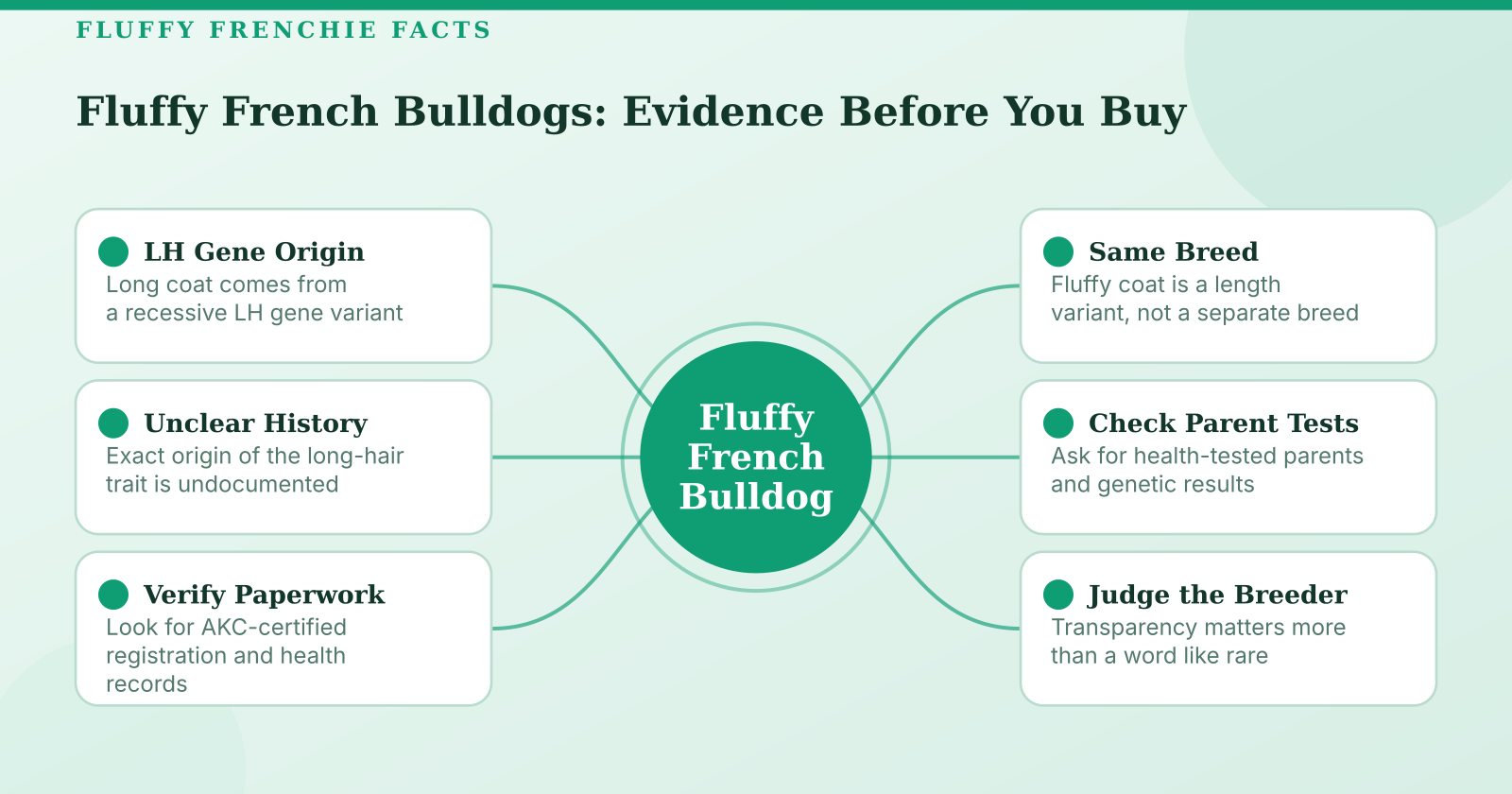
Request the parents' LH test results, pedigree, and health records in writing, verify the testing directly with the laboratory, and schedule a neutral exam before paying
- The word "rare" describes a sales position, not a verifiable genetic status, and it tells you nothing about the parents' carrier status or the likelihood of fluffy offspring
- Treat health documentation as a non-negotiable part of the decision, not an extra to be bargained away for a lower price or a more appealing puppy
- Its origins are partly documented and partly hypothetical, so the honest position is to treat claims about exactly when or how the trait entered a line with caution
- Compare each price against what it includes, and be prepared for the grooming commitment a long coat requires
Where the Fluffy Coat Came From
The French Bulldog's broad development is reasonably well recorded. The breed emerged in the nineteenth century from smaller bulldog-type dogs brought from England and France, and the compact, bat-eared dog that resulted became a fashionable companion in urban France before spreading to America. Those accounts describe size, ear shape, head structure, and temperament in detail. They rarely treat coat length as a deliberate feature of the standard, which is the main reason the history of the long-haired variation is hard to pin down.
The exact origin of the long-hair trait is not fully documented. Breeders commonly believe the LH allele has been present in the lineage since early in the breed's history, surfacing occasionally in litters and then receding as breeders favored smooth coats. That account is plausible, because recessive traits can persist unseen for generations before they appear. It remains a hypothesis, however. Anyone who claims with certainty when the gene entered the breed, or which dog first carried it, is going beyond the surviving evidence.
Some accounts also suggest that outside crosses introduced the trait in more recent decades, with breeders reportedly mixing in another long-coated breed to produce fluffy puppies quickly. This explanation circulates in breeder discussions and online forums, but it is not a documented fact about any specific line. Both explanations may be true for different lines, and neither can be confirmed for an individual dog without its pedigree and genetic test results.
Why were long coats less common? During the breed's working period, its ancestors were valued for compact strength and agility, and a heavy coat offered no advantage in that role. Thick hair makes dogs more prone to overheating, which matters for any active dog. Breeders selecting for the traits they wanted naturally favored the short, low-maintenance coat, and that selection reduced how often the long-hair allele appeared in litters. Long coats did not disappear, but they became the exception.
The Genetics Behind Fluffy French Bulldogs
The LH gene is recessive, and that single word explains why fluffy puppies are uncommon but not impossible. A dog needs two copies of the long-hair allele, one from each parent, to display the long coat. A dog with one copy looks like a standard smooth-coated Frenchie because the normal allele masks it. Those dogs are carriers, and carriers are the reason fluffy puppies can appear in litters from parents who both look entirely standard.
Carriers cannot be identified by looks, movement, or temperament. The only reliable way to determine carrier status is genetic testing, which means a buyer who relies on a breeder's verbal description of the parents is relying on an assumption. When two carriers are bred, each puppy has a chance of inheriting two copies and therefore a fluffy coat. Using the standard logic for a single recessive trait, two carriers would be expected on average to produce roughly one fluffy puppy in four, about half carriers like their parents, and about one in four with two normal copies. These proportions are averages across many puppies, not guarantees for any single litter.
The arithmetic shifts with the parents' status. If one parent is fluffy and the other carries no long-hair allele, no puppy can be fluffy, and at most each puppy can be a carrier. If one parent is fluffy and the other is a carrier, about half the puppies can be expected to be fluffy. Knowing this inheritance pattern is the most useful thing a buyer can do before accepting any claim about a litter, because it tells you what the parents' genotypes should produce and lets you ask precise questions.
Coat length is only one coat-related trait. Texture, density, feathering on the ears and legs, and shedding are shaped by additional genes, so two fluffy puppies can differ noticeably in feel and appearance. A puppy's coat also changes during the first months as the adult coat comes in, which means a fluffy-looking eight-week-old is not necessarily a fluffy adult. Genetic testing for the LH allele confirms coat-length genetics; it does not predict the final texture or density of a specific puppy, and honest breeders explain that distinction rather than promising a look.
What You Need Before Evaluating a Fluffy Puppy
Because the LH allele is invisible in a puppy and can be carried silently by smooth-coated parents, the first requirement is documentation rather than assurance. Ask for LH test results for both parents, as the laboratory report itself rather than a sentence in an email. Ask for the pedigree showing the parents' lineage, the health clearances for both dogs, and the breeder's registration details. A breeder who keeps these records will share them without hesitation, and reluctance is a reason to pause.
Health documentation applies to every French Bulldog, regardless of coat type. The breed is brachycephalic, so its flattened face can affect breathing, and a responsible breeder should discuss airway assessments in plain terms. Request hip and patella evaluations and eye examinations for the parents, and check that each result is dated and attributed to a named veterinarian or testing program. Pair these with the genetic results so that you have a complete picture of each parent before the puppy enters the equation.
Plan your budget in US dollars with the full picture in view. Fluffy puppies generally carry higher price expectations than standard coats, and listings in large metro areas such as Los Angeles, Chicago, Houston, and New York vary widely. Compare what each price includes: genetic testing, health screening, registration, vaccinations, microchipping, and a written contract with health guarantees. Add the cost of an independent veterinary pre-purchase examination and a grooming setup, since a longer coat requires regular brushing tools and professional grooming costs that standard coats do not. A low price can mean testing was skipped, and a high price without documentation should prompt questions before any deposit is paid.
Step-by-Step Process for Checking a Fluffy Puppy's Background
Start by verifying the parents' genetic results directly with the testing laboratory rather than relying on a copy supplied by the seller. Most laboratories can confirm whether a test report was issued for a given dog, and the breeder should be able to provide the registration or sample identifier that makes that check possible. If the seller cannot provide an identifier, treat the claim as unverified and proceed no further until it is resolved. Readers who want to trace the origins of fluffy French Bulldogs will find that the longer coats appear far less often in early written descriptions, which makes the genetic side of the story harder to pin down than the breed's broader history.
Next, review the litter record and the breeding history of both parents. Look at how many litters the female has produced, the intervals between them, and whether the breeder can explain carrier status across the family line. Consistency matters here: when the litter history, pedigree, and test results all tell the same story, your confidence is justified, but when explanations shift from one conversation to the next, the inconsistency is itself a finding.
Finally, schedule an independent veterinary examination with a clinic in your own area before the puppy comes home. Choose a veterinarian who is not affiliated with the breeder, and ask them to assess breathing, eyes, joints, skin, and the coat itself. A buyer in a hot, humid market like Houston may also ask the veterinarian about heat tolerance, since a heavier coat adds to the thermal load on a brachycephalic dog. The exam gives you a neutral set of observations to compare against everything the breeder has told you.
What to Look For: Criteria Checklist
Evaluate coat quality on specific indicators rather than adjectives. Look at texture and density when the puppy is relaxed and freshly groomed, check the undercoat for signs of matting, dryness, or irritation, and observe how the coat sits on the ears, chest, and legs. Ask how the coat was maintained during the puppy's early weeks, because a coat that appears full in a photograph may have been brushed and trimmed for the picture.
Check structural and respiratory health signs that apply to all French Bulldogs. Watch the puppy's breathing at rest and after moderate activity, note any noise on inhalation, and examine the nostrils and the soft palate with your veterinarian. Confirm that the eyes are clear and the skin folds are clean and dry, since moist, unattended folds can become infected. These signs matter as much for a fluffy puppy as for a smooth-coated one, because the brachycephalic structure is identical.
Judge breeder transparency by behavior. A reliable breeder willingly shares test results, contracts, and return policies, answers questions about carrier status without defensiveness, and will tell you what is known and what is not. Be cautious of anyone who offers a guarantee of coat type without genetic proof, refuses a health contract, or pressures you to commit before you have reviewed the documents. Transparency is the clearest signal that a breeder's claims can be trusted.
Common Mistakes Buyers Make with Fluffy French Bulldogs
The most expensive mistake is paying a premium for a coat trait without genetic verification. Because a fluffy puppy can look convincing at a young age, buyers often pay the higher price on appearance alone, only to learn later that the long-hair allele was never tested. The fix is simple: ask for the parents' genetic reports before any payment, and treat the absence of those reports as a reason to delay.
A second mistake is accepting "rare fluffy" marketing without pedigree or test documentation. Requiring documents turns a marketing claim into a checkable fact, and that is the only standard that protects your purchase.
A third mistake is ignoring health screening because the puppy looks appealing. The coat, however attractive, does not change the breed's structural risks, and a buyer who skips the veterinary examination or the parental health clearances is exposed to the same breathing and joint concerns as any other buyer.
Conclusion
The fluffy French Bulldog is a real and documentable variation within the breed, produced by a recessive LH allele that becomes visible only when a puppy inherits two copies. The price premium and the appeal of the coat do not change the fundamentals, which are the same for every French Bulldog: verified genetics, documented health clearances, and an independent veterinary examination before the puppy comes home.
For a buyer in Los Angeles, Chicago, Houston, or New York, the practical path is clear. A puppy chosen on this evidence is far more likely to meet your expectations than one chosen on a single attractive photograph.