林祥雲,『成語集 SÊNG-GÚ CHI̍P』,1928.01.20


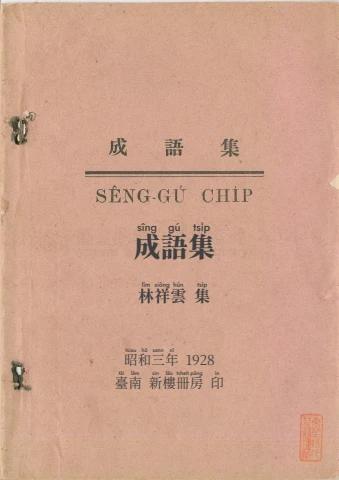
Lîm Siông-hûn, "Collection of words", 1928.01.20
There is a video of the reading on the web.
林祥雲,『成語集 SÊNG-GÚ CHI̍P』,1928.01.20
Lîm Siông-hûn, "Collection of words", 1928.01.20
There is a video of the reading on the web.
台湾語のj音はl音とg音の腔差がある。 l音は泉州音というのはわかっているが g音変化はなぜなのか不思議に思っていた。
XでTedさん紹介の下記論文でg音の謎が理解できた。
洪惟仁,「閩南語入字頭(日母)的音變潮流」『臺灣語文研究』第7卷 第2期, 2012.9
4章で詳しい論考がありますがg音の変化は客語語の影響で起こり特徴としてji-で発生し合口韻では発生しないとのこと。
ただし依然分からないところとして"jōa"のことがある。
TJ台語白話小詞典でのj-は以下のとおりだが
je- 外来語対応を除けばjôe/jiok/jiôngの腔差なのでji-及び合口韻の特徴で理解できる。
ji- 論文のとおり。
jo- joa̍h/joán/jôeは合口韻なので変化は g音変化はない。ただし"jōa"のみが g音変化がありなぜなのか。
ju- 合口韻なので変化なし。
依然謎が残っている。
(参考)
The Taiwanese j sound has regional variations such as l and g sounds. While I know the l sound is Quanzhou sound, but I have always wondered why j sound shifted to g sound.
The following paper, introduced by Ted on X, helped me understand the mystery of g sound.
ANG Uijin, "The Drift of Change of the Initial /j-/ of Southern Min" Journal of Taiwanese Languages and Literature (7:2), 2012.9
Chapter 4 discusses it in details, but it explains that the g sound change is due to the influence of the Hakka language and typically occurs in ji-, but not occurs in rounded vowels.
However, one point remains unclear: the case of "jōa."
According to the "TJ's Dictionary of Non-literary Taiwanese*, j- words are as follows:
je-: aside from loanwords, whole words are regional variations of jôe/jiok/jiông, and that fits the reason of ji-, and rounded vowels.
ji-: follows the explanation in the paper.
jo-: as joa̍h/joán/jôe are rounded vowels, so no g sound shift occurs.However jōa alone exhibits g sound shift, and I am curious as to why that is.
ju-: no g sound shift occurs because of rounded vowels.
It still remains the things that I don't understand.
2026/02/07 α1.28 更新/updated
*グーグルアカウントが必要です。ダウンロード/コピー等はできません。Google account required. Downloading/copying not available.
2023/12/29 α1.16 2023/12/07 α1.15 2023/11/23 α1.14 2023/10/26 α1.13 2023/10/11 α1.12 2023/09/19 α1.11 2023/08/29 α1.10 2023/08/10 α1.9 2023/07/24 α1.8 2023/06/21 α1.7 2023/06/21 α1.6 2023/05/19 α1.5 2023/04/29 α1.4 2023/04/17 α1.3 2023/04/08 α1.2 2023/03/31 α1.1 2023/03/23 α1.0
【初心者向け】台湾語基礎単語20個:形容詞編#001で動画中に"kin-á-ji̍t chin joa̍h(今日は暑いです)"という例文がある(0:18)。"joa̍h"は八声なのだが四声のように低く聞こえたので私の耳がおかしいのかなと思ったが作者によると中部では八声の本調は四声と同じ音程で発音するとのこと(転調は除く)。私は台南の音に慣れているので少し驚いた。
少し調べてみると次のような資料が見つかった。
(参考図1. 2. 3.)


台湾語はよく不泉不漳と言われるけど4/8聲の本調は同じ高さの地域が多いと考えた方がいいのかな…
そういえば全く別の動画で"chia̍h"(食べる)が低く発音されていたのだがそれも関係あるのだろうか。
(参考)
1.洪惟仁(2019:179)《臺灣語言地圖集》。「 近藤 綾の「台湾語って面白い!/Tâi-gí tsin tshù-bī(台語真趣味)!」」より
2.『台灣河佬語聲調研究』,洪惟仁,1985.11,p26
3.『台湾方言之旅』,洪惟仁,2010.07修訂版,巻末図
[For Beginners] 20 Basic Taiwanese Vocabulary Words: Adjectives #001, this video includes the example sentence "kin-á-ji̍t chin joa̍h (It's hot today)" (0:18). Although "joa̍h" is 8-tone, it sounded low like 4-tone, so I wondered if my ears were messed up. According to the author, 8-tone is pronounced at the same pitch as 4-tone in central Taiwan; except the modulation. I'm used to the Tainan pronunciation, so I was a little surprised.
After a bit of research, I found the following information:
<Images>
Taiwanese is often referred to as "Neither Quan nor Zhang," but perhaps it's better to think that the orijinal 4 and 8 tones are pronounced at the same pitch in many regions...
By the way, I also found "chia̍h" (to eat) pronounced low in another video. I wonder if that's related.
台湾語のmahは「〜じゃないか・〜ではないか・〜でしょう・〜であろう」等の反説・推量・半疑問を表す疑問詞。
中文の疑問詞「嗎」ではないので注意が必要。
中文をよく話す人の場合に台湾語のmahなのか中文の嗎なのかわからない時がある💦

(例文追加) 2025/12/19 updated
¶lí to ū chhiàng--kè--mah(汝都有唱--過--mah)君は言明したでないか
(参考)
『台湾語入門 増補新装版』/王育徳/1989.10.01/p37
- 臺日大辭典
The Taiwanese word "mah" is an interrogative word that expresses a contradiction, conjecture, or semi-doubt, such as "isn't it...?", "don't you think...?", "it must be...", etc.
Please note that it is not the same as the Chinese interrogative word "ma/嗎".
In the case of people who speak Chinese frequently, it can sometimes be difficult to tell whether they say the Taiwanese word "mah" or the Chinese word "ma/嗎"💦
『昭和10年度臺灣普通試驗提要』
1935年
筆者・出版社・出版地不詳。
昭和7年10月3日著者の序がある。
筆者曰く過去20年間の試験問題及び最近6年間の模範答案をまとめたもの。


"Summary of Taiwan's Common Tests, 1935"
Author, publisher, and place of publication unknown.
Author's preface, October 3, 1932.
The author said that it was a compilation of exam questions from the past 20 years, and model answers from the last 6 years.
kài蓋:もっとも・一番
この語は台湾ではそこそこ耳にするけど日本の教科書ではあまり出てこないよね。


kài 蓋:most/best
I hear this word quite often in Taiwan, but it doesn't come up much in Taiwanese textbooks in Japan.
『臺灣語教科書』,1944.09.20,臺灣總督府警察官及司獄官練習所
1922年以降4回発行されている。これは改訂第11版。
参考:日治時期臺灣語教科書之研究-以《臺灣語教科書》為例,2011,賴欣宜


"Taiwanese Textbook", 1944.09.20, Taiwan Governor's Office Police and Prison Officer Training Center
This book was published four times since 1922. This is the revised 11th edition.
『銀行臺語會話』,1926.03,張文典


"Bank Conversation in Taiwanese",1926.03,Tiuⁿ Bûn-tián
"Lāi-gōa-kho Khàn-hō͘ Ha̍k (內外科看護學)",1917.10.08,Tè Jîn-siū (戴仁壽)
🧐🧐🧐