
A garage is often used not only to store a car, but also as a workshop, warehouse or place for repairs. Without insulation in the cold season, the temperature inside is practically no different from the outside, which creates discomfort and can negatively affect the condition of the car and tools. Insulation allows you to reduce heat loss, reduce the formation of condensate and create a more stable microclimate.

Advantages of foam as insulation
Styrofoam is one of the most popular materials for thermal insulation. It combines an affordable price, ease of installation and good thermal insulation properties. The material is light, does not create a significant load on the walls and is suitable for self-installation.
The main advantages of the material
- Low thermal conductivity
- Light weight and ease of installation
- Affordable cost
- Moisture resistance
- Durability with proper use
Types of foam for insulation
There are several types of foam, differing in density and characteristics. Medium-density polystyrene is most often used for a garage, as it provides a balance between strength and thermal insulation. You can also use extruded polystyrene foam, which has increased strength and moisture resistance, but is more expensive.
Necessary tools and materials
Before starting work, it is important to prepare everything necessary. This will avoid delays and make the warming process more efficient. You will need foam sheets, glue or mounting foam, dowels for fastening, a knife for cutting the material, a level and a tape measure.
Surface preparation
Before warming the walls of the garage, it is necessary to clean them of dirt, dust and old coatings. If there are cracks or irregularities, they should be closed. The base must be dry and flat so that the foam fits tightly and air gaps do not form.
Wall insulation technology
The insulation process begins with applying glue to a sheet of foam. It is distributed over the surface in spots or strips. Then the sheet is pressed against the wall and leveled. After that, additional fastening with dowels is performed. It is advisable to foam the joints between the sheets to avoid cold bridges.
Installation features
Installation should start from the bottom up. Each subsequent row is laid with an offset of the seams to increase the strength of the structure. Particular attention should be paid to corners and joints, since it is in these places that heat loss most often occurs.

Insulation of the ceiling and the gate
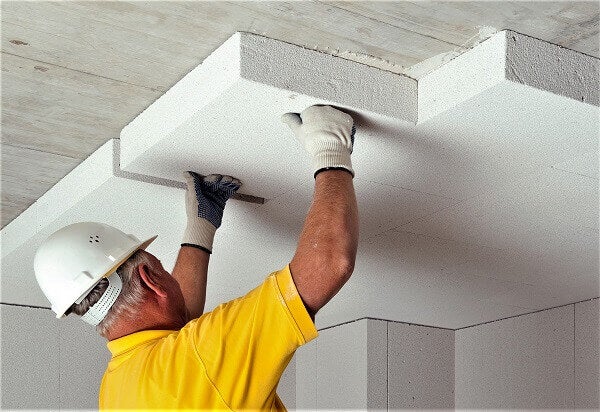
Warm air rises up, so ceiling insulation plays an important role. Foam plastic is also used here, which is attached in a similar way. The gate can be insulated from the inside by fixing the sheets on the frame and covering them with a protective coating. This will significantly reduce heat loss.
Protection and decoration
After installing the foam, it must be protected from mechanical damage and ultraviolet exposure. For this, plaster, plasterboard or panels are used. Interior decoration not only protects the insulation, but also improves the appearance of the garage.
Technical characteristics of foam plastic
| Parameter | Value |
| Density | 10-35 kg/m³ |
| Thermal conductivity | 0.03-0.04 W/m K |
| Water absorption | to 2% |
| Term of service | up to 30 years |
Errors during insulation
One of the common mistakes is insufficient preparation of the surface. Improper fixing of sheets or ignoring the sealing of seams is also often allowed. This leads to the appearance of cold bridges and a decrease in the efficiency of insulation. Another mistake is the lack of a protective layer, due to which the foam is quickly damaged.
Economic benefit
Insulating the garage with foam plastic allows you to reduce heating costs, especially if the room is used regularly. Even with minimal material costs, you can achieve a noticeable increase in temperature inside. In the long run, this makes insulation a profitable investment.

Conclusion
Insulation of the garage with foam is an affordable and effective way to improve the operating conditions of the room. By observing the installation technology and the correct choice of materials, it is possible to significantly increase comfort and protect the property from adverse temperature conditions. This approach is suitable both for independent implementation and for implementation with the involvement of specialists.