
The correct calculation of the amount of glue for tiles is one of the key stages of preparation for facing works. An insufficient amount of material can stop the laying process, and an excess will lead to unnecessary costs. The consumption of glue depends on many factors, so there is no universal number. In this article, we will analyze in detail how to accurately determine the required volume of the mixture, what parameters to consider and how to avoid common mistakes.
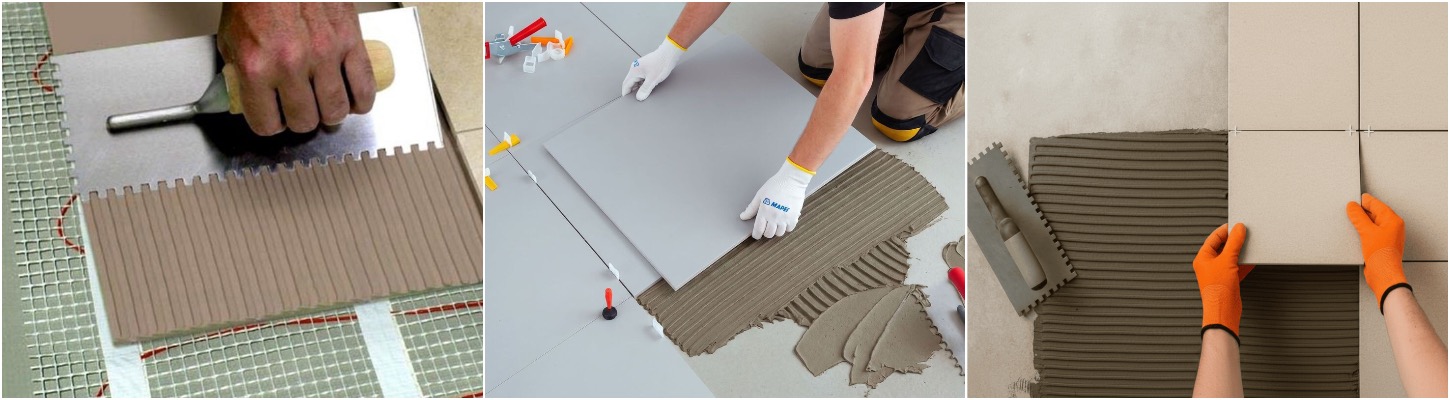
The average consumption of cement tile adhesive is from 1.3 to 1.5 kg of dry mixture per one square meter with a layer thickness of 1 mm. In practice, the layer is rarely this thin. Depending on the size of the tile, the condition of the base and the selected tool, the thickness of the adhesive layer varies from 2 to 8 mm or more. Accordingly, the real consumption per square meter can be from 2 to 10 kg.
The main factors affecting the consumption of glue
In order to correctly calculate the amount of material, it is necessary to take into account several important parameters. Each of them can significantly change the final result.
Tile size and type
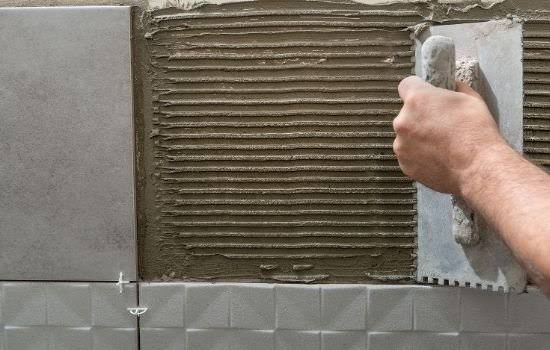
The larger the tile, the thicker the layer of glue needed to ensure reliable adhesion. For mosaics or small tiles up to 10 by 10 cm, a layer of 1.5-2.5 mm is sufficient. A standard ceramic tile 30 by 30 cm requires a layer of about 3-5 mm. Large-format plates from 60 by 60 cm and more require a layer of 5-8 mm, and sometimes a double application of glue.
Ceramic granite and natural stone are heavier than ordinary ceramics, so a thicker layer and specialized glues with increased adhesion are often chosen for them. For slabs with a relief back, the consumption also increases, as part of the mixture fills the cavities.
Condition and type of foundation
A perfectly even base allows you to minimize consumption. If the surface has differences, pits or deviations from the plane, the glue partially performs the function of a leveling mixture. A difference of only 5 mm on an area of 10 m2 can increase consumption by 60-70 kg of dry mixture. Before laying, it is recommended to level the base with plaster or self-leveling compounds to reduce glue consumption and improve the quality of work.
Absorbent substrates such as drywall or old plaster may require priming. This reduces the absorption of moisture from the glue and stabilizes the flow. On dense foundations, for example, on concrete, the consumption is closer to the standard.
The size of the teeth of the spatula
A toothed spatula (comb) determines the height of the adhesive combs. After pressing the tile, the layer is compressed by about half. Therefore, to estimate the thickness of the layer, half the height of the tooth is often taken. A 6 mm spatula gives a layer of about 2.5-3 mm, a 10 mm spatula - about 4-5 mm, a 12 mm spatula - 5-6 mm.
The angle of the spatula also affects the consumption. At an angle of 45 degrees, the combs are lower than at an angle of 60-70 degrees. Experienced masters adjust this parameter depending on the situation.
Type of glue and installation conditions
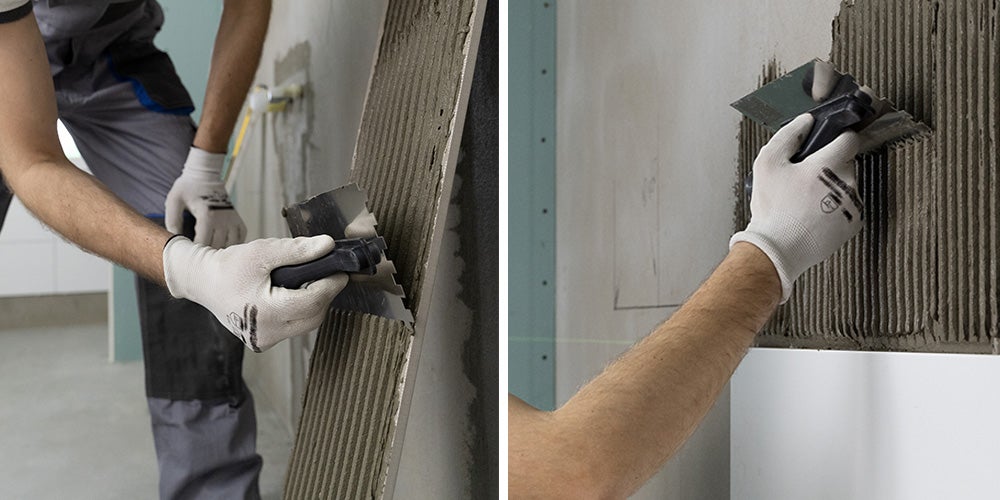
Conventional cement adhesives of class C1 have a basic consumption of about 1.3 kg per 1 mm layer. Polymer modified glues C2 - about 1.4 kg. Elastic compositions S1 and S2 can reach 1.5-1.7 kg due to the presence of special additives. Dispersion and epoxy adhesives have other norms, which are always indicated on the package.
When laying on a heated floor, outdoors, in wet rooms or on large formats, the double application method is often used. Glue is applied to the base with a comb, and a thin layer to the reverse side of the tile. This increases consumption by 30-50 percent, but ensures full contact and prevents cavities.
The formula for calculating the amount of glue
The basic formula looks like this: the amount of glue in kilograms is equal to the surface area in square meters, multiplied by the thickness of the layer in millimeters and by the basic consumption per 1 mm (usually 1.3-1.5 kg). A margin of 10-15 percent is added to the obtained result.
Calculation example. The area of the bathroom is 12 m2. A tile of 30 by 30 cm. A trowel with a tooth of 8 mm is chosen, which gives a layer of approximately 4 mm. The basic consumption of glue is 1.4 kg per 1 mm. Calculation: 12 × 4 × 1.4 = 67.2 kg. With a margin of 10 percent: 67.2 × 1.1 = 73.9 kg. For bags of 25 kg, you need to buy 3 bags (75 kg).
Another example. Floor 20 m2, large-format tile 60 by 60 cm, spatula 12 mm, layer about 6 mm, double application. The basic consumption is 1.5 kg. Calculation without double application: 20 × 6 × 1.5 = 180 kg. Taking into account the double application, we add 40 percent: 180 × 1.4 = 252 kg. With a margin of 10 percent: about 277 kg. This is approximately 12 bags of 25 kg.
Always check the data on the packaging of a particular adhesive. Manufacturers indicate the estimated consumption for different sizes of the spatula. If the base is uneven, increase the margin to 15-20 percent.
Estimated glue consumption table
| Tile size | Recommended spatula tooth size | Estimated layer thickness | Average consumption, kg/m2 |
| Mosaic up to 10×10 cm | 4×4 mm | 1,5-2,5 mm | 2,0-3,5 |
| 10×10 - 20×20 see | 6×6 mm | 2,5-3,5 mm | 3,0-4,5 |
| 20×20 - 30×30 see | 8×8 mm | 3,5-4,5 mm | 4,0-5,5 |
| 30×30 - 40×40 see | 10×10 mm | 4-5 mm | 4,5-6,5 |
| 40×40 - 60×60 see | 12×12 mm | 5-6 mm | 5,5-7,5 |
| More than 60×60 cm | 12-15 mm | 6-8 mm | 7,0-10,0 |
These values are approximate and are calculated for a flat base with a single application. In practice, the numbers may vary depending on the brand of glue, the laying technique and the condition of the surface.
Practical advice on calculation and purchase
Before starting work, measure the area as accurately as possible. For walls, consider door and window openings, subtracting their area. For the floor, consider niches, protrusions and other elements. It is better to make a diagram of the room and calculate the area by zone.
Buy glue from one manufacturer and one batch. Different batches may have slight differences in composition, which affects color and characteristics. Keep a few bags as a spare in case of additional work or repairs.
Do not skimp on the quality of the glue. Cheap compositions often have a higher consumption and worse adhesion. For difficult conditions (warm floor, street, large formats) choose elastic adhesives of class C2 S1 or C2 S2.
- Always add a margin of 10-15 percent to the estimated quantity.
- Check the expiration date of the mixture before buying.
- Prepare the glue in small portions so that it does not have time to set.
- Follow the proportions of water specified by the manufacturer.
- Use a quality spatula with even teeth.

Calculation features for different premises
In the bathroom, the area is usually small, but there are many corners, niches and transitions. This increases waste and requires more inventory. A smaller spatula is often used for walls than for the floor. If the tile is laid on plasterboard, the base must be well primed.
In the kitchen, the floor often has significant loads, so strong adhesives are chosen. If there is a warm floor, be sure to use elastic compositions. Consumption on the floor is usually higher than on the walls.
Frost-resistant and water-resistant glues are needed for balconies, terraces and facades. Double application is almost always used here, especially for ceramic granite. Consumption can be 40-50 percent higher than standard.
In large rooms (corridors, halls) with large-format tiles, it is important to ensure an even layer without cavities. For this, tile leveling systems are used and the thickness of the glue is carefully controlled.
Common calculation errors
One of the most common mistakes is calculation without taking into account the stock. As a result, there is not enough material for the last square meters, and it is necessary to urgently look for additional bags, often of a different batch.
The second mistake is ignoring the state of the foundation. People take the norm from the package, designed for an ideal surface, and work on an uneven wall or floor. As a result, the consumption increases many times.
The third mistake is the wrong choice of spatula. Too small a tooth does not provide enough layer for a large tile, and too large leads to overwear and problems with alignment.
The fourth mistake is saving money on the foundation. The absorbent base quickly removes moisture from the glue, impairing adhesion and increasing real consumption.
How to check the correctness of the calculation
After you have calculated the amount, compare the result with the manufacturer's data on the package. Many companies publish cost tables for different spatulas. If your numbers are significantly different, check that you have determined the thickness of the layer correctly.
You can do a test installation on a small area. Apply glue to 1 m2, lay a few tiles and estimate how much of the mixture actually went. This method is especially useful when working with non-standard bases or a new-to-you glue.
Remember that accurate calculation saves money and time. It is better to spend half an hour on measurements and calculations than to stop work due to a lack of material or to buy extra bags that will not be needed later.
In summary, the amount of tile adhesive is determined by the area, size of the tile, the condition of the base, the type of tool, and the characteristics of the mixture itself. Use a formula based on the thickness of the layer, add a reasonable margin and always refer to the manufacturer's recommendations. Then you will buy exactly as much material as you need for a high-quality and long-lasting result.