
Why teams spend time on Juniper QFX5200-32C-AFI2 before the PO
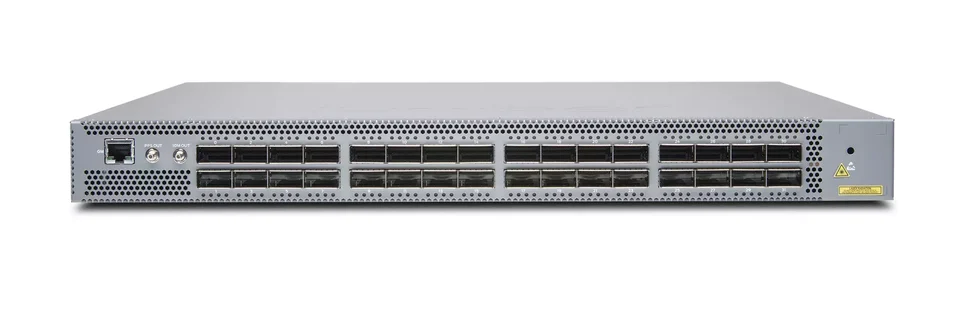
Juniper QFX5200-32C-AFI2 is positioned on the supplier listing as storage hardware within the listed series line. Storage purchases fail when the SKU string, capacity class, and controller/enclosure role are not locked before the purchase order is issued. This article walks through a procurement-grade evaluation using only the product identity and description visible on the linked page—without inventing performance numbers that are not printed there.
Product Overview The Juniper QFX5200-32C-AFI2 delivers line-rate, low-latency 10/25/40/50/100GbE switching in a compact 1U fixed form factor, ideal for spine-and-leaf fabric deployments in data centers. Featuring 32 QSFP28 ports with channelization support, it provides 6.4 Tbps bidirectional throughput and 3.2 Bpps forwarding capacity. Optimized for standards-based fabrics including EVPN-VXLAN, this back-to-front airflow (AFI) model supports high-scale routing, bridging, and security services on Junos OS. Architecture & Performance Powered by a 1.8 GHz quad-core Intel CPU with 16 GB DRAM and 64 GB SSD storage, the QFX5200-32C-AFI2 offers exceptional scale: 136k MAC addresses, 128 LAGs (64 ports per LAG), 4096 VLANs, 9216-byte jumbo frames, and 16 MB packet buffer. Layer 3 scales to 128k IPv4 prefixes (RIB), 104k IPv4 hosts, 98k IPv6 prefixes, and 52k IPv6 hosts. Additional performance includes 768 ingress/1024 egress firewall filters, 32k ARP entries, 16k MPLS labels (2048 L3VPNs with Premium Services License), 64 MSTP/253 VSTP instances, 1024 GRE tunnels, and 4 mirroring sessions (4 ports/4 VLANs). Hardware Design 1U chassis (1.72 x 17.36 x 20.48 in, 23.8 lb shipped) with 5 hot-swap fans (4+1 redundancy, QFX5200-32C-FANAFI, 135 CFM back-to-front airflow). Dual hot-swap PSUs (1+1, JPSU-850W-AC-AFI, 312W max/184W avg). Management: 1x RJ-45 console, 1x RJ-45 OOB, 2x SFP, 1x USB Type A, 10 MHz/PPS/Timing ports. Environmental: 0-40°C operating, 10k ft altitude, Zone 4 seismic. Port & Optics Flexibility 32 QSFP28 ports support breakout to 4x25G/2x50G configurations. Comprehensive transceiver compatibility for DAC/AOC/optics across 1G/10G/25G/40G/50G/100G. Ordering Information Main Unit: QFX5200-32C-AFI2Fan Modules: QFX5200-32C-FANAFI (5x, 4+1)Power Supplies: JPSU-850W-AC-AFI (2x, 1+1)Grounding: Panduit LCD10-10A-L lug, 14 AWG 90°C cableCompatible PSUs: JPSU-850W-AC-AFO, JPSU-850W-DC-AFI, JPSU-850W-DC-AFO. Rack kits: JNP-4PST-RMK-1U-E, EX-4PST-RMK.
Verified product identity
- Brand: Juniper
- Model / SKU: QFX5200-32C-AFI2
- Product code (MPN): QFX5200-32C-AFI2
- Series: listed series
- Product type: network / IT hardware
- Configuration: as listed
- Condition on listing: Original New
- Ordering role: Main SKU
Current supplier listing for configuration and availability: Juniper QFX5200-32C-AFI2.
What the listing actually asserts
- Product Overview The Juniper QFX5200-32C-AFI2 delivers line-rate, low-latency 10/25/40/50/100GbE switching in a compact 1U fixed form factor, ideal for spine-and-leaf fabric deployments in data centers. Featuring 32 QSFP28 ports with channelization support, it provides 6.4 Tbps bidirectional throughput and 3.2 Bpps forwarding capacity. Optimized for standards-based fabrics including EVPN-VXLAN, this back-to-front airflow (AFI) model supports high-scale routing, bridging, and security services on Junos OS. Architecture & Performance Powered by a 1.8 GHz quad-core Intel CPU with 16 GB DRAM and 64 GB SSD storage, the QFX5200-32C-AFI2 offers exceptional scale: 136k MAC addresses, 128 LAGs (64 ports per LAG), 4096 VLANs, 9216-byte jumbo frames, and 16 MB packet buffer. Layer 3 scales to 128k IPv4 prefixes (RIB), 104k IPv4 hosts, 98k IPv6 prefixes, and 52k IPv6 hosts. Additional performance includes 768 ingress/1024 egress firewall filters, 32k ARP entries, 16k MPLS labels (2048 L3VPNs with Premium Services License), 64 MSTP/253 VSTP instances, 1024 GRE tunnels, and 4 mirroring sessions (4 ports/4 VLANs). Hardware Design 1U chassis (1.72 x 17.36 x 20.48 in, 23.8 lb shipped) with 5 hot-swap fans (4+1 redundancy, QFX5200-32C-FANAFI, 135 CFM back-to-front airflow). Dual hot-swap PSUs (1+1, JPSU-850W-AC-AFI, 312W max/184W avg). Management: 1x RJ-45 console, 1x RJ-45 OOB, 2x SFP, 1x USB Type A, 10 MHz/PPS/Timing ports. Environmental: 0-40°C operating, 10k ft altitude, Zone 4 seismic. Port & Optics Flexibility 32 QSFP28 ports support breakout to 4x25G/2x50G configurations. Comprehensive transceiver compatibility for DAC/AOC/optics across 1G/10G/25G/40G/50G/100G. Ordering Information Main Unit: QFX5200-32C-AFI2Fan Modules: QFX5200-32C-FANAFI (5x, 4+1)Power Supplies: JPSU-850W-AC-AFI (2x, 1+1)Grounding: Panduit LCD10-10A-L lug, 14 AWG 90°C cableCompatible PSUs: JPSU-850W-AC-AFO, JPSU-850W-DC-AFI, JPSU-850W-DC-AFO. Rack kits: JNP-4PST-RMK-1U-E, EX-4PST-RMK.
- Condition: Original New
Anything not listed above—throughput tables, MAC scale, exact PoE watts, dimensions, noise, or software feature matrices—should be treated as unconfirmed for this article. Prefer to re-open the live product page when the project needs those fields.
Additional product-page detail
Resources Company Open cart Home / Networking / Switches / Juniper QFX Series / QFX5200-32C-AFI2 Brand Juniper 5 Verified QFX5200-32C-AFI2 Model (MPN) QFX5200-32C-AFI2 SKU QFX5200-32C-AFI2 Condition Factory Sealed Original Packaging (NIB) Out of Stock Key Specifications Full Product Name QFX5200 Switch OS Supported Junos OS Fixed/Modular Chassis? Fixed Form Factor 1 U Chassis Height 1.72 in / 4.3688 cm Chassis Width 17.36 in / 44.0944 cm Your Price Call for Pricing Volume discounts available Availability Out of Stock Get Global Discount Need configuration help? Our CCIE certified engineers can help you verify compatibility.
Secure Payment VISA Pay WIRE Fast Dispatch Global logistics network aiming for same-day handover.
The Juniper QFX5200-32C-AFI2 delivers line-rate, low-latency 10/25/40/50/100GbE switching in a compact 1U fixed form factor, ideal for spine-and-leaf fabric deployments in data centers. Featuring 32 QSFP28 ports with channelization support, it provides 6.4 Tbps bidirectional throughput and 3.2 Bpps forwarding capacity. Optimized for standards-based fabrics including EVPN-VXLAN, this back-to-front airflow (AFI) model supports high-scale routing, bridging, and security services on Junos OS.
Powered by a 1.8 GHz quad-core Intel CPU with 16 GB DRAM and 64 GB SSD storage, the QFX5200-32C-AFI2 offers exceptional scale: 136k MAC addresses, 128 LAGs (64 ports per LAG), 4096 VLANs, 9216-byte jumbo frames, and 16 MB packet buffer. Layer 3 scales to 128k IPv4 prefixes (RIB), 104k IPv4 hosts, 98k IPv6 prefixes, and 52k IPv6 hosts. Additional performance includes 768 ingress/1024 egress firewall filters, 32k ARP entries, 16k MPLS labels (2048 L3VPNs with Premium Services License), 64 MSTP/253 VSTP instances, 1024 GRE tunnels, and 4 mirroring sessions (4 ports/4 VLANs).
Role fit and architecture notes
Teams usually shortlist this class of system when they need a named listed series configuration for a capacity or performance tier that matches an existing storage architecture. The listing identity below is the only hard ground truth for ordering.
- Confirm whether the PO line is a controller, disk enclosure, software license, or full system SKU
- Separate media type assumptions (HDD/SSD/all-flash wording if present on the page) from unverified IOPS claims
- Align rack space, power, and multipath fabric design with the physical unit you will actually receive
- Plan spare disks / controllers only after the exact model string is fixed
The verified listing text does not present PoE. Do not infer PoE from series naming habits in the market. If powered endpoints are required, select a PoE-marked SKU deliberately.
Uplink / multi-rate path signals found in the listing text should drive optic and cabling decisions. Listed ports field: see product page port listing. Multi-rate cages are not the same as a free license to mix any transceiver; standardize approved part numbers for your estate.
Port, power, and cabling decision tree
Use this sequence before you approve quantities:
- Copy the exact model string and product code into the design BOM and the purchase requisition side by side.
- Count copper and optical interfaces against day-1 endpoints plus a documented growth reserve (for example 20–30% empty ports in dense closets).
- Decide media: Cat5e/Cat6/Cat6A for multi-gig copper; OS2/OM3/OM4 and approved optics for fiber uplinks.
- Power path: AC is mentioned on the listing—align PDU type, cordage, and dual-supply policy with site standards.
- Thermal and depth: reserve blanking panels and airflow direction consistency even when the page omits exact BTU numbers.
- Management path: out-of-band Ethernet or console access should be drawn on the rack elevation before install day.
Configuration questions procurement should force engineering to answer
- Is the ordered string exactly QFX5200-32C-AFI2 / QFX5200-32C-AFI2, with no missing -P/-HP/-E/-QA suffix from a sibling SKU?
- Which features are mandatory on day-1 versus nice-to-have, and which of those are actually evidenced on the product page?
- What is the uplink handoff speed and media to the next layer, and who owns the optic BOM?
- Are licenses, support years, or maintenance phrases embedded in the product name already priced into the line item?
- What is the RMA and spares strategy: cold spare per site, or N+1 for multi-closet campuses?
- Who validates firmware baseline and golden config before the change window?
Deployment and rollout narrative
A low-risk rollout for Juniper QFX5200-32C-AFI2 looks less like “unbox and patch” and more like a short controlled project:
- Lab or pilot: stage one unit with the same cabling plant and uplink type planned for production. Capture boot time, default management address behavior, and any first-login prompts.
- Image and config: store a baseline configuration template versioned in your repository. Avoid hand-built snowflake units across sites.
- Physical install: label front ports and rear power feeds; photograph serial labels for the CMDB on the same day as racking.
- Link validation: verify every uplink, LAG/MLAG if used, and PoE negotiation for the first bank of endpoints before declaring success.
- Cutover: schedule during the agreed change window with a rollback that re-homes endpoints to the previous edge device or temporary switch.
- Hypercare: watch error counters, power draw, and user tickets for 48–72 hours; only then close the change.
Buying checklist (copy into the ticket)
- Exact model and product code recorded in BOM and PO
- Live product page re-checked for the wording that justified the buy
- Port math signed by network design owner
- Power, rack unit, and airflow constraints signed by data-hall / closet owner
- Optics / DAC / AOC list attached when SFP or multi-rate uplinks are in play
- Support / RMA path and serial capture process defined
- Pilot quantity vs full rollout quantity decided with dates
- Firmware and baseline config ownership named
Product-page Q&A worth capturing in the RFQ
- What is the switching capacity of QFX5200-32C-AFI2? 6.4 Tbps bidirectional (6400 Gbps), 3.2 Tbps unidirectional (3200 Gbps), 3.2 Bpps forwarding.
- Does QFX5200-32C-AFI2 support EVPN-VXLAN? Yes, optimized for standards-based EVPN-VXLAN fabrics in spine-and-leaf deployments.
- What ports does the QFX5200-32C-AFI2 have? 32x QSFP28 ports (10/25/40/50/100GbE with channelization), plus management (RJ-45 console/OOB, 2x SFP), USB Type A, 10 MHz/PPS/Timing ports.
- What is the power consumption of QFX5200-32C-AFI2? 312 W max, 184 W average (AC). Dual 850W PSUs (1+1 redundancy, JPSU-850W-AC-AFI).
- What is the buffer size on QFX5200-32C-AFI2? 16 MB total shared packet buffer.
How to use the product page during negotiation
Keep the conversation anchored to the same SKU everyone can open: Juniper QFX5200-32C-AFI2. When a quote uses a slightly different model string, stop and reconcile before price discussions continue. Ask suppliers to quote model + product code together, to state condition (Original New), and to confirm whether accessories implied by the description are included or sold separately.
For multi-site buys, freeze one golden line item and replicate it. Mixing near-sibling SKUs across buildings is a common source of asymmetric PoE, uplink, or licensing behavior that only appears after install.
Summary
Juniper QFX5200-32C-AFI2 is a good candidate only when the verified identity and interface story match the design you intend to operate for the next hardware cycle. Use the linked product page as the shared source for model string, product code, and description text; keep unlisted performance claims out of the purchase justification until they are confirmed by your own design package. Order deliberately, pilot once, then scale the same SKU.