
FHA Appraisal Management: What AMCs Need to Get Right Every Single Time
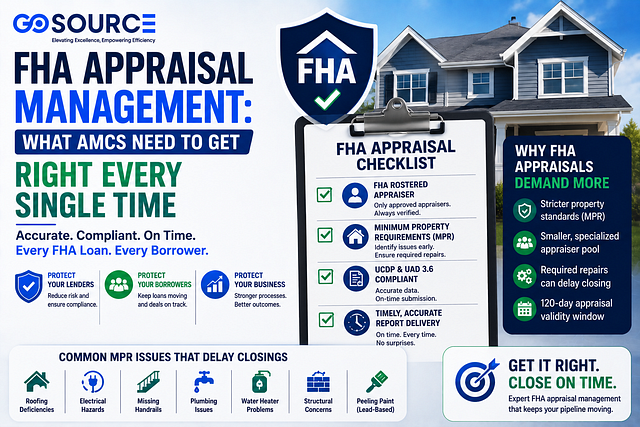
FHA loans serve some of the most important borrowers in the mortgage market for first-time homebuyers, low-to-moderate-income families, and people rebuilding after financial hardship. These borrowers often have tight timelines, limited reserves, and very little room for error when it comes to the appraisal process.
That is exactly why FHA appraisal management is one of the most demanding operational areas an AMC can handle and one of the most consequential when things go wrong.
FHA appraisals are not the same as conventional appraisals. They come up with their own set of rules, their own appraiser requirements, their own property condition standards, and their own submission processes. An AMC that treats FHA orders the same way it handles conventional orders will generate problems for the lender, for the borrower, and for itself.
This blog breaks down exactly what FHA appraisal management requires, where most AMCs get it wrong, and what a properly structured FHA workflow looks like.
What Makes FHA Appraisals Different
Before getting into operations, it is worth being clear about what separates FHA appraisals from conventional ones because the differences are significant.
FHA appraisals serve two purposes at once. A conventional appraisal answers one question: what is this property worth? An FHA appraisal answers two questions: what is this property worth, and does it meet HUD’s Minimum Property Requirements (MPR)? The appraiser is essentially doing a value analysis and a property condition assessment at the same time.
The appraiser must be on the FHA appraiser roster. Not every licensed appraiser can complete an FHA appraisal. The appraiser must be specifically approved by HUD and listed on the FHA Appraiser Roster, as a requirement that immediately narrows the pool of available appraisers compared to conventional assignments.
Property condition findings can kill a deal. In a conventional appraisal, the appraiser notes the condition, but the lender decides how to handle it. In an FHA appraisal, certain property conditions are not optional; they must be repaired before the loan can close. A missing handrail, exposed wiring, a damaged roof, or a water heater without a pressure relief valve can all become required repairs that delay or derail the transaction.
The appraisal stays with the property, not the lender. FHA appraisals are case number-specific and tied to the property for 120 days. If a borrower walks away and a new buyer comes along, the new lender may be able to use the existing appraisal or may need to order a new one depending on the timeline. AMCs managing FHA volume must understand this case transfer process and handle it correctly.
UCDP submission is still required. Like conventional loans, FHA appraisals submitted for GSE-backed transactions must be delivered through the UCDP. As UAD 3.6 becomes mandatory in November 2026, this requirement applies to FHA appraisals as well—meaning FHA workflows must be UAD 3.6-ready, not just conventional ones.
The FHA Appraiser Roster: Why Panel Management Is Critical
One of the most operationally important aspects of FHA appraisal management is maintaining a properly credentialed panel of FHA-approved appraisers.
This sounds straightforward but creates specific challenges in practice.
Roster status can change. An appraiser who was on the FHA roster last month may not be on it this month. Appraisers can be removed for compliance issues, failure to complete continuing education, or license suspension. An AMC that assigns an FHA to an appraiser who has been removed from the roster is creating a serious compliance problem, one that may not surface until the loan is underwritten.
Geographic distribution matters more for FHA. Because the FHA roster pool is smaller than the general appraiser population, AMCs may have thinner active coverage in certain markets for FHA-eligible appraisers than they do conventionally. Rural markets are particularly challenging; finding an FHA-rostered appraiser within a reasonable distance of the subject property can be difficult, and assignment cycling in thin markets drives turn time delays.
Continuing education and compliance tracking. FHA-approved appraisers must maintain their credentials through continuing education and compliance with HUD guidelines. AMCs that track these requirements proactively, flagging appraisers approaching credential gaps before they become problems, deliver consistently cleaner FHA panels than those that discover the issue at assignment time.
What this means operationally: AMCs handling meaningful FHA volume need a dedicated panel segment for FHA-rostered appraisers, with automated tracking of roster status, license currency, and geographic coverage gaps. Routing FHA orders from the general panel without this segmentation is a compliance risk that will show up in lender audits.
HUD Minimum Property Requirements: The Appraisal Standard That Trips Up Deals
HUD’s Minimum Property Requirements are the property condition standards that every FHA-financed home must meet. When an appraiser identifies an MPR issue, it becomes a required repair, meaning the seller must fix it before closing; the buyer must negotiate it into the purchase agreement, or the deal stalls.
For AMCs, MPR issues are a pipeline risk management problem. Here is why.
When a required repair is identified in an appraisal report, there is a defined process for how it is handled. The repair is completed, and then one of two things must happen: either the original appraiser inspects the repair and certifies that it meets MPR standards, or a second appraiser does so. This re-inspection requirement adds time, cost, and complexity to the transaction, and it requires AMC coordination to manage correctly.
The most common MPR issues that generate required repairs include:
- Roofing defects with less than two years of remaining life
- Exposed or defective wiring and electrical issues
- Missing or broken handrails on stairs and elevated areas
- Water heaters without pressure relief valves or that do not meet local code
- Evidence of active pest infestation
- Structural issues, including foundation cracks or damaged load-bearing elements
- Inadequate heating systems that cannot maintain minimum temperatures
- Water damage or evidence of moisture intrusion
AMCs that brief their FHA-rostered appraisers on MPR documentation standards, what must be noted, how it must be described, and when a repair certification is required generate cleaner reports with fewer mid-transaction surprises. Those that treat FHA assignments identically to conventional ones generate more required repairs, more re-inspection requests, and more pipeline delays.
The FHA Case Number and Appraisal Transfer Process
Every FHA loan has a case number assigned by HUD. The appraisal is tied to that case number, not to the lender or the AMC.
This creates a specific operational requirement that AMCs managing FHA volume must handle correctly: the appraisal transfer process.
When a borrower switches lenders during the transaction, which happens more often on FHA loans than on conventional ones, the appraisal does not automatically transfer. The original lender must transfer the case number to the new lender, and the new AMC must be able to receive and properly document the transferred appraisal in their system.
When a property sells to a new buyer within the 120-day appraisal validity window, the new buyer’s lender may use the existing appraisal through the same case transfer process or may determine a new appraisal is needed based on the timeline and any changes to the property.
AMCs that do not have a documented, compliant FHA case transfer process are creating documentation gaps that surface during lender audits. This is a procedural area where many AMCs have significant room for improvement.
FHA Appraisal Management in the Context of UAD 3.6
As UAD 3.6 mandatory adoption arrives on November 2, 2026, FHA appraisal workflows must adapt alongside conventional workflows, and this is a point that some AMCs are missing.
UAD 3.6 applies to FHA appraisals submitted through the UCDP, just as it applies to conventional ones. The structured data format, the MISMO 3.6 XML delivery requirement, and the expanded property characteristic fields all apply to FHA appraisal reports.
This means AMCs that have been preparing UAD 3.6 only in the context of their conventional volume are leaving their FHA workflows behind, and those gaps will surface in submission failures and compliance findings after November 2.
A properly prepared AMC will have verified that its FHA-rostered panel appraisers are using UAD 3.6-certified software, that its QC platform validates FHA-specific data fields under the new format, and that its UCDP submission workflow handles FHA case numbers correctly under UAD 3.6 delivery requirements.
What Lenders Should Expect from Their AMC on FHA Volume
If you are a lender routing FHA volume through an AMC, there are specific capabilities that should be non-negotiable:
Verified FHA roster management. Your AMC should be able to confirm in writing that every appraiser assigned to an FHA order is currently on the HUD FHA appraiser roster, not just generally licensed. Ask how roster status is tracked and how frequently it is verified.
MPR documentation standards. Ask whether your AMC briefs its panel appraisers on MPR documentation requirements and how required repairs are communicated and managed through to resolution.
FHA case transfer process. Confirm that your AMC has a documented process for case number transfers and can handle incoming transferred appraisals without creating documentation gaps.
UAD 3.6 FHA readiness. Ask specifically whether UAD 3.6 compliance has been verified for FHA workflows, not just conventional. The answer should be yes with specific documentation.
FHA turn time benchmarks. FHA appraisals typically take longer than conventional appraisals due to MPR inspection requirements and the narrower appraiser pool. Ask for FHA-specific turn time data, not just a blended average that includes conventional volume.
How Go Source Valuation Supports FHA Appraisal Management
At Go Source Valuation, we understand that FHA appraisal management requires a different level of operational discipline than conventional workflows. Our back-office support infrastructure is built to help AMCs manage FHA volume correctly, from roster verification and MPR workflow management to UAD 3.6 for readiness and UCDP submission support.
If your AMC is handling FHA volume and wants to make sure the operational infrastructure is right, we would like to help. Visit our AMC Management Solutions page to learn more.
Frequently Asked Questions
What makes FHA appraisal management different from conventional appraisal management?
FHA appraisals serve two purposes: determining property value and verifying that the property meets HUD’s Minimum Property Requirements. They require appraisers who are specifically approved and listed on the HUD FHA Appraiser Roster, follow stricter property condition standards, and are tied to an FHA case number rather than to the lender. These differences require AMCs to operate FHA-specific workflows rather than treating FHA orders like conventional ones.
What is the FHA Appraiser Roster, and why does it matter to AMCs?
The FHA Appraiser Roster is HUD’s list of appraisers who are approved to complete FHA appraisals. Only appraisers on this roster can be assigned FHA orders, a requirement that narrows the available panel pool compared to conventional assignments. AMCs must track roster status actively because appraisers can be removed from the roster for compliance issues, license problems, or failure to maintain continuing education requirements.
What are HUD minimum property requirements?
HUD Minimum Property Requirements are the property condition standards that every FHA-financed home must meet. When an appraiser identifies an MPR issue such as a damaged roof, exposed wiring, or missing handrail, it becomes a required repair that must be completed and certified before the loan can close. MPR findings are one of the most common sources of FHA transaction delays.
What is an FHA case number, and how does it affect appraisal management?
An FHA case number is a unique identifier assigned by HUD to every FHA loan. The appraisal is tied to the case number rather than to the lender or AMC, and it remains valid for 120 days. When a borrower switches lenders or a new buyer purchases the same property within the validity window, the case number and appraisal must be properly transferred, a process that requires documented AMC procedures to handle correctly.
Does UAD 3.6 apply to FHA appraisals?
Yes. UAD 3.6 applies to FHA appraisals submitted through the UCDP, just as it applies to conventional appraisals. AMCs that have prepared their conventional workflows for UAD 3.6 but not their FHA workflows will face submission failures and compliance gaps after the November 2, 2026, mandatory deadline.
What FHA-specific turn time should lenders expect from their AMC?
FHA appraisals typically take longer than conventional assignments due to the narrower pool of FHA-rostered appraisers, particularly in rural and less densely populated markets, and the additional time required for MPR inspections and required repair certifications. Lenders should ask their AMC for FHA-specific turn time data rather than relying on blended averages that include conventional volume.
How should an AMC manage FHA-required repairs?
When a required repair is identified, the AMC should communicate it clearly to the lender and coordinate the re-inspection process either by the original appraiser or a second appraiser once the repair is completed. The repair is completed. AMCs that have documented MPR workflows for communicating, tracking, and closing out required repair items generate fewer mid-transaction delays than those handling repairs on an ad hoc basis.