
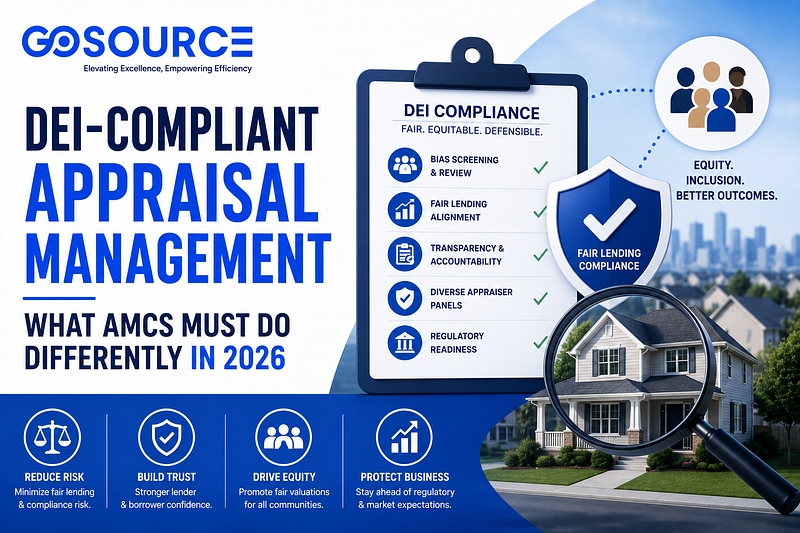
There has never been more attention on the relationship between appraisal management and fair lending than there is right now.
Since the Property Appraisal and Valuation Equity Task Force, better known as PAVE, published its action plan in 2022, the federal regulatory posture on appraisal bias has shifted meaningfully. State regulators have launched enforcement actions. Investigative journalism has documented individual cases of racially disparate valuations. Lenders have faced scrutiny over their oversight of AMC partners. And borrowers, advocates, and legislators have made it clear that the status quo is not acceptable.
For appraisal management companies, the question is no longer whether DEI compliance is relevant to their operations. It is how fast they can build the systems, processes, and accountability structures that real DEI compliance requires, and whether their lender clients can see evidence that those structures work.
This post is a practical guide to what DEI-compliant appraisal management actually means in 2026: what the regulatory expectations are, where the operational gaps typically exist, and what AMCs need to do differently.
Why This Is a 2026 Priority, not a 2022 Conversation
Some AMCs may feel that the PAVE conversation is older than news that the initial attention has faded, and the urgency has passed. That reading misunderstands the regulatory trajectory.
The PAVE action plan did not just generate awareness. It generated specific commitments from federal agencies, including HUD, CFPB, DOJ, and the FHFA, to take active enforcement action on appraisal bias. Those agencies have been building their frameworks, training their examiners, and gathering data. The enforcement phase is not behind us it is in front of us.
Separately, Fannie Mae and Freddie Mac have both integrated appraisal equity considerations into their quality control frameworks. AMCs that do not have documented bias screening processes are carrying an audit exposure that will become visible during GSE reviews.
And at the lender level, institutions that have faced fair lending examinations are now passing that scrutiny down the chain to their vendors. If your AMC cannot demonstrate a credible DEI compliance framework, you are not just a liability to yourself — you are a liability to every lender you serve.
What “Appraisal Bias” Actually Means Operationally
Before discussing what AMCs must do differently, it is worth being precise about what appraisal bias means in practice because the term is often used in ways that are either too narrow or too vague to be useful.
Racial and ethnic disparities in valuations. The most well-documented form of appraisal bias involves properties in predominantly non-white neighborhoods receiving lower valuations than comparable properties in predominantly white neighborhoods. Research from Freddie Mac, the Urban Institute, and academic institutions has consistently found these disparities across multiple metropolitan markets. For AMCs, this means the composition of the comparable sales selected, and the adjustments applied to those comps can perpetuate or amplify existing market disparities.
Language in narrative sections. Appraisal reports include narrative descriptions of neighborhoods, location characteristics, and market conditions. Language that describes neighborhoods using terminology historically associated with racial steering, references to “changing” neighborhoods, “transitional” areas, or certain demographic characteristics, creates fair lending exposure even when the appraiser’s intent was not discriminatory.
Adjustment patterns. An appraiser who consistently applies larger negative adjustments to properties in certain zip codes adjustments that are not adequately supported by market data may be producing reports that have a disparate impact on borrowers in those areas, whether intentionally or not.
Property type and condition disparities. Research has also documented cases where properties in certain communities received lower condition ratings or more conservative GLA estimates than comparable properties in other areas; differences that compound over time into significant valuation gaps.
Reconsideration of value patterns. AMCs that track ROV requests can see patterns in which types of borrowers are most likely to challenge an appraisal and what the outcomes of those challenges are. Systematic disparities in ROV outcomes are a fair lending indicator.
The PAVE Framework: What It Requires from AMCs
The PAVE task force made specific recommendations that translate directly into operational requirements for appraisal management companies. Understanding what was recommended, not just the headline, is essential for building a compliant framework.
Bias screening for appraisal review. PAVE explicitly called for the development of tools and processes to identify potential bias in appraisal reports before they are delivered to lenders. This means AMCs must build or integrate bias screening into their QC workflow, not treat it as a post-hoc investigation triggered by complaints.
Appraiser diversity and panel management. The task force noted that the appraiser profession is among the least racially diverse of any licensed profession in the United States. While AMCs cannot mandate the composition of the independent appraiser population, they can and should take active steps to recruit, develop, and retain appraisers from underrepresented communities.
Transparency in complaint handling. PAVE recommended clear, accessible processes for borrowers to challenge appraisals they believe reflect bias, and for those complaints to be tracked, investigated, and reported. AMCs that cannot demonstrate a functioning ROV and complaint process are out of alignment with these recommendations.
Data collection and reporting. The task force called for expanded data collection to enable analysis of the valuation of disparities at scale. For AMCs, this means maintaining data that allows them to identify whether patterns in their order volume reflect disparities and being able to produce that analysis on request.
Building a DEI-Compliant Appraisal Management Operation
What does an AMC that takes DEI compliance seriously actually do differently? Here is a practical breakdown of the operational areas that must change.
1. Integrate bias screening into QC, not as a separate function
The most common mistake AMCs make is treating bias review as a special project or a reactive function triggered by complaints. In a DEI-compliant operation, bias screening is part of the standard QC workflow for every file.
This includes automated review of narrative language for flagged terminology, analysis of comparable selection for potential geographic bias, comparison of adjustment patterns against market-supported benchmarks, and flagging of reports where the neighborhood description and the valuation conclusion appear inconsistent with each other.
The output of this screening must be documented in the file, with a clear record of what was reviewed, what was found, and what action was taken.
2. Track and analyze valuation patterns by geography and demographics
A DEI-compliant AMC does not just review individual files; it monitors portfolio-level patterns. This means tracking average valuations by zip code or census tract over time, comparing outcomes for borrowers in different demographic areas, monitoring which appraisers are being assigned to which geographies, and analyzing whether ROV outcomes differ by borrower location or property demographics.
This analysis does not require identifying individual borrowers by race it requires mapping outcomes against geographic and demographic data that is already part of the public record.
3. Build a genuine ROV process
The reconsideration of the value process is one of the clearest operationalized expressions of a fair lending commitment. A DEI-compliant ROV process has several components:
- A clear, accessible process for borrowers and lenders to submit ROV requests with supporting data
- Defined timelines for review and response that do not create disparate barriers for certain loan types
- Substantive review criteria that go beyond checking whether the appraiser submitted the original request to the correct field
- Documentation of every ROV outcome, including whether the value was revised and the basis for the decision
- Periodic analysis of ROV patterns to identify whether certain geographies, appraisers, or property types generate disproportionate ROV activity
4. Implement appraiser panel diversity initiatives
AMCs have more influence over appraiser panel composition than they typically acknowledge. Specific steps include actively recruiting appraisers from underrepresented communities, partnering with training programs and professional organizations that focus on diverse appraiser development, reviewing whether panel eligibility requirements have the unintended effect of excluding qualified appraisers from underrepresented groups, and tracking panel diversity metrics over time.
This is not about lowering qualification standards. It is about ensuring that the panel reflects the communities whose properties are being appraised, which has been shown to correlate with more accurate and equitable valuations.
5. Train appraisers and reviewers on fair lending
AMC panels and internal review staff must receive regular, substantive training on fair lending requirements, USPAP obligations related to non-discrimination, the history of appraisal bias and its documented market impacts, and how to identify and avoid practices that contribute to disparate outcomes.
This training must be documented, current, and mandatory, not optional or one-time.
6. Document everything
A DEI compliance framework that exists only in internal conversations is not a compliance framework. Everything must be documented: the screening criteria, the review process, the findings, the outcomes, the training records, the panel management policies, and the pattern analysis. Documentation is what turns a good-faith effort into a defensible posture of compliance.
What Lenders Should Require from Their AMC Partners
Lenders who rely on AMC partners share the fair lending exposure when those partners do not have adequate DEI compliance frameworks. Regulators have made clear that vendor management is a component of lender compliance and that responsibility for appraisal bias does not end at the AMC boundary.
Practically, lenders should be asking their AMC partners:
- What specific bias screening tools are integrated into your QC workflow?
- Can you provide documentation of your ROV process and recent ROV outcomes?
- What does your appraiser panel diversity look like, and what are you doing to improve it?
- Do you produce portfolio-level analysis of valuation patterns by geography?
- What fair lending training do your review staff and panel appraisers complete?
- Can you share your DEI compliance documentation for our vendor management file?
An AMC that cannot answer these questions clearly and in writing is carrying fair lending risk and transferring some of that risk to every lender they serve.
UAD 3.6 and DEI: The Data Advantage
One underappreciated aspect of the UAD 3.6 transition is what it means for bias detection. The new structured data format, replacing unstructured narrative text with standardized, machine-readable fields, makes systematic analysis of valuation patterns significantly more tractable.
With structured data, it becomes possible to analyze adjustment patterns, comparable selection decisions, and condition ratings at scale across large portfolios and diverse geographies. AMCs that are investing in UAD 3.6 integration are simultaneously building the data infrastructure that makes robust DEI analysis possible.
This is one of the most significant opportunities the UAD 3.6 transition creates: not just compliance with the technical format, but the ability to generate the kind of evidence-based analysis of valuation equity that regulators, GSEs, and lender partners will increasingly expect.
Go Source Valuation’s Commitment to Equitable Appraisal Management
At Go Source Valuation, we believe that operational excellence and equitable outcomes are not in tension; they reinforce each other. Our AMC back-office support infrastructure is built to help clients implement the kind of rigorous, documented, data-informed processes that DEI compliance requires.
From ROV workflow management to appraisal review support, our team brings both the process discipline and the compliance expertise that helps AMCs build fair lending frameworks that hold up to scrutiny from lenders, regulators, and the communities they serve.
If you are ready to take a serious look at your DEI compliance posture, we would like to talk. Visit our AMC Management Solutions page to learn more about how Go Source Valuation supports AMC operational excellence and fair lending readiness.
Frequently Asked Questions
What does DEI-compliant appraisal management mean?
DEI-compliant appraisal management means operating an appraisal management company in a way that actively identifies, mitigates, and monitors racial and socioeconomic bias in property valuations. It includes integrating bias screening into QC workflows, maintaining a diverse appraiser panel, operating a transparent ROV process, tracking valuation pattern data by geography, training staff on fair lending, and documenting all the above in a way that is auditable.
What is the PAVE task force, and why does it matter to AMCs?
PAVE stands for Property Appraisal and Valuation Equity. It was an interagency task force launched in 2021 and published its action plan in 2022, bringing together HUD, CFPB, DOJ, FHFA, and other federal agencies to address documented racial bias in home appraisals. PAVE’s recommendations have directly shaped regulatory expectations for AMCs, including requirements for bias screening, ROV processes, data collection, and appraiser diversity initiatives.
Is appraisal bias a legal compliance issue or just a best practice?
It is a legal compliance issue. Fair lending laws, including the Fair Housing Act and the Equal Credit Opportunity Act, prohibit practices that result in discriminatory treatment in residential real estate valuations, regardless of intent. Regulatory agencies have made clear that appraisal bias can constitute a fair lending violation, and enforcement actions against lenders and AMCs are an active and growing area of regulatory activity.
How does an AMC identify appraisal bias?
Bias identification requires a multi-layered approach: automated screening of narrative language in appraisal reports for flagged terminology, statistical analysis of comparable selection patterns across geographic areas, review of adjustment consistency against market-supported data, monitoring of ROV patterns by borrower location and demographics, and portfolio-level analysis of valuation outcomes mapped against census tract data. No single method is sufficient on its own.
What is a reconsideration of value, and how does it relate to DEI compliance?
A reconsideration of value, or ROV, is a formal request by a borrower or lender for an appraiser to reconsider a valuation conclusion based on new information or evidence of factual error. The ROV process is directly relevant to DEI compliance because systemic disparities in how borrowers submit ROVs and in what outcomes they receive can be indicators of broader fair lending issues. A well-designed ROV process is both a quality control mechanism and a fair lending safeguard.
What role does appraiser panel diversity play in DEI compliance?
Research has shown that appraiser familiarity with the communities and property types they are evaluating correlates with more accurate and equitable valuations. A diverse appraiser panel in terms of race, ethnicity, and geographic experience is a component of a DEI-compliant operation. AMCs can and should take active steps to recruit and retain appraisers from underrepresented communities, review their panel eligibility criteria for unintended exclusionary effects, and track diversity metrics over time.
What should lenders look for when evaluating an AMC’s DEI compliance?
Lenders should ask for documentation of bias screening tools and workflows, ROV process documentation and outcome data, an appraisal for panel diversity metrics, evidence of staff and panel fair lending training, and portfolio-level valuation pattern analysis. An AMC that cannot provide clear, written answers to these questions represents a vendor of management and fair lending risk.