
Introduction: The Old Evaluation Criteria No Longer Hold
A few years ago, lenders evaluated AMC partners primarily on two things: turn time and panel coverage. Could the AMC deliver appraisals within the SLA window? Did they have appraisers in the geographies the lender served? If the answer to both was yes, the relationship moved forward.
That evaluation framework hasn’t disappeared, but it’s no longer sufficient. Lenders, particularly mid-size and institutional mortgage originators, are applying a more sophisticated lens to AMC for selection. Regulatory pressure, GSE audit scrutiny, appraisal bias concerns, and hard lessons from compliance failures have pushed lender risk and operations teams to ask harder questions before and during AMC engagements.
For AMCs, this is both a challenge and an opportunity. The companies that can demonstrate operational depth, not just capacity, are winning disproportionate shares.
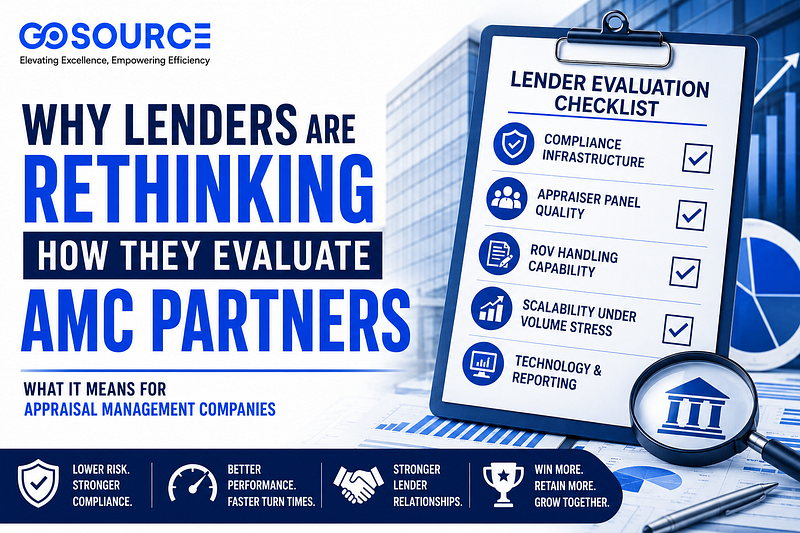
The New Lender Evaluation Framework: What’s Actually Being Scored
1. Compliance Infrastructure Transparency
Lenders increasingly want visibility into how an AMC manages its own compliance obligations, not just assurances that they’re met. This includes:
- Evidence of systematic appraiser license and E&O verification processes
- State registration documentation for all jurisdictions in which the AMC operates
- USPAP compliance tracking at the order level
- AIR (Appraiser Independence Requirements) policy documentation
An AMC that can produce organized, audit-ready compliance documentation on request signals operational maturity. One that scrambles to compile it signals risk.
2. Appraiser Panel Quality Metrics
It’s no longer enough to claim a large panel. Lenders are asking AMCs to demonstrate panel quality through:
- Appraiser credentialing and certification tier breakdowns
- Geographic coverage density by market and property type
- Revision and error rate data at the appraiser level
- Panel diversity metrics, particularly in the context of appraisal bias scrutiny
AMCs that track and report on these metrics proactively, rather than producing them only when asked, are seen as partners rather than vendors.
3. Reconsideration of Value (ROV) Handling Capability
With FHFA’s updated ROV guidance now embedded in GSE seller/servicer guidelines, lenders are paying close attention to how their AMC partners handle reconsideration requests. The question isn’t just whether the AMC processes ROVs; it’s whether they have a structured, documented, and compliant workflow for doing so.
AMCs that can articulate their ROV process clearly, including timelines, escalation paths, and documentation standards, remove a significant compliance liability from their lender clients.
4. Scalability Evidence Under Volume Stress
Lenders who’ve worked with AMC partners through rate cycle swings know that operational quality during high-volume periods tells you more about a partner than performance in slow markets. Questions lenders are now asking include:
- How does the AMC’s staff-to-order ratio change during surge periods?
- What’s the overflow plan when primary panel appraisers are unavailable?
- How do SLA metrics trend during volume spikes compared to baseline?
AMCs that can show consistent operational performance data across market cycles not just current metrics, carry significantly more credibility in competitive evaluations.
5. Technology and Reporting Capability
This isn’t about having impressive software; it’s about whether the AMC’s technology infrastructure enables the reporting and visibility the lender needs. Specifically:
- Can the AMC provide lender-facing dashboards with real-time order status?
- Can they generate compliance and performance reports in formats the lender risk team can actually use?
- Is there a documented data security framework governing how appraisal data is handled?
The best AMCs in the market have invested in operational infrastructure, people, processes, and technology that make their lender clients’ internal reporting and compliance functions easier, not harder.
If you’re an AMC looking to benchmark your own operational capabilities against what top-tier lender clients expect, exploring structured AMC management solutions built around lender-grade compliance and reporting standards is a useful starting point.
What Lenders Are Deprioritizing
Understanding what’s losing weight in lender evaluations is as useful as knowing what’s gaining it.
Brand recognition without operational proof. Lenders care less about AMC marketing positioning than about documented performance. A smaller, operationally tight AMC will frequently outcompete a larger, better-known AMC on institutional client evaluations if they can demonstrate better metrics.
Technology features without workflow integration. Platform sophistication matters but only if it translates to measurable workflow outcomes. AMCs that lead with technology without substantiating operational results are increasingly losing to competitors who lead with data.
Capacity claims without panel depth evidence. “We have X thousand appraisers in our network” has become table stakes. What lenders want to know is how many of those appraisers are actively producing, what their quality metrics look like, and how the AMC manages underperformers.
The Retention Side: Keeping Lender Clients Once You’ve Won Them
Winning an institutional lender client is a significant operational investment. Retaining them requires a different set of disciplines.
The most common reason lenders move AMC volume isn’t a catastrophic failure; it’s slow performance decay. Turn times drift. Revision rates creep up. Communication becomes less responsive. And by the time the lender operations team formally flags the concern, the relationship is already at risk.
The AMCs with the lowest institutional client churn typically share one practice: proactive performance reporting. Rather than waiting for lenders to ask how things are going, they deliver regular, structured performance summaries, order volume, turn time trends, QC metrics, and compliance status before the lender must request them.
This practice does two things simultaneously. It demonstrates operational confidence (you only share metrics you’re not afraid to show), and it keeps the AMC visible and accountable in a way that passive partners never are.
Building the AMC That Lenders Want to Grow With
The lender-AMC relationship, at its best, is a long-term operational partnership, not a transactional vendor for arrangement. The AMCs that earn that partnership status are the ones that have invested in the underlying infrastructure to sustain it: compliance systems that scale, panel management disciplines that maintain quality under pressure, and reporting capabilities that give lenders the visibility they need to defend their AMC relationship internally.
That infrastructure isn’t built overnight. But for AMCs at growth inflection points, adding lender clients, expanding into new geographies, and navigating new regulatory requirements, the operational foundation built now determines the client relationships possible two or three years from now.
Closing Perspective
The lender market is consolidating around a smaller number of high-trust AMC relationships. The criteria for earning that trust have shifted from capacity to demonstrated operational quality, and the AMCs that understand this shift are positioning accordingly. The ones that don’t will continue competing on turn time and price in a market where neither is a durable differentiator.