
The Hidden ROI of Appraiser Panel Quality: What AMCs Get Wrong About Their Most Important Asset
Every AMC talks about appraiser panel quality. Almost none of them measure it correctly. Instinct is understandable. Panel quality feels like something you know when you see it a well-credentialed appraiser, low revision rates, and clean reports. But “we know good when we see it” is not a management strategy. It’s a gap that’s being treated as judgment, and in competitive AMC operations, that gap costs real money.
Appraiser panel management is the operational core of what an AMC does. The lenders who hire you are paying for reliable, accurate, and defensible valuations delivered on time. Every element of your competitive position, pricing, turn times, report quality, and compliance posture flows from how well your panel performs. Yet most AMCs manage their panels reactively: they add appraisers when capacity is tight, remove them when something goes wrong, and do very little systematic performance tracking in between.
This post is about changing that. Specifically, it’s about understanding the actual ROI mechanics of panel quality and building the operational infrastructure to actively manage it rather than just responding to it.
Why Panel Quality Has Direct Revenue Implications
Let’s start with something most AMC operations discussions skip over: the direct connection between appraiser panel quality and AMC revenue.
Revision rates are the most immediate revenue drain. Every revision cycle on a completed appraisal consumes staff time, QC review, communication management, and tracking through to resolution. In high-volume AMC operations, revision rates of even 10–15% across the panel represent a significant hidden labor cost that never shows up on a fee-per-order P&L analysis.
Turn-time performance directly affects lender client satisfaction and, by extension, contract renewal positioning. AMCs that can reliably deliver within committed turn times command stronger client relationships and are better positioned in competitive RFP processes. Appraisers who consistently miss turn times don’t just create individual transaction problems; they create aggregate performance data that weakens your client’s story.
Report rejection rates where a lender’s internal QC or underwriting team rejects a delivered report carry the highest cost. A rejected report means the order comes back through the system: reassignment, new completion, potential borrower delays, and sometimes direct lender escalation. High rejection rates are also one of the fastest ways to lose a lender relationship.
Panel coverage gaps create order acceptance constraints. An AMC that can’t staff in a geographic area with a qualified appraiser on reasonable turn times either must decline orders lost revenue or pull from outside its quality-managed panel, compliance and quality risk.
When you map these four dynamics together, appraiser panel quality isn’t a service quality metric. It’s a revenue driver.
What Most AMCs Are Actually Measuring
Most AMC panel tracking is organized around binary data: an appraiser is on the panel or they’re not, their license is valid or it isn’t, they completed an order on time or they didn’t. This binary tracking is necessary but deeply insufficient.
What’s typically missing:
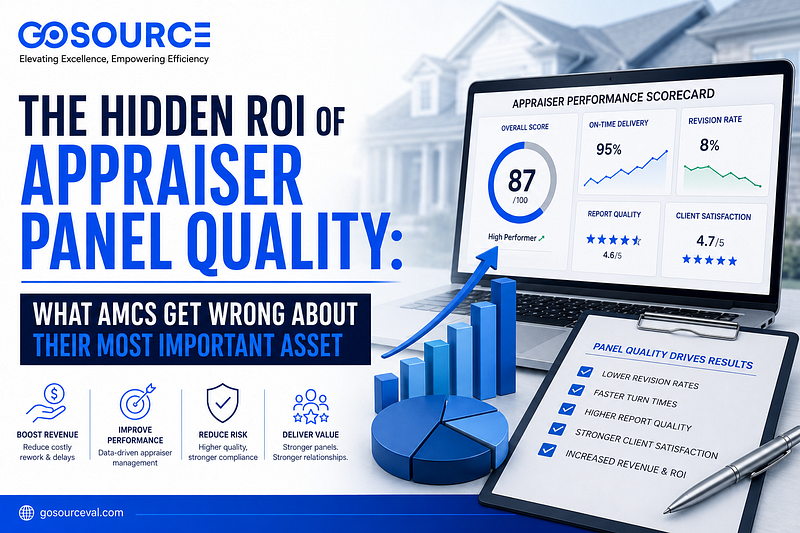
Composite performance scoring that aggregates revision rate, turn-time consistency, report accuracy (factual error rate), and lender rejection rate into a single appraiser-level metric. This composite score is the real management lever it lets you allocate high-priority or complex orders to proven performers and identify patterns in underperformance before they become removal decisions.
Geographic specialization tagging tracks not just where an appraiser is licensed but where they perform well. An appraiser licensed statewide may produce strong work in suburban markets and consistently miss rural or complex properties. If your panel management system doesn’t capture this, you’re assigning geography when you should be assigning a competency match.
Report type performance differentiation matters for AMCs handling diverse product mixes. An appraiser who produces clean 1004s may struggle with 1073 condo reports or desktop/hybrid assignments. Panel quality management that doesn’t track performance by assignment type will systematically mismatch appraisers to orders.
Client-specific performance data is the most sophisticated level of panel tracking, and the most valuable. Different lender clients have different reporting standards, turn-time expectations, and geographic priorities. An appraiser who performs well for one client may have higher revision rates with another. AMCs that track performance at the client-appraiser intersection can manage panel allocation in ways that improve outcomes for every client relationship simultaneously.
The Scorecard Infrastructure: Building What You’re Currently Missing
Building meaningful appraiser scorecards requires three things: the right data inputs, a consistent scoring framework, and operational integration that connects scores to assignment decisions.
Data Inputs to Track at the Order Level:
Every order that moves through your AMC should generate data points on the assigned appraiser:
- Acceptance time
- Completion time
- On-time delivery rate
- QC revision count per report
- Revision turnaround time
- Report rejection rate by client
- Factual error rate
- Communication responsiveness score
None of these data points requires exotic technology. They require consistent data capture at each order stage and a system that aggregates them at the appraiser level over time.
The Scoring Framework:
Effective appraiser scorecards typically weigh the metrics above based on business impact. The revision rate and lender rejection rate carry the heaviest weight because they carry the highest cost. Turn-time consistency carries significant weight because of its direct client satisfaction impact. Communication responsiveness is a lower weight but still tracked because of its effect on order cycle efficiency.
A tiered scoring system, Tier 1 (preferred), Tier 2 (standard), Tier 3 (probationary), gives you a practical management structure. Tier 1 appraisers are prioritized for new order allocation and complex or high-value assignments. Tier 3 triggers a performance improvement of conversation and, if unresolved, panel removal.
Operational Integration:
The scorecard only generates ROI if it’s connected to assignment decisions. An order management system that automatically routes new orders to the highest-scoring available appraiser in a geography weighted by composite score, not just availability, will produce systematically better outcomes than manual assignment that relies on dispatcher judgment.
Panel Recruitment as a Strategic Function
Most AMCs treat panel recruitment as an operational response to capacity shortfalls. A geography goes uncovered, or a high-volume period strains existing capacity, and recruitment begins. This reactive model means you’re always recruiting from a position of immediate need rather than strategic positioning.
Leading AMCs treat panel recruitment as an ongoing strategic function with specific targets:
Geographic coverage mapping identifies current gaps where order acceptance is constrained by panel capacity and prioritizes recruitment by gap severity and order volume in the area.
Product type coverage identifies where the panel lacks depth in specific assignment types, such as rural properties, complex commercial-residential, condo markets, and manufactured housing, and recruits specifically to fill those gaps.
Quality threshold recruitment means AMCs that have built strong scoring infrastructure can apply the same quality filters at recruitment that they apply to existing panel members. Appraiser background, designation level, years of experience in specific markets, and references from other AMCs all factor into onboarding decisions.
Retention as a recruitment priority is underappreciated. High-performing appraisers have options. AMCs that offer consistent order volume, prompt payment, reasonable communication standards, and professional treatment retain their best panel members at higher rates. The cost of losing a Tier 1 appraiser in recruitment, onboarding, and the performance gap during replacement is high.
What an Outsourced Panel Management Support Changes the Equation
Building and managing the infrastructure described above, scorecard systems, performance tracking, credential monitoring, and assignment routing represents a significant operational investment. For mid-size AMCs, the internal resource requirement often exceeds what’s practical to build from scratch.
This is where specialized support services create tangible ROI. Go Source Valuation’s appraiser scorecard and panel management support services provide AMCs with the data infrastructure and operational expertise to manage panel quality systematically without building the entire capability internally.
The value isn’t just cost efficiency. It’s operational maturity: the ability to show lender clients, during vendor audits, that your panel management is data-driven, documented, and actively managed. That posture is a differentiator in competitive AMC markets where lenders are increasingly sophisticated about vendor quality.
The Competitive Positioning Argument
The business case for investing in appraiser panel quality management ultimately rests on competitive positioning, not just operational efficiency.
Lenders evaluating AMC partners are asking the same questions their regulators ask them: How do you know your appraisers are qualified? How do you monitor performance over time? What happens when performance drops? What’s your panel coverage in our key markets?
AMCs that answer these questions with documented systems, data-backed performance metrics, and a clear operational methodology are competing in a different tier than those who answer with “we have an experienced team and good relationships.”
The investment in panel quality infrastructure is an investment in the quality of that competitive answer and in the lender relationships that follow from it.
Frequently Asked Questions
Q: How many appraisers should an AMC have on its panel?
A: Panel size depends on order volume, geographic coverage requirements, and product mix. The more useful metric is panel depth, or how many qualified appraisers you have per active market area. A geography where you have only one or two active appraisers is a coverage risk regardless of total panel size.
Q: How do you handle an appraiser who delivers quality work but consistently misses turn times?
A: Turn-time performance should be addressed through a documented performance conversation before it affects panel status. In some cases, turn-time issues are workload-driven and can be managed through order volume adjustment. If performance doesn’t improve after documented intervention, the scorecard should reflect it, and assignment volume should be reduced, or the appraiser should be moved to Tier 3.
Q: What’s the difference between an appraiser scorecard and a simple pass/fail quality check?
A: A pass/fail quality check tells you whether a specific report was acceptable. A scorecard tracks performance trends over time, across multiple dimensions, enabling proactive management before a problem becomes a removal decision. Scorecards also enable tiered assignment routing, which improves outcomes system-wide rather than just catching failures after the fact.
Q: How should AMCs handle appraiser complaints about panel management decisions?
A: Documented, data-driven panel management decisions are significantly more defensible than judgment-based ones. When an appraiser disputes a performance action, the ability to show them objective metrics, revision rates, turn-time data, and specific report findings changes the conversation. AMCs that rely on subjective assessments expose themselves to disputes that are harder to resolve professionally.
Q: Can small AMCs realistically build scorecard infrastructure?
A: Yes, though the build approach differs by scale. Smaller AMCs may start with simpler composite tracking in existing spreadsheets or order management systems before investing in purpose-built technology. The critical step is consistent data capture at the order level the analytics layer can be built incrementally once the data foundation exists.
Q: How does panel quality management connect to Dodd-Frank compliance?
A: Dodd-Frank requires AMCs to ensure appraisers are appropriately credentialed and that the appraisal process is independent. Panel quality management that includes credential monitoring and performance documentation directly supports both requirements. A documented, auditable panel management system is also strong evidence of good-faith compliance during regulatory review.
Q: What role does outsource support play in panel management for growing AMCs?
A: Outsourced panel management support through providers like Go Source Valuation gives growing AMCs access to structured scorecard systems, credential monitoring processes, and quality review infrastructure without the internal resource investment of building those systems from scratch. It allows AMCs to operate at a higher maturity level than their internal headcount would typically support, which is particularly valuable during growth phases when operational infrastructure often lags revenue.