
Meta Description: Ever wondered what happens inside an AMC when a deadline is missed, and a lender is on the phone? This minute-by-minute breakdown reveals the operational truth and what separates AMCs that recover fast from those that spiral.
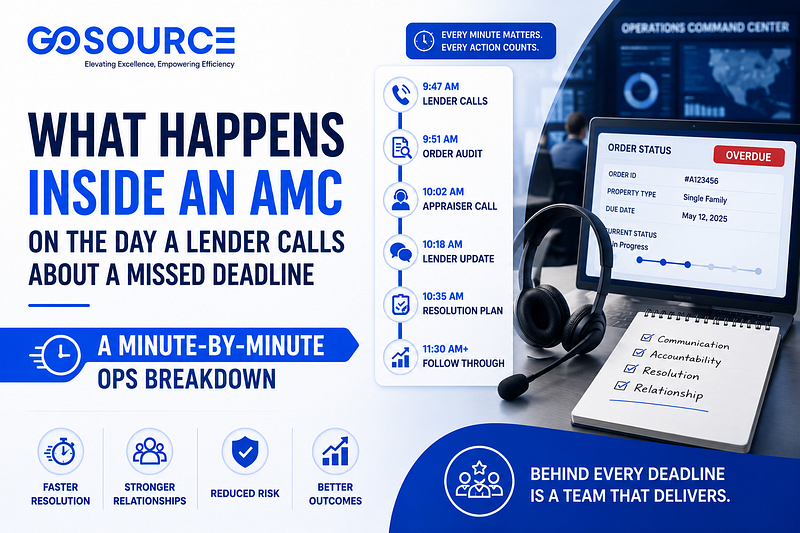
It is 9:47 on a Tuesday morning.
A loan officer at a regional lender has just called their AMC account contact not through the portal, not through the ticketing system, but directly on the phone, because a purchase appraisal that was supposed to be delivered yesterday still has not arrived. The closing is scheduled for Thursday. The borrower has already given notice at their apartment. The real estate agent calls the loan officer every two hours.
What happens next inside that AMC in the following four hours will determine whether this lender relationship survives the quarter.
Most people outside the appraisal management industry, and honestly, many people inside it have never seen this moment play out in real time. The public-facing narrative around AMCs focuses on compliance, technology, and turnaround metrics. What it rarely covers is the operational anatomy of a crisis: who does what, in what order, with what tools, and how fast.
That is exactly what this piece breaks down. Because understanding what a well-run AMC does at this moment versus what a poorly run one does is the clearest window into why operational infrastructure is the most important investment an appraisal management company can make.
9:47 AM The Call Comes In
The lender’s contact at the AMC is a client relations coordinator. She has fourteen active lender accounts, manages a shared inbox that receives roughly 200 messages a day, and is currently on a separate call when the loan officer’s number appears on her screen.
In a poorly run AMC, she finishes the other call first, pulls up the order in the system, sees a status that reads “In Progress” with no further detail, and calls the loan officer back twelve minutes later with nothing new to say.
In a well-run AMC, the call goes to a backup coordinator who has access to the same account information. That person can pull the order record within sixty seconds, see the full timeline, identify where the delay originated, and either resolve it or route it to the right person before the loan officer’s frustration compounds.
The difference is not technology. Both AMCs have a portal. The difference is whether there is a trained human being with immediate access to order context and the authority to act on it.
9:51 AM The Order Audit
Once the order is flagged as a priority escalation, the first task is simple: figure out exactly what happened.
A complete order record in a functioning AMC management system should show the full timeline of when the order was placed, when it was assigned, when the appraiser confirmed the appointment, when the inspection was completed, and what the current status of the report is. If those data points exist and are current, an experienced coordinator can reconstruct the failure point in under three minutes.
Common failure points fall into a handful of categories:
The appraiser accepted the order but fell behind in their queue and did not flag it. The inspection was completed, but the report has not been submitted to the portal yet. A revision request went out after an initial review, and the appraiser has not responded. There was a contact issue with the borrower, and the inspection was never scheduled. The order sat in a queue stage waiting for a coordinator action that never happened because the coordinator who owned it was out and no backup was assigned.
Each of these failure points has a different resolution path. An AMC with clean order documentation knows which one it is facing by 9:54 AM. An AMC with messy records, incomplete status updates, and no clear ownership trail is still trying to figure it out at 10:30.
10:02 AM The Appraiser Call
If the report has not been submitted, the coordinator calls the appraiser directly.
This call is one of the most operationally sensitive moments in the entire appraisal management process. The coordinator needs to get honest information about where the report stands and does it in a way that does not make the appraiser feel attacked, pressured, or inclined to become defensive.
An undertrained coordinator turns this into a pressure call. “We need the report today; the lender is calling us. Can you have it done by noon?” That approach may occasionally accelerate a submission, but it damages the relationship, and it signals to the appraiser that this AMC is going to make his life harder whenever something goes sideways. Over time, that appraiser starts declining orders from this AMC before situations like this can repeat.
A well-trained coordinator opens differently. She acknowledges the situation, asks where the report actually stands in the appraiser process, and listens. If the appraiser is two hours from completion and just got behind, she has a real number to give the lender. If the appraiser has hit a genuine comps problem or a scope-of-work issue that is adding complexity, she flags it up the chain immediately so the lender can be given an informed update rather than a placeholder.
The appraiser call, done correctly, accomplishes two things: it gets an accurate status, and it reinforces that this AMC handles pressure professionally. That matters the next time this appraiser’s phone rings with an order.
10:18 AM The Lender Update
By this point, a well-run AMC should have enough information to give the lender a real answer.
Not vague reassurance. Not “we’re looking into it.” An actual status where the report is, what caused the delay, what the realistic delivery window is, and what the AMC is doing at this moment to close that window.
This update call is where client relationships are won or lost on a bad day. Lenders understand that things go wrong. Inspections get rescheduled. Appraisers get sick. Complex properties take longer than anticipated. What lenders do not forgive is being kept in the dark, being told things are fine when they are not, or being handed a vague answer that forces them to go back to their borrower with nothing useful to say.
The loan officer this Tuesday morning needs to be able to call their borrower and their real estate agent with a number. “The appraisal is being finalized; we expect it by 2 PM today, and we’ve confirmed directly with the appraiser” is a sentence that saves closing. “We’re working on it” is a sentence that sends a borrower to a different lender next time.
The AMC that delivers the first version of that sentence on a bad day earns trust in a way that twenty good days cannot replicate.
10:34 AM The Internal Debrief
While the client relationship coordinator manages the flow of communication, a parallel conversation is happening inside the AMC between the coordinator and her supervisor or QC lead.
What specifically caused this delay? Was it a system issue, an order that moved to the wrong queue stage and sat there? Was it a coordinator handoff that was missed during a coverage gap? Was it an appraiser on the panel who has a pattern of late submissions that was never flagged? Was it a lender order that came in with incomplete instructions, causing a scope-of-work clarification cycle that added two days?
This debrief matters for two reasons. First, it determines whether the resolution for this specific order is on track. Second, it identifies whether this was a one-time event or a symptom of a recurring operational gap.
AMCs that conduct honest internal debriefs on escalations, even brief ones, build better operations over time. AMCs that treat each escalation as a discrete emergency to survive rather than a data point to be learned from repeating the same failures across different lenders and different orders.
The internal debrief is unglamorous and easy to skip when the immediate fire feels more urgent. But it is how operational cultures improve.
11:15 AM The Report Arrives
If everything in the preceding ninety minutes went the way it should, the appraiser has submitted the report to the portal by mid-morning.
But submission is not delivery. Before the report goes to the lender, it needs to pass through the QC review. In a functioning AMC, that review is not a rubber stamp; it is a structured check against a defined criteria set that includes USPAP compliance basics, scope-of-work verification, comparable selection logic, condition and quality ratings, and any lender-specific overlays that apply to this file.
On a day with a lender escalation active, the temptation is to rush the QC review to get the report out the door and end the crisis. That temptation should be resisted. A report that gets the lender with a material deficiency does not solve the problem; it replaces one crisis with a worse one. A report that needs to go back to the appraiser for a legitimate revision after the lender has already told the borrower it is arriving this afternoon is operationally catastrophic.
The right answer is a fast but complete QC review by someone experienced enough to know the difference between a cosmetic issue that can be flagged as a minor note and a substantive problem that requires appraiser correction. That distinction requires training and judgment, not just a checklist.
12:04 PM Delivery and Follow-Through
The report clears QC and goes to the lender at noon.
In a well-run AMC, the client relations coordinator sends a brief direct message to the loan officer, not just the automated portal notification confirming delivery, noting the file is clean, and thanking them for their patience. That message takes forty-five seconds to write, and it closes the loop in a way that the automated notification does not.
The loan officer calls their real estate agent. The closing stays on schedule. The borrower signs on Thursday.
And the AMC that handled the morning professionally, that gave real answers, made the right calls, conducted an honest debrief, and delivered a clean report under pressure has just done more for that lender relationship than any sales conversation or service agreement ever could.
What Separates the Two Outcomes
Looking back at this morning from both versions of the AMC, the differences are not dramatic. They are structural.
The well-run AMC had backup coordinator coverage, so the initial call was handled immediately. It had clean order documentation, so the status was readable in under three minutes. It had trained coordinators who knew how to talk to appraisers under pressure without damaging the relationship. It had a QC process that was fast but substantive. And it had a client communication culture that defaults to specific, honest information rather than vague reassurance.
None of these things are technology problems. The portal is the same. The appraiser pool is the same. The lender’s deadline is the same. What is different is the operational infrastructure behind the interface of the people, the training, the documentation habits, the QC discipline, and the communication culture.
That infrastructure does not build itself. It requires intentional investment, consistent management, and enough coordinator capacity to handle the volume without corners being cut when things get busy.
Why Most AMCs Struggle to Build This Internally
The honest reason most AMCs do not operate at this level is that they do not want to. It is that building deep operational infrastructure while simultaneously managing lender relationships, panel recruitment, compliance requirements, and technology systems is genuinely difficult to do all at once.
Coordinator training gets deprioritized when volume spikes. QC processes get compressed when staffing is thin. The internal debrief culture never develops because there is always another order more urgent than the last lesson. And the result, over time, is an AMC that runs on reaction managing each crisis as it arrives rather than building the systems that prevent the next one.
This is exactly the gap that outsourced AMC operations support is designed to fill. Rather than rebuilding every internal function from scratch, AMCs can add the coordinator depth, QC capacity, CRM infrastructure, and administrative support that allow them to operate at a higher level without the overhead of building a fully staffed internal team.
Go Source Valuation’s AMC management solutions provide precisely this kind of operational depth, appraisal review support, virtual assistant capacity, technology integration, and client relationship management infrastructure built specifically for appraisal management companies that want to handle the hard days well, not just the easy ones.
The Hard Days Reveal Everything
A missed deadline is not just a logistical problem. It is an operational x-ray.
It shows whether the AMC has real coordinator coverage or just a phone number. It shows whether order documentation is clean or chaotic. It shows whether the appraiser relationship is professional or transactional. It shows whether QC is a real function or formality. And it shows whether client communication is honest and specific or vague and defensive.
Lenders do not remember the thirty deliveries that arrived on time. They remember the one that did not and how their AMC behaved in the next four hours.
Building the operations that make those four hours go right is not an optional investment. It is the foundation of every lender relationship worth keeping.
FAQ
What is the most common reason for AMC appraisals missing their deadlines?
The most frequent causes are appraiser queue overload without early flagging, incomplete order instructions that trigger scope-of-work clarification cycles, missed coordinator handoffs during coverage gaps, and contact issues with borrowers that delay inspection scheduling.
How should an AMC communicate with a lender when an appraisal is delayed?
With specific, honest information as early as possible. Lenders can manage a delay when they know the real timeline and the reason. What damages lender relationships is vague reassurance, delayed communication, and updates that turn out to be inaccurate.
What role does a QC reviewer play when a delayed report arrives?
The QC reviewer needs to conduct a complete but efficient review — checking for USPAP compliance, scope-of-work accuracy, comparable logic, and lender-specific overlays — without rushing in a way that lets a substantive deficiency through. Speed under pressure is valuable only when quality is maintained alongside it.
How does AMC coordinator training affect turnaround time?
Directly. Trained coordinators resolve order exceptions faster, communicate with appraisers more effectively, catch documentation gaps earlier in the process, and manage lender escalations in ways that preserve the relationship. Undertrained coordinators create friction at every stage that adds hours and sometimes days to turnaround.
Can outsourcing AMC operations improve lender communication quality?
Yes. Outsourced ops partners bring structured coordinator capacity, established CRM workflows, and trained client communication practices that allow AMCs to deliver consistent, professional lender experiences regardless of internal volume or staffing fluctuations.