
Why Your Appraiser Scorecard Is the Most Underrated Asset in Your Appraisal Business
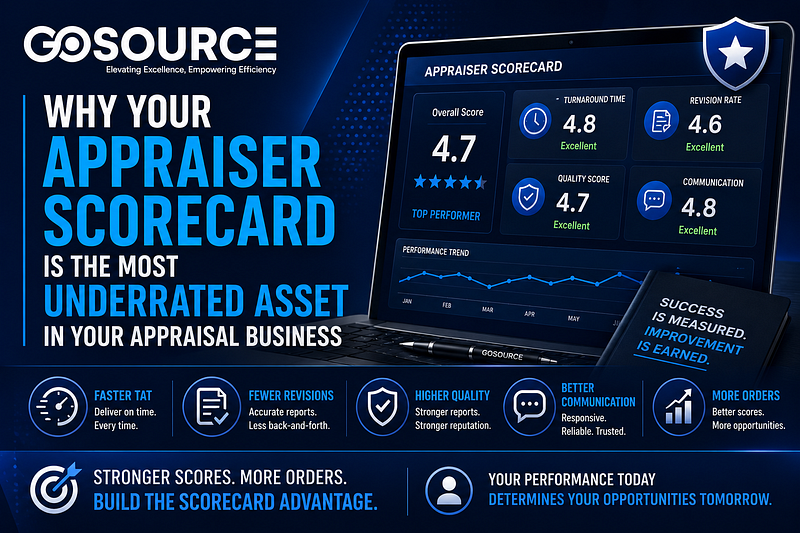
Let me ask you something, honestly: when was the last time you actually thought about your appraiser scorecard, not just glanced at it, but sat down and really understood what the numbers were saying?
If you’re like most appraisers, the answer is probably “not recently enough.” And that’s not a knock on your work ethic. It’s just that this industry has always rewarded technical skills, knowing your comps, writing clean reports, staying current on USPAP compliance, and somehow, the scorecard piece gets treated like administrative nonsense.
But here’s the reality in 2026: your scorecard isn’t background noise. It’s the signal appraisal management companies (AMCs) are listening to when they decide who gets the next order.
What an Appraiser Scorecard Actually Measures
Before we get into improvement strategies, it’s worth being clear on what an appraiser’s performance scorecard tracks. Different AMCs weigh things differently, but the core metrics are consistent across the board:
Turnaround Time (TAT) is almost always the first thing AMCs look at. It measures how quickly you complete and submit reports from the time an order is assigned. This isn’t just about being fast; it’s about being reliably fast. An AMC would rather have someone who consistently hits a 5-day TAT than someone who sometimes delivers in 3 days and sometimes takes 10.
The “revision rate” measures how often your reports come back with correction requests to post-QC. A high revision rate is expensive for AMCs; it slows down the pipeline, frustrates lenders, and signals that something in your process needs attention. Even experienced appraisers with strong technical skills can have elevated revision rates simply due to formatting issues or documentation gaps.
Quality Control (QC) scores go deeper than revision rate. They measure the overall accuracy, completeness, and compliance of your reports. This includes things like unsupported adjustments, missing comparable data, and failure to meet investor-specific guidelines.
Communication responsiveness is one of those metrics that appraisers often overlook because it feels soft. But from an AMC coordinator perspective, an appraiser who responds promptly to Messages and proactively flags delays is genuinely easier to work with, and that shows up in scoring.
USPAP and investor guideline compliance round out the picture. The mortgage industry is heavily regulated, and appraisers who consistently produce compliant reports build a reputation that translates directly into more appraisal work orders.
Why This Matters More Now Than It Did Five Years Ago
The appraisal industry has changed significantly. AMCs have grown more sophisticated in how they manage their appraiser panels, and most have moved toward algorithm-driven assignment systems. In plain terms: when a new order comes in, software, not a coordinator flipping through a contacts list, decides which appraiser gets it.
That software is looking at your scorecard.
If you’re sitting in the top tier of an AMC’s performance ranking, you get first crack at orders. If you’re in the middle, you get what’s left. If you’re at the bottom, the system may not even offer you orders in certain coverage areas.
This is why appraisers who understand their appraiser performance metrics and actively work to improve them have a real competitive advantage, particularly in markets where order volume fluctuates.
Practical Ways to Improve Your Scorecard
Here’s what separates appraisers who climb the ranking from those who stay stuck in the middle.
Build turnaround time consistency into your workflow. The goal isn’t to rush; it’s to keep a standardized report template that reduces time spent on formatting, and setting personal internal deadlines that give you a buffer before the AMC’s actual due date. When delays do happen, communicate early. AMCs respond much better to proactive updates than to missed deadlines with no warning.
Treat revision requests as a diagnostic tool. Every QC correction that comes back to you is data. Instead of just fixing the issue and moving on, take a minute to categorize it. Is it a comparable selection problem? An adjustment methodology issue? A formatting inconsistency? When you see patterns, you can address the root cause rather than just the symptoms. Over time, this is what drives your revision rate down.
Stay genuinely current on compliance requirements. USPAP updates, GSE guideline changes, and UAD reporting standards shift more frequently than most. appraisers track. Building a monthly habit of reviewing industry updates keeps you from getting caught. flat-footed. Compliance adherence isn’t just about avoiding penalties; it’s a direct input into your QC score and your reputation with lenders.
Communicate like a professional, not just a contractor. When you update your AMC coordinator proactively, “Inspection scheduled for Wednesday, report expected Thursday,” your building trust. When they must chase you for status updates, you’re eroding it. This distinction shows clearly how AMCs rate communication responsiveness, and it costs you nothing to get right.
What Partnering with a Quality AMC Actually Looks Like
One of the most important things I want to say here is this: improving your scorecard isn’t something you have to figure out alone. Not all AMCs treat appraisers the same way.
Some AMCs assign orders, collect reports, and move on. You get corrections and a little explanation. You get a score but no context for what’s driving it. Over time, this approach leaves appraisers feeling like they’re flying blind.
The better model, and it does exist, is an AMC that treats performance improvement as a partnership. That means giving appraisers access to their actual appraiser scorecard metrics, providing constructive feedback rather than just flagging errors, and offering guidance that helps you genuinely improve over time.
Go Source Valuation operates on this model. Their appraisers receive monthly performance insights, clear, actionable QC guidance, and real support to improve turnaround times and revision rates. The result is that appraisers on the Go Source panel tend to build stronger scorecards over time, and stronger scorecards mean more orders.
If you’re looking to understand your scorecard better and start building priority placement on AMC assignment lists, their blog is a solid starting point. This piece on how to improve your appraiser scorecard breaks down the key metrics in practical terms and explains what high-performing appraisers are doing differently.
The Long Game
Here’s something worth sitting with: the appraisers who are most successful in this industry aren’t necessarily the most technically brilliant. They’re the ones who understand that their reputation and, in today’s AMC ecosystem, their reputation is their scorecard, built through consistent, reliable, professional behavior over time.
A strong AMC appraiser panel ranking doesn’t happen overnight. But it also doesn’t require a dramatic overhaul of how you work. It requires showing up reliably, communicating clearly, producing clean, compliant reports, and being willing to learn from feedback.
Do that consistently, and the orders follow.
Go Source Valuation works with appraisers across the country to help them perform better and earn more. Learn more at gosourceval.com or reach out directly at appraisers@gosourceval.com.
FAQ Section
Q1: What is an appraiser scorecard, and why does it matter?
An appraiser scorecard is a performance evaluation tool used by Appraisal Management Companies (AMCs) to measure and rank appraisers based on key metrics like turnaround time, revision rate, QC scores, and communication responsiveness. It matters because most AMCs today use algorithm-driven assignment systems, meaning your scorecard ranking directly determines how many appraisal work orders you receive. A strong scorecard puts you at the top of the assignment queue. A weak one gets you passed over, often without any direct notification.
Q2: Which scorecard metric has the biggest impact on how many orders I receive?
Turnaround Time (TAT) is typically weighted most heavily by AMCs, but the real differentiator isn’t just speed; it’s consistency. AMCs build their workflows around predictable appraisers. Beyond TAT, your revision rate has a significant impact because high revision frequency increases operational costs for the AMC, which their systems are designed to minimize. Consistently clean reports with low revision rates signal that you’re a reliable, low-friction appraiser, and the algorithm rewards that with more orders.
Q3: How often should I review my appraiser scorecard?
Ideally, you should review your appraiser performance metrics at least once a month. Most AMCs update scoring on a rolling basis, so monthly check-ins give you enough data to spot trends without overreacting to single-report fluctuations. If your AMC provides monthly performance reports, as Go Source Valuation does, use those sessions to identify whether specific metrics are trending up or
down and
Q4: Can a single bad report significantly hurt my scorecard?
It depends on the severity and your existing score baseline. One late delivery or one revision request on an otherwise clean history is unlikely to dramatically shift your ranking. However, a compliance issue, a USPAP violation, or failure to meet investor-specific guidelines can have an outsized negative impact because compliance flags carry a heavier weight in most AMC scoring systems. The bigger risk is a cluster of issues: a stretch of late deliveries or multiple revisions in a short period can erode a scorecard quickly. Consistency in both directions matters.
Q5: What’s the difference between a QC score and a revision rate on an appraiser scorecard?
They’re related but distinct. Your revision rate measures how often your reports require corrections after QC review; it’s a frequency metric. Your QC score reflects the overall quality and accuracy of your reports, including factors like comparable selection, adjustment support, compliance with lender guidelines, and report completeness. You can have a low revision rate but still carry QC flags if the corrections being requested are significant. Both metrics feed into your overall scorecard and improving one without the other gives you an incomplete picture of your performance.
Q6: Does working with a supportive AMC actually make a difference in scorecard improvement?
Yes, significantly. The AMC relationship isn’t passive. AMCs that provide transparent, detailed scorecard feedback and constructive QC guidance give appraisers the information they need to make real improvements. AMCs that only flag errors without context leave appraisers guessing. Go Source Valuation operates on a partnership model where appraisers receive monthly performance insights and actionable QC guidance, not just corrections. Appraisers who understand why their score is improving faster and sustaining higher rankings over time. You can learn more about how this works at gosourceval.com/appraiser-scorecard.