
For small jewelry workshops, efficiency and consistency are often the difference between a time-consuming process and a smooth production workflow. While many artisans focus on selecting high-quality tools for cutting, soldering, and setting stones, surface finishing is another area that greatly affects the final appearance of a piece. A jewelry rotary tumbler has become an increasingly valuable machine for small-scale makers because it can improve polishing results, reduce manual labor, and help maintain a stable level of quality across different projects.
One of the biggest advantages of a rotary tumbler is its ability to perform repetitive finishing tasks without constant operator attention. Traditional hand polishing requires patience, skill, and considerable time, especially when working on multiple pieces with similar requirements. A rotary tumbler uses controlled mechanical movement to create continuous contact between jewelry pieces and polishing media. This process gradually smooths rough edges, removes minor surface imperfections, and enhances the overall shine while allowing the jeweler to focus on other important tasks.
For small workshops where labor resources are limited, saving time is a major benefit. A single artisan may handle design, fabrication, repair, and customer orders at the same time. By placing unfinished pieces into a tumbler and allowing the machine to work during less active periods, production schedules become easier to manage. This does not replace craftsmanship but instead gives makers more freedom to concentrate on areas that require personal expertise, such as stone setting or detailed engraving.
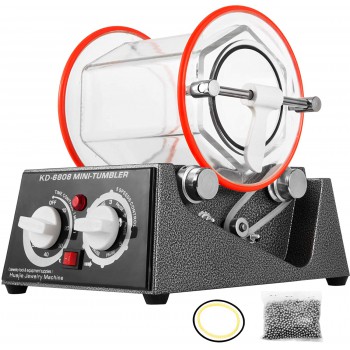
Another important benefit is the consistency of results. Hand polishing can vary depending on the operator’s technique, pressure, and experience level. A rotary tumbler creates a more uniform finishing environment, which is especially useful when producing batches of rings, chains, or small components. Consistent surface treatment helps a workshop maintain professional standards and ensures that every item leaving the bench has a similar level of refinement.
Rotary tumblers are also useful for improving the durability and comfort of finished jewelry. The controlled abrasion process can soften sharp edges, refine small surface marks, and prepare metal surfaces for additional finishing steps. For certain applications, tumbling can strengthen the surface of metal by compressing and smoothing microscopic irregularities. This makes it a practical step before final polishing or quality inspection.
The compact size and relatively simple operation of many jewelry rotary tumblers make them suitable for small studios with limited workspace. Unlike large industrial finishing systems, these machines usually require minimal setup and can be integrated into existing workflows without major changes. Their versatility allows jewelers to process different materials, including gold, silver, copper, and other jewelry alloys, by selecting appropriate media and operating conditions.
From an economic perspective, a rotary tumbler can also provide long-term value. Although it requires an initial investment, the reduction in polishing time and the improvement in workflow efficiency can quickly justify the cost. Small workshops often benefit most from tools that increase productivity without requiring additional employees or complicated training.
Proper use and maintenance are essential to achieving the best results. Choosing the correct tumbling media, adjusting operation time, and keeping the machine clean all influence the final finish. Different jewelry designs may require different approaches, and experienced craftsmen understand that the tumbler is a precision support tool rather than a simple automatic polishing solution.
In modern jewelry making, small workshops need equipment that balances affordability, reliability, and performance. A jewelry rotary tumbler meets these needs by reducing repetitive work, improving finishing quality, and creating a more efficient production environment. For independent jewelers who want to expand their capabilities while preserving the handmade character of their creations, this machine represents a practical investment in both craftsmanship and productivity.
