
In contemporary jewelry studios, the rolling mill stands as one of the most powerful tools for transforming raw metal into expressive design elements. More than a machine for thinning sheet or wire, the rolling mill is a creative partner—one that rewards patience, precision, and experimentation. Mastering its use opens the door to textures, forms, and structural possibilities that would be difficult or impossible to achieve by hand alone.
At its most basic level, a jewelry rolling mill machine consists of hardened steel rollers that compress metal as it passes through. This controlled pressure reduces thickness while increasing length, allowing jewelers to create consistent sheets or wires from ingots. However, the true artistry of the rolling mill begins once the fundamentals are understood. Knowing how much to reduce the metal in each pass—typically no more than 10–20 percent—is essential. Overworking the metal in a single pass can cause cracking or uneven deformation, especially in alloys like sterling silver or gold with high copper content.
Annealing plays a central role in successful rolling. As metal is compressed, its internal crystal structure becomes strained and work-hardened. Regular annealing restores ductility, making the metal responsive again. Jewelers who master the rhythm of rolling and annealing develop an intuitive sense of when the metal needs rest. This balance between force and recovery is where technical skill meets craftsmanship.
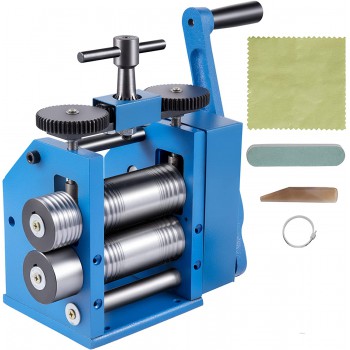
Beyond thickness control, rolling mills excel at creating surface texture. By sandwiching materials such as paper, fabric, mesh, or engraved plates between the rollers and the metal, jewelers can imprint intricate patterns directly onto the surface. This technique allows for endless variation, turning simple sheet metal into a richly textured canvas. Because no two passes are exactly the same, textured rolling introduces an element of organic uniqueness that many designers prize.
Rolling mills also support structural creativity. Tapered wire, graduated sheet, and custom profiles can be produced with careful setup and repeated passes. These variations add visual flow and ergonomic comfort to rings, bangles, and neck pieces. Instead of relying on pre-manufactured stock, designers gain full control over proportion and weight, aligning the material more closely with their artistic intent.
Maintenance and alignment are often underestimated but are critical to mastering the tool. Clean rollers prevent unwanted marks, while proper alignment ensures even pressure across the metal. A well-maintained rolling mill not only produces better results but also extends the life of both the machine and the metal being worked.
Ultimately, mastering the rolling mill is about understanding transformation—how pressure reshapes material, how texture tells a story, and how intention guides technique. For jewelry designers willing to invest time and curiosity, the rolling mill becomes more than equipment. It becomes a bridge between raw metal and refined expression, translating mechanical force into wearable art.
