
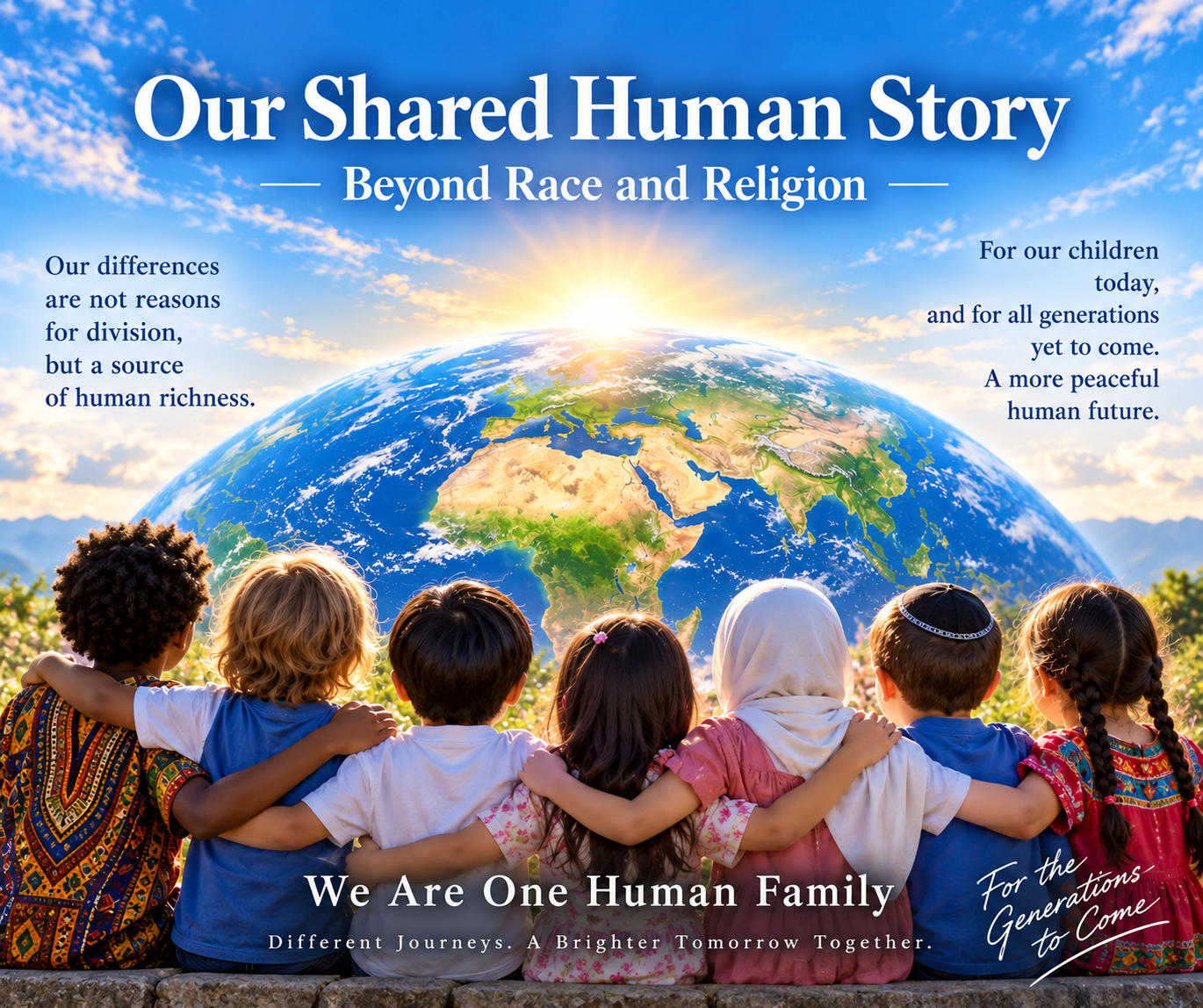
Our Shared Human Origins
Modern humans evolved in Africa.
Over many thousands of years, our ancestors migrated across the world, adapting to new environments, forming communities, and creating different ways of life.
That long journey is part of the shared story of every person alive today.
Our distant ancestors raised children, protected their families, shared food and knowledge, cared for one another, and struggled to survive. Generation after generation, life was passed from parents to children, carrying humanity forward.
As populations moved, met, separated, and sometimes mixed with one another, human societies became extraordinarily diverse.
Our appearances changed over generations. Languages developed and evolved. Cultures, traditions, and ways of life took different paths.
Today, we may look different, speak different languages, live in different countries, belong to different cultures, and follow different religions—or no religion at all.
Yet beneath all of these differences, we remain members of the same species and participants in the same long human story.
We are all part of one human family.
Every one of us is descended from people who once protected and cared for their children, just as generations before them had done.
Different Journeys, One Humanity
The people living today in Africa, Europe, Asia, Oceania, and the Americas have followed different historical paths.
The people of Japan are part of that story as well.
The Japanese population, like populations elsewhere, was shaped by migrations, population movements, interactions, and mixing over many generations. The history of the Japanese archipelago is not a story of an isolated people appearing fully formed in the distant past. It is part of the larger and much more complicated history of human movement across Asia and beyond.
Other populations around the world have their own histories of migration, interaction, adaptation, and cultural change.
These different journeys have given humanity its remarkable diversity.
But diversity does not create a hierarchy of human worth.
Differences in skin color, facial features, ancestry, ethnicity, nationality, language, or culture do not make one person more human than another.
We can recognize differences without turning them into divisions.
We can acknowledge that human populations have different histories without treating those histories as measures of human value.
We can look different without believing that one appearance is superior to another.
And we can belong to different cultures without seeing people from other cultures as somehow outside the human family.
Yet racial and ethnic discrimination still causes suffering around the world.
When I think about our shared history, that is difficult for me to understand.
Human diversity is real. It is one of the remarkable results of our long journey as a species.
But difference does not require hierarchy.
Religion and Our Shared Humanity
Religion is another area in which humanity has developed extraordinary diversity.
People have different ideas about God, morality, human existence, death, and the nature of the universe. Others do not follow a religion at all.
These differences are real, and we do not need to pretend otherwise.
We do not have to believe the same things in order to respect one another.
Across many religious and ethical traditions, we can find ideas that encourage compassion, generosity, self-restraint, kindness, and concern for others.
At the same time, human history also shows that religious differences have sometimes been used to justify exclusion, persecution, and conflict.
Perhaps that is one of the lessons we can learn from history: beliefs can matter deeply to us without giving us permission to deny the dignity of others.
We can remain committed to our own faith while respecting someone who follows another.
We can disagree about profound questions without turning disagreement into hatred.
We can help someone whose beliefs are completely different from our own.
We can even recognize that we may never agree on some of the deepest questions of existence—and still choose to treat one another with dignity.
Religious diversity does not have to become a reason for discrimination or persecution.
It can also be an opportunity to encounter perspectives different from our own and to understand more about the extraordinary variety of human experience.
Imagine Our Descendants
Sometimes I imagine the world hundreds or even thousands of years from now.
Human beings will continue to move, meet, form families, and create new cultures.
The descendants of today's children may someday look very different from us.
They may speak languages we cannot understand.
They may live in countries or societies that do not yet exist.
They may belong to cultures very different from our own.
They may follow religions that are unfamiliar to us—or no religion at all.
When I imagine my own descendants, some of them may have a different appearance from mine.
Some may speak another language.
Some may have a different faith.
Some may live in places I have never seen.
But would any of that make them less precious to me?
No.
They would still be descendants of the generations we love today.
And that makes me wonder:
What if, hundreds or thousands of years from now, those descendants looked at one another and saw only their differences?
What if they discriminated against one another because of skin color?
What if they hated one another because they followed different religions?
What if they treated one another as enemies simply because their cultures, appearances, or beliefs had grown apart?
Would we want that future for them?
I would not.
Because no matter how different they may look, what language they may speak, or what faith they may follow, each of them would still be my descendant—and precious to me.
And if we truly care about our descendants, perhaps we should care not only about what they inherit from us materially, but also about what they inherit from us morally.
Which Matters More?
Even today, people around the world continue to suffer because of prejudice, discrimination, persecution, and conflict connected to race, ethnicity, religion, nationality, and other differences.
Many of these divisions have been reinforced from one generation to the next.
That is why I think we should sometimes ask ourselves a simple question:
Which matters more—our assumptions about one another, or the happiness of our children?
The boundaries that seem permanent to us may not remain the same forever.
People who seem unrelated today may someday be connected through families, friendships, communities, and generations in ways we cannot imagine.
But even if those boundaries remain for centuries, the fundamental principle does not change:
Being different does not make someone less worthy of dignity.
We do not need to wait for humanity to become more similar in order to treat one another well.
We can do it now.
If we continue to pass prejudice and hostility from one generation to the next, our descendants may inherit conflicts that we had the opportunity to overcome.
But the opposite is also possible.
We can pass something better to them.
The Future Is Not Yet Written
Long ago, our distant ancestors struggled to survive.
They protected their children.
They shared food, knowledge, care, and hope.
Generation after generation, ordinary people did what they could to give their children a chance to live.
Eventually, those lives led to us.
Now the future is in our hands.
We cannot change the suffering and conflicts of the past.
But we can influence what we pass on to the generations that follow us.
We can teach children that someone who looks different is not therefore a stranger.
We can show them that people do not need to share the same religion in order to respect one another.
We can teach them to be curious about differences rather than afraid of them.
We can choose respect over contempt.
Cooperation over hatred.
Understanding over prejudice.
None of this requires us to abandon our identities or our convictions.
We can be proud of our cultures without believing that other cultures are inferior.
We can love our own traditions without demanding that everyone else share them.
We can disagree without dehumanizing one another.
And we can recognize that the person standing before us is, before anything else, another human being.
The Kind of Humanity I Hope For
I imagine that our ancestors wanted their children to live safely and happily.
I imagine that our descendants will want the same for their children.
And I believe that most of us, despite our many differences, share that basic hope.
For the sake of our children and the generations still to come, I hope that racial discrimination, ethnic hatred, and religious persecution can someday become things of the past.
But I do not think the answer is to erase human diversity.
Our differences in appearance, language, culture, ancestry, and faith are part of the extraordinary journey humanity has taken across geography, history, and generations.
The goal is not to make everyone the same.
The goal is to create a world in which being different does not make someone less worthy of dignity, respect, safety, or compassion.
A world in which we can see one another not only as members of different races, ethnicities, religions, or nations, but first as fellow human beings.
A world in which difference is not a reason for fear.
A world in which disagreement does not require hatred.
A world in which diversity enriches humanity rather than being used to divide it.
We all inherited life from countless generations before us.
Most of the people who made our existence possible are unknown to us.
We do not know their names.
We do not know what they looked like.
We do not know what languages they spoke or what beliefs they held.
But their lives mattered, because without them, we would not be here.
One day, we will become part of that distant past.
And the future will belong to generations we may never meet.
Perhaps we should ask ourselves what kind of world we want them to inherit.
Not a world without differences.
Not a world in which everyone believes the same things.
But a world in which differences do not determine who deserves dignity, safety, opportunity, or compassion.
A world where people can be different without becoming enemies.
A world where children can grow up knowing that someone who looks different is not less human.
A world where people can disagree about religion, politics, culture, and the meaning of life without losing sight of one another's humanity.
The future is not yet written.
We are writing part of it now.
For the smiles of our children.
For the generations still to come.
Let us work to end discrimination and hatred—not someday, but beginning with our own generation.
Let us leave behind not a world without differences, but a world mature enough to live with them.
And let us give the generations we may never meet something worth inheriting:
a more peaceful human future, built on dignity, understanding, and respect.
FMO-AOKI