

人気ブログランキングへ
I chanced upon this post from a fellow blogger from Tsukuba, Ibaraki. Her post, “Some Thoughts on Eclipses, Japanese Mythology, Princess Himiko and the Location of the Ancient Land of Yamatai” is an interesting read. Below is an excerpt from her blog.
______
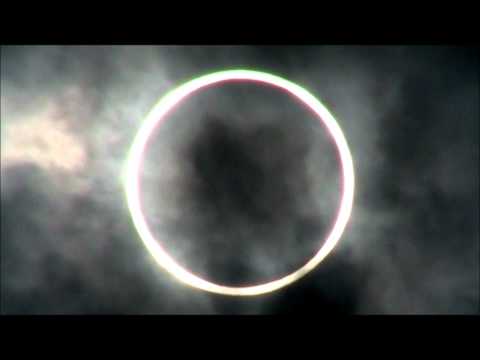
Though there are many references to possible eclipses to be found in the oral and written literatures of the world , the only national mythology or religion that I know of which has an eclipse-like episode as its MOST CENTRAL and well-known narrative, is that of Japan. Here is how the story of AMA NO IWATO (天岩戸), goes as found in the ancient (7th cenury) text- the KOJIKI.
Amaterasu no Omikami (the Sun Goddess, still worshiped by the Imperial Family as their direct ancestor), distraught by her brother Susanoo no Mikoto`s (The God of the Storm) outrageous behaviour (damaging rice fields and irrigation canals, throwing excrement about, and finally hurling a flayed horse at her attendants who were weaving at the time, killing some of them) withdrew into a cave , sealed herself up with a boulder and subsequently threw the world into darkness ( a very eclipse-like episode indeed!)
The myriad Gods were thrown into consternation and at a loss as to what to do. They finally decided to lure her out with entertainments (lewd dancing, singing and raucous laughter), and a MIRROR in which the Godess saw herself reflected when she peered out to see what all the fun was about. Seizing the chance, as she started to come forward, they grabbed her and blocked the cave so that she couldnt slip back in. Light was returned to the world and all was well again. For a slightly more detailed account read: http://en.wikipedia.org/wiki/Amaterasu .
The impact of this short but very influential story can be seen in several unique aspects of Japanese life (two of which I will mention here). First, at festivals and certain other religious events (Cherry Blossom viewing, for example) the Japanese often become , under the influence of liquor, quite animated and excited, often to the point of lewdness ( as if in imitation of the dancing which Amaterasu was so interested in, and appropriately entertaining for the Gods manifest in the blossoms). Then you have the religious importance of mirrors (which can often be be found inside shrines or in the form of the New Year’s mirror rice cakes -kagami-mochi, 鏡餅, which are also intended to ATTRACT the Gods) which is most probably connected to the mirror used in the story to attract the Goddess.
For me, and many other readers of the text, this episode from the Kojiki suggests that sometime in Japan’s prehistory, there had been a total eclipse which left a deep impression on the people . Now compared with other great civilizations, Japanese HISTORY (written records), does not go very far back at all ( though Japanese archaeological finds are among the most ancient in the world). In fact, the oldest extant text is the 7th century Kojiki itself. Thus, the eclipse which is referred to in the Ama no Iwato story, must surely have taken place sometime in the centuries preceding the writing down of the myth, back when the original Japanese state (ruled by the ancestors of today’s Imperial Family was starting to take shape.
Since there are no records written by the Japanese themselves from that time (though the oral histories were passed down and later written down as the founding myths of the Kojiki), it is to Chinese texts that we must turn to for any documentation regarding the embryonic Japanese State.
“Some Thoughts on Eclipses, Japanese Mythology, Princess Himiko and the Location of the Ancient Land of Yamatai” by Avi Landau http://blog.alientimes.org/2012/05/some-thoughts-on-eclipses-japanese-mythology-princess-himiko-and-the-location-of-the-ancient-land-of-yamatai/?utm_source=feedburner&utm_medium=email&utm_campaign=Feed%3A+Tsukublog+%28TsukuBlog%29

人気ブログランキングへ