
Curtains are one of the most measurement-sensitive products sold online. Width and drop both matter, fullness ratio changes how much fabric is actually consumed, heading style adds or removes length, and a pair of curtains needs to be priced and cut as a matched set rather than two independent panels. A generic Shopify product page, built around fixed variants, has no way to represent any of that — which is why so many curtain retailers still push made-to-measure orders into a quote form. A shopify custom price calculator removes that step: the customer enters window width and drop, selects heading style and fullness, and sees an accurate price immediately, calculated the same way a workroom would price it manually.
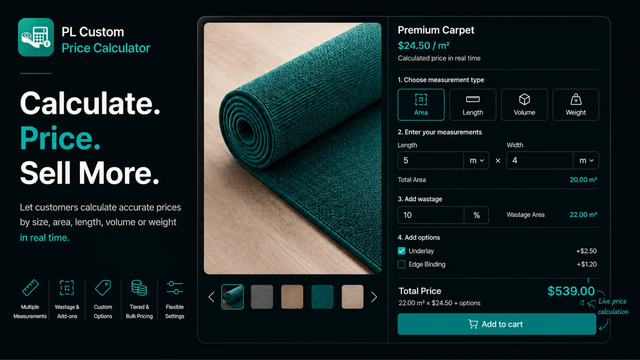
This article covers what actually goes into pricing made-to-measure curtains, the calculations a calculator needs to get right, and how to configure Pluginos PL Custom Price Calculator so the number on screen matches what the workroom can cut and sew.
Why Curtains Are Harder to Price Than Most Measurement-Based Products
Two customer measurements, one fabric quantity
A customer measures their window — width and drop — but that's not the fabric quantity required. The track or pole width determines curtain width; the drop determines curtain length; and neither maps directly to metres of fabric without applying fullness and hem allowances first.
Fullness ratio multiplies fabric use
Fullness — how much fabric is gathered into each metre of track — typically runs from 1.5x for a simple, flatter look to 2.5x or 3x for a fuller pencil pleat or pinch pleat finish. A 2m track at 2x fullness needs 4m of flat fabric width before panels are even cut, and this multiplier changes the fabric requirement (and therefore the price) more than almost any other single input.
Heading style changes both fullness and hem allowance
Pencil pleat, pinch pleat, eyelet, and wave heading each carry a standard fullness ratio and a different amount of fabric taken up in the heading tape or pleat construction itself. Getting heading-specific fullness wrong is the most common source of underpriced curtain orders.
Pattern repeat compounds with panel width
As with wallpaper, a patterned curtain fabric has a repeat that must be matched across joined widths within a panel and, ideally, across the pair. Wide windows requiring multiple fabric widths per panel consume noticeably more fabric on a large-repeat print than a plain one.
Pairs, not singles
Curtains are usually priced and ordered as a pair, split evenly (or asymmetrically, for some bay configurations) across two panels covering one track. The calculator needs to treat "track width" as the customer input and handle the pair-splitting internally, rather than asking the customer to work out and enter two separate panel widths.
The Calculations Behind Made-to-Measure Curtain Pricing
Step 1: Fabric widths required
Fabric widths per panel = ceiling((track width ÷ 2 × fullness) ÷ fabric roll width), applied per panel, then doubled for the pair. This determines how many widths of fabric must be joined to achieve the required fullness across the track.
Step 2: Drop plus allowances
Cut length per drop = window drop + heading allowance + hem allowance + pattern repeat allowance. Heading allowance varies by style (a deep pinch-pleat heading consumes more than a simple eyelet header); hem allowance is typically a fixed amount for the bottom turn.
Step 3: Total fabric required
Total fabric = fabric widths required × cut length per drop, giving the metres of fabric that need to be ordered and cut — the figure that actually drives cost, distinct from the window measurement the customer typed in.
Step 4: Labour and construction cost
Unlike flooring or tile, curtains include significant made-to-measure labour — cutting, joining widths, heading construction, hemming, and lining if selected. This is usually a separate cost layer added on top of the fabric cost, sometimes flat per pair, sometimes scaling with panel width or heading complexity.
Configuring PL Custom Price Calculator for Made-to-Measure Curtains
PL Custom Price Calculator's support for custom rules, multiple product options, and area/length-based calculation covers the layered structure curtain pricing needs.
Step 1: Set the calculation base
Use a length- or area-based calculation keyed to track width and drop, rather than a simple single-measurement field, since both dimensions independently affect fabric consumption.
Step 2: Enter fabric roll width and repeat per product
As with wallpaper, roll width and pattern repeat belong on each fabric product, since the calculator needs them to determine how many widths are required and how much extra length each repeat consumes.
Step 3: Add heading style as a driving option
Build heading style as a dropdown — pencil pleat, pinch pleat, eyelet, wave, tab top — with each option carrying its own fullness ratio and heading allowance, so selecting a heading automatically adjusts the underlying fabric calculation rather than requiring the customer to know or enter a fullness number themselves.
Step 4: Add fullness as a visible, editable figure
Where a store wants to offer flexibility beyond heading defaults, expose fullness as an adjustable field (typically constrained between reasonable bounds, e.g. 1.5x–3x) so trade customers or those wanting a fuller look can increase it, with the price updating accordingly.
Step 5: Set hem and heading allowances per collection
Configure fixed cut-length additions for hem and heading construction so the fabric-length calculation includes them automatically rather than relying on the customer's raw drop measurement.
Step 6: Add lining as a scaling option
Lining fabric consumption tracks the same panel and drop calculation as the main fabric, so it should be built as an option that recalculates alongside the primary measurement rather than a flat add-on priced independently of size.
Step 7: Add a labour/construction charge
Configure this as either a flat per-pair fee or a rule scaling with number of fabric widths, reflecting that a wide bay window pair genuinely takes more workroom time than a narrow single-width pair.
Step 8: Apply tiered pricing for trade or bulk orders
Interior designers and trade buyers ordering multiple windows at once benefit from — and expect — tiered pricing above a certain quantity or total value threshold.
Step 9: Style and label for a non-technical buyer
Use "Track or pole width" and "Drop (floor to top of track)" rather than generic field names, and place a short note beside the heading selector explaining fullness in plain terms, since most retail customers have never specified fullness before and shouldn't need to understand the underlying multiplication to trust the result.
A Worked Example: Pricing a Pinch Pleat Pair
Fabric at £32/m, roll width 137cm, pattern repeat 20cm. Pinch pleat heading: fullness 2.2x, heading allowance 15cm, hem allowance 20cm. Labour: £18 per fabric width used.
Track width 2.4m, drop 2.1m.
Fabric required per panel: (2.4m ÷ 2 × 2.2) ÷ 1.37m = 1.93, rounded up to 2 widths per panel, 4 widths total for the pair.
Cut length per drop: 2.1m + 0.15m (heading) + 0.20m (hem) + 0.20m (repeat allowance) = 2.65m.
Total fabric: 4 widths × 2.65m = 10.6m at £32/m = £339.20 for fabric, plus labour at £18 × 4 widths = £72, giving a total of £411.20, calculated and displayed live as the customer adjusts track width, drop, or heading style.
Without this logic built into the page, the customer either guesses at a flat "per window" price that doesn't reflect their actual fullness and repeat, or waits for a manual quote from the workroom.
Content That Works Alongside a Curtain Calculator Page
Measuring guides
"How to measure for made-to-measure curtains" — covering track vs pole width, recess vs outside mount drop, and where to measure from — linking directly to a product page where the reader can price their result immediately.
Heading style explainers
Content comparing pencil pleat, pinch pleat, eyelet, and wave, including typical fullness and the visual difference each produces, justifying why heading choice changes the price shown by the calculator.
Fullness and fabric-use guides
Plain-language content on why fuller headings use more fabric, with the calculator embedded so readers can compare the cost of 1.5x versus 2.5x fullness on their own window.
Room and window-type pages
Bay windows, French doors, and large picture windows each involve multi-width panels and repeat considerations distinct enough to merit their own page with pricing attached.
Mistakes That Cost Curtain Retailers Sales and Margin
- Ignoring fullness in the price calculation — pricing as if 1m of track needs 1m of fabric drastically underquotes any properly gathered heading
- No heading-specific allowance — pinch pleat and eyelet consume different amounts of fabric; treating them identically misprices one or the other
- Missing pattern repeat entirely — under-orders fabric on printed designs, a common source of returns and remakes
- Pricing panels individually instead of as a pair — customers expect one price for the window, not two separate calculations they have to add themselves
- No labour component — fabric cost alone consistently underprices the actual cost of construction
- Fixed fullness with no flexibility — trade and design-conscious customers often want to adjust fullness beyond a store default
- Calculator disconnected from a measuring guide — curtains are unforgiving of measurement error, and pairing the calculator with clear instructions reduces costly remakes
Final Thoughts
Curtain pricing is really several calculations layered together — fullness, heading allowance, repeat, and labour — collapsed into two numbers a customer actually has: window width and drop. A shopify custom price calculator that runs that layered calculation in the background, rather than asking the customer to understand fullness ratios themselves, is what turns a made-to-measure enquiry into a completed order.
PL Custom Price Calculator's rule-based, option-driven structure handles exactly this kind of layered pricing — heading-driven fullness, repeat-aware cut length, and labour scaling with fabric widths — applied consistently across a full curtain fabric catalogue