
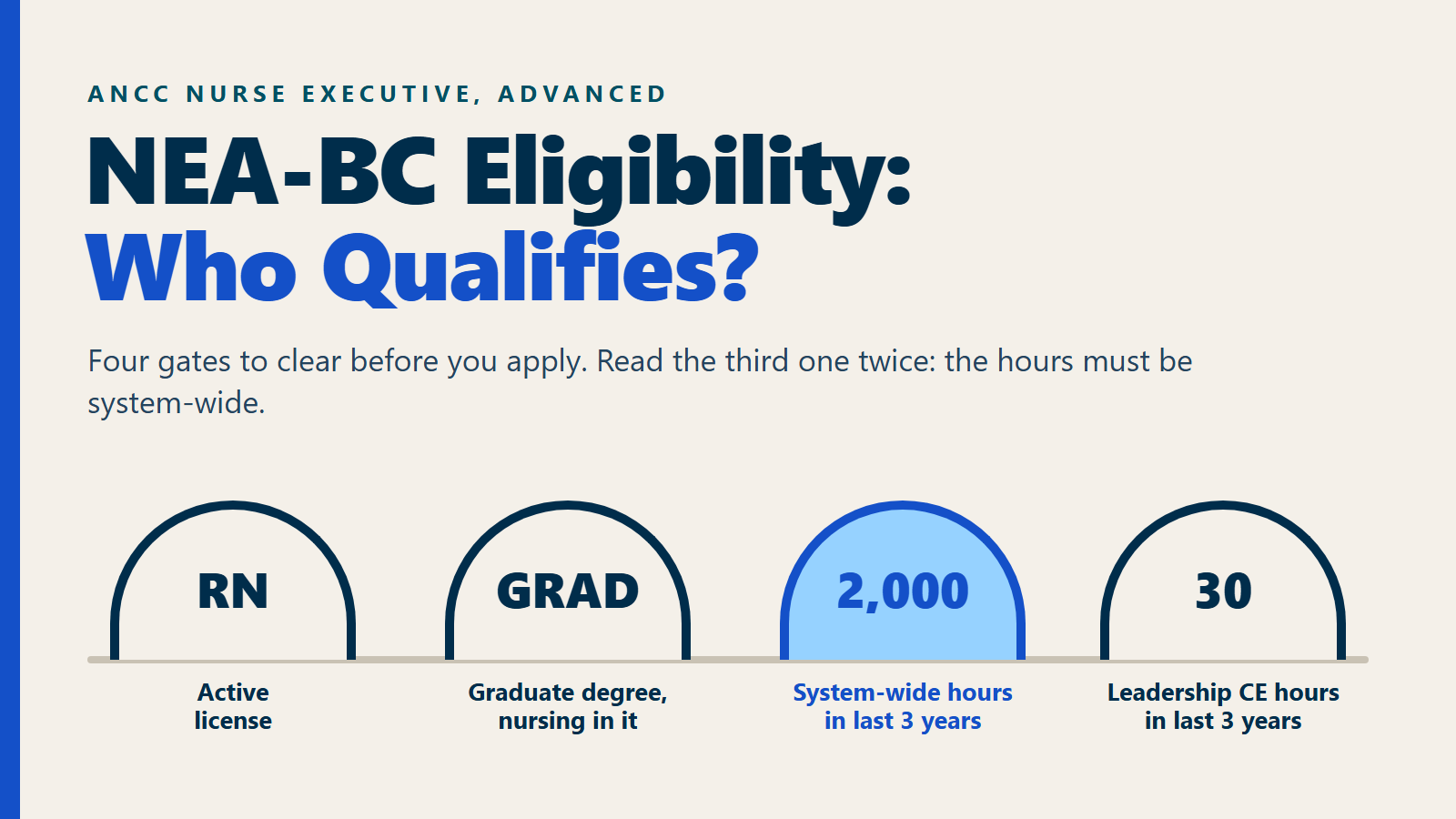
NEA-BC eligibility requirements come down to four things: an active RN license, a graduate degree (with either that degree or your bachelor's in nursing), at least 2,000 hours of organization-wide or system-wide leadership in the last 3 years, and 30 hours of leadership continuing education in the same 3 years. Meet all four and ANCC lets you sit the Nurse Executive, Advanced exam.
The hard part is rarely the license or the CE. It is the word "system-wide". Many strong nurse leaders have the hours but the wrong scope, and that is where the line between NE-BC and NEA-BC sits. These notes walk through each requirement, how to check your own hours honestly, and what to have ready before you pay. Every rule and figure here was read on ANCC's own pages on 30 October 2026.
What is the NEA-BC credential?
NEA-BC stands for Nurse Executive Advanced-Board Certified. It is awarded by the American Nurses Credentialing Center (ANCC) after you meet the eligibility rules and pass a computer-based exam.
ANCC writes the exam for nurses with "system-wide or organization-wide influence". These are leaders who are usually accountable for several groups of nurses, and often for non-nurse staff and operations too. Their work leans toward strategy, high-level finance, resource management and system integration, and they often represent the organization to the outside world. You can read that description on the ANCC Nurse Executive, Advanced certification page, which is also where you apply.
The credential is valid for 5 years. It is accredited by both ABSNC and NCCA.
What are the four NEA-BC eligibility requirements?
ANCC lists exactly four requirements. You need all of them on the day you apply.
- An active RN license. A current, active registered nurse license in a US state or territory, or the legally recognized equivalent in another country.
- A graduate degree, with nursing in it. You must hold a graduate degree, and either your baccalaureate or your graduate degree must be in nursing.
- 2,000 hours of senior leadership. At least 2,000 hours in a leadership, management or administration position with primary responsibility for organization-wide or system-wide operations and outcomes that include nursing, all within the last 3 years.
- 30 hours of leadership CE. Thirty hours of continuing education in leadership, management or administration, also within the last 3 years.

Does my degree count for NEA-BC?
Your degree counts if you hold a graduate degree and at least one of your two degrees, the bachelor's or the graduate one, is in nursing. This is the rule that most often surprises people who move into leadership from another path.
Here is how common combinations work out:
| Your degrees | Meets the NEA-BC degree rule? |
|---|---|
| BSN + MSN | Yes: graduate degree, both in nursing |
| BSN + MBA or MHA | Yes: graduate degree, and the bachelor's is in nursing |
| Non-nursing bachelor's + MSN | Yes: the graduate degree is in nursing |
| ADN + non-nursing bachelor's + MBA | No: neither the bachelor's nor the graduate degree is in nursing |
| BSN only | No: no graduate degree (look at NE-BC instead) |
ANCC asks for transcripts as part of the application. Its page says it will accept unofficial transcripts, such as a photocopy or a printed academic record, but it keeps the right to reject any copy that looks altered.
How do I count the 2,000 leadership hours?
Count only hours from the last 3 years, and only hours in a role where you held primary responsibility for operations and outcomes across the organization or system. Hours spent running a single unit count toward NE-BC, not NEA-BC.
A simple way to check yourself is to look at your job description and ask three questions:
- Do I answer for outcomes across more than one department, facility or service line, not just my own unit?
- Am I accountable for several groups of nurses, and possibly for non-nursing staff or operations?
- Is my work mostly strategy, budget, resources and system integration, rather than daily staffing and shift problems?
If you answer yes to all three, your hours are probably the right kind. If the honest answer to the first question is "no", you most likely belong in NE-BC for now.
To get a feel for the number, 2,000 hours is about one year of full-time work at 40 hours a week. Someone who moved into a system-wide director role 14 months ago, working full time, will usually clear the bar. Someone who has been a unit manager for 10 years, but only took on the system role 6 months ago, will usually fall short, however experienced they are.
How is NE-BC different from NEA-BC eligibility?
The two credentials share the same exam format and the same fees. They differ in degree level and in the scope of the leadership hours. The ANCC Nurse Executive (NE-BC) page lists its own rules, and the side-by-side view makes the gap clear.
| Requirement | NE-BC | NEA-BC |
|---|---|---|
| RN license | Current, active | Current, active |
| Degree | Bachelor's or higher in nursing | Graduate degree; bachelor's or graduate in nursing |
| 2,000 hours, last 3 years | Daily operations and outcomes of one or more units or departments | Organization-wide or system-wide operations and outcomes that include nursing |
| Leadership CE, last 3 years | 30 hours | 30 hours |
| Exam | 150 questions, 3 hours | 150 questions, 3 hours |
| Fee (ANA member / non-member) | $295 / $395 | $295 / $395 |
In plain words: NE-BC fits the nurse manager or director who runs units. NEA-BC fits the leader who runs nursing across a whole organization or system. Neither one is a step you must take before the other.
What does the 30 hours of continuing education need to cover?
The 30 hours must be in leadership, management or administration, and they must have been earned within the last 3 years. Clinical CE, however good, does not fill this requirement.
Useful sources are leadership conferences, finance or budgeting courses for health care managers, quality and safety leadership programs, and workforce or human resources topics. A smart way to choose is to match them to the exam outline. Since the NEA-BC test is built around leadership, quality and safety, human capital and health care delivery, CE in those areas helps both your eligibility and your exam score.
Keep every certificate. ANCC's FAQ says it runs random audits on initial specialty certification applications every year, and an audit can ask for your CE certificates and a written attestation of your practice hours, even after the credential has been issued.
What does the NEA-BC exam look like once you qualify?
Once ANCC accepts your application, you get a 120-day window to sit the exam at a Prometric center. The exam gives you 3 hours for 150 questions, of which 125 are scored and 25 are unscored pretest questions that look exactly like the rest.
The current NEA-BC Test Content Outline, effective November 11, 2025, splits the 125 scored questions like this:
| Domain | Scored questions | Share |
|---|---|---|
| Leadership | 42 | 34% |
| Quality and Safety | 32 | 26% |
| Human Capital Management | 26 | 21% |
| Health Care Delivery | 25 | 20% |
ANCC reports scaled scores up to 500, and you pass with a scaled score of 350 or higher. If you do not pass, the ANCC Certification Handbook says you can retest after 60 calendar days, with no more than three attempts in any 12-month period.
How much does it cost to apply for NEA-BC?
The application costs $395 for non-members and $295 for American Nurses Association members. Both prices include a $140 administrative fee that is not refunded.
That non-refundable part is the best reason to check your eligibility carefully before you pay. If ANCC finds that your hours were unit-level rather than system-wide, part of your fee is gone. ANCC also says that a membership discount can only be claimed for up to 5 business days after it receives your application, so join ANA first if you plan to.
What should you have ready before you apply?
Gather your paperwork before you open the online application, so you can finish it in one sitting.
- A copy of your active RN license showing the license number and expiry date.
- Transcripts for every degree you list, official or unofficial.
- Your job description, an organization chart and dates for each leadership role in the last 3 years.
- A simple log adding up your system-wide hours to at least 2,000.
- Certificates for your 30 hours of leadership CE, all dated within the last 3 years.
ANCC's page lists the steps in order: prepare, apply online, send your education documents (by e-mail or by post), then schedule with Prometric using your certification number.
Which mistakes cost NEA-BC applicants time and money?
Most problems come from reading the rules too quickly. These are the ones to watch:
- Counting unit-level hours as system-wide. This is the most common mismatch, and it is the exact line between the two credentials.
- Using hours or CE older than 3 years. Both look-back windows end on the day you apply, not the day you started your role.
- Mixing clinical CE into the 30 hours. Only leadership, management or administration CE counts.
- Missing a nursing degree. A non-nursing bachelor's plus an MBA does not qualify, however senior the role.
- Joining ANA too late. The member price cannot be claimed after the 5-business-day window.
- Throwing away records. An audit can come after you are certified, so keep your CE certificates and hours log.
A worked example: does Maria qualify?
Maria (an invented case) holds a BSN and an MHA. For the past 7 years she managed a 32-bed surgical unit. Twenty months ago she became Director of Perioperative Services, responsible for surgery, recovery and sterile processing across three hospitals in her health system. She has 34 hours of leadership CE, 20 of them from the last 2 years and 14 from 5 years ago.
Walk her through the four requirements:
- License: active RN license. Met.
- Degree: her MHA is a graduate degree and her BSN is in nursing. Met.
- Hours: 20 months full time in a three-hospital role is about 3,400 hours of system-wide responsibility, inside the last 3 years. Met. Her unit-manager years do not count here, but she no longer needs them.
- CE: only 20 of her 34 hours fall within the last 3 years. Not met yet.
Maria qualifies once she completes 10 more hours of leadership CE. Until then, applying would risk her $140 administrative fee.
How long should you plan from first check to exam day?
A comfortable plan takes about eight weeks: two for paperwork and six for study. Here is one way to lay it out.
- Week 1: Check all four requirements against your own records. Build your hours log and list your CE with dates.
- Week 2: Fill any CE gap, order transcripts, join ANA if you want the member price, then apply online.
- Week 3: Read the NEA-BC Test Content Outline line by line and mark the topics you meet least in your current job.
- Week 4: Leadership domain (42 questions): strategic planning, governance, change management and business planning.
- Week 5: Quality and Safety (32 questions): regulatory standards, high reliability, root cause analysis and FMEA.
- Week 6: Human Capital Management (26 questions): labor laws, workforce health and safety, and professional governance.
- Week 7: Health Care Delivery (25 questions): delivery models, ethics, research translation and technology integration.
- Week 8: Review your weakest domain, then schedule your Prometric seat inside your 120-day window.
For a short look at another ANCC board exam, the MedicoExam channel has a 96-second video on a sister credential, the Informatics Nursing (NI-BC) exam. The channel has no NEA-BC video yet, so treat this one as a feel for how ANCC frames its specialty exams, and take the NEA-BC rules from this page and ANCC's own.
Frequently asked questions
1. Can I take NEA-BC without a master's degree?
No. NEA-BC requires a graduate degree, and either that degree or your bachelor's must be in nursing. Nurse leaders with a nursing bachelor's but no graduate degree can look at NE-BC, which accepts a bachelor's or higher in nursing.
2. Do unit manager hours count toward the NEA-BC 2,000 hours?
No. NEA-BC hours must come from a role with primary responsibility for organization-wide or system-wide operations and outcomes that include nursing. Hours spent running one or more units match the NE-BC requirement instead.
3. How recent do my NEA-BC hours and CE need to be?
Both must fall within the last 3 years. That covers the 2,000 hours of leadership experience and the 30 hours of leadership, management or administration continuing education.
4. What score do I need to pass the NEA-BC exam?
ANCC reports scaled scores up to 500, and you need a scaled score of 350 or higher. The score is based only on the 125 scored questions; the 25 pretest questions do not count.
5. Can ANCC check my NEA-BC eligibility after I am certified?
Yes. ANCC runs random audits of initial specialty certification applications every year, and an audit can happen after the credential has been issued. You may be asked for your CE certificates and a written attestation of your practice hours, so keep both.
Before you apply, the ANCC certification FAQs are worth a read for transcripts, audits and renewal. Check your hours first, and the rest of the application is straightforward.