
Flat roofs earn their reputation twice: first for giving clean lines and usable space, and second for testing the patience of owners when damp and condensation creep in. In Essex, with its briny air, brisk coastal winds, and sharp temperature swings between clear nights and mild days, the balance between a watertight roof and a properly breathing structure can be delicate. Get the ventilation wrong and you invite mould, swollen timbers, blistering membranes, and dripping ceilings. Get it right and a flat roof can run for decades with only modest upkeep.
I have spent enough cold mornings on terraces in Leigh-on-Sea and late afternoons over garages in Brentwood to recognise where these problems begin and how to prevent them. Condensation is rarely caused by one dramatic fault. It comes from an accumulation of small misjudgments — an unsealed kitchen duct, a missing vapour control layer, a boxer vent placed in the wrong zone, or insulation pinched at the perimeter. The good news is that most issues have clear, practical solutions that work with the materials and building stock commonly found across Essex.
Why condensation lingers under flat roofs
Condensation forms when warm, moisture-laden air meets a surface at or below its dew point. In homes and light commercial buildings, that moisture mostly comes from living: cooking, bathing, drying clothes, or the latent moisture in the structure itself. When this air escapes into a roof void and hits a cold deck or membrane, it deposits water. One frosty night is enough to soak felt underlay; a week of it can drip through joints and stain ceilings.
In Essex, two microclimate quirks add stress. Along the coast, salt-laden air accelerates corrosion of fixings and wears on exposed trims, which magnifies any weakness around ventilation components. Inland, clear winter nights cause radiative cooling that drives deck temperatures well below the air temperature at dawn. That increases dew point risk even when the roof appears sound and the day is relatively mild.
The roof build-up matters. A cold roof (insulation between joists with a ventilated void above) relies on free air movement to purge moisture. A warm roof (insulation above the deck below the membrane) controls vapour with a continuous vapour control layer and keeps the deck warm enough to avoid condensation. Hybrid roofs, common in refurbishments, inherit the worst of both if done casually.
The tell-tale signs you’re dealing with vapour, not rain
People often misdiagnose condensation as a leak. The symptoms overlap but are not identical. Condensation tends to appear as broad, patchy damp on ceilings rather than a sharp drip line. The pattern also follows cold bridges: wetter M.W Beal & Son Roofing Contractors roofing company essex near external walls, over downstand beams, or where insulation is thin at the perimeter. On inspection, you might find black mould on the underside of the deck, swollen chipboard, or beads of water on nails that pierce the deck. Insulation can feel clammy rather than soaked through.
By contrast, rain leaks follow a path: a blister or split in the membrane, a loose flashing, a cracked outlet. They show up quickly after weather events and often stain in a teardrop or defined run. When I pull up a sample patch, leaks announce themselves with obvious points of entry, whereas condensation damage is diffuse and often smells musty, not earthy.
This distinction matters because the remedy is different. You can patch a split membrane in an hour. Drying a saturated roof void and stopping the vapour source may take weeks and a sequence of small interventions.
Choosing the right roof build-up in Essex
Most flat roofing in Essex falls into three camps: bitumen felt systems, single-ply membranes, and liquid-applied coatings. The membrane is less crucial to condensation control than the build-up beneath it, but some products integrate ventilation or tolerate retrofit vents better than others. Regardless of the finish, you decide first whether the roof should be warm, cold, or hybrid.
A warm roof suits most refurbishments where ceiling heights allow. The deck stays nearer room temperature, which dramatically reduces the chance of interstitial condensation. Insulation (usually PIR or mineral wool boards) sits above a timber or concrete deck with a bonded vapour control layer beneath. The membrane — felt, single-ply, or liquid — then goes on top. You avoid ventilation altogether in most warm roofs, which simplifies detailing near parapets and party walls.
A cold roof is better reserved for situations where you must keep the roof thickness low and you can guarantee continuous cross-ventilation. That means clear air paths from eaves to eaves, 50 mm air gaps above insulation, and unobstructed vents providing at least 25 mm continuous ventilation to opposing sides. Many older extensions in Billericay and Chelmsford were built this way. They can work, but only if you treat ventilation as a system, not a token slot vent here and there.
Hybrid roofs occur when you add insulation above a deck that still covers a partially insulated cavity or intermittent voids. If you do this, you must treat the warm layer as the primary system and close off old voids or ventilate them deliberately so they do not trap moist air against cold elements.
What proper ventilation looks like
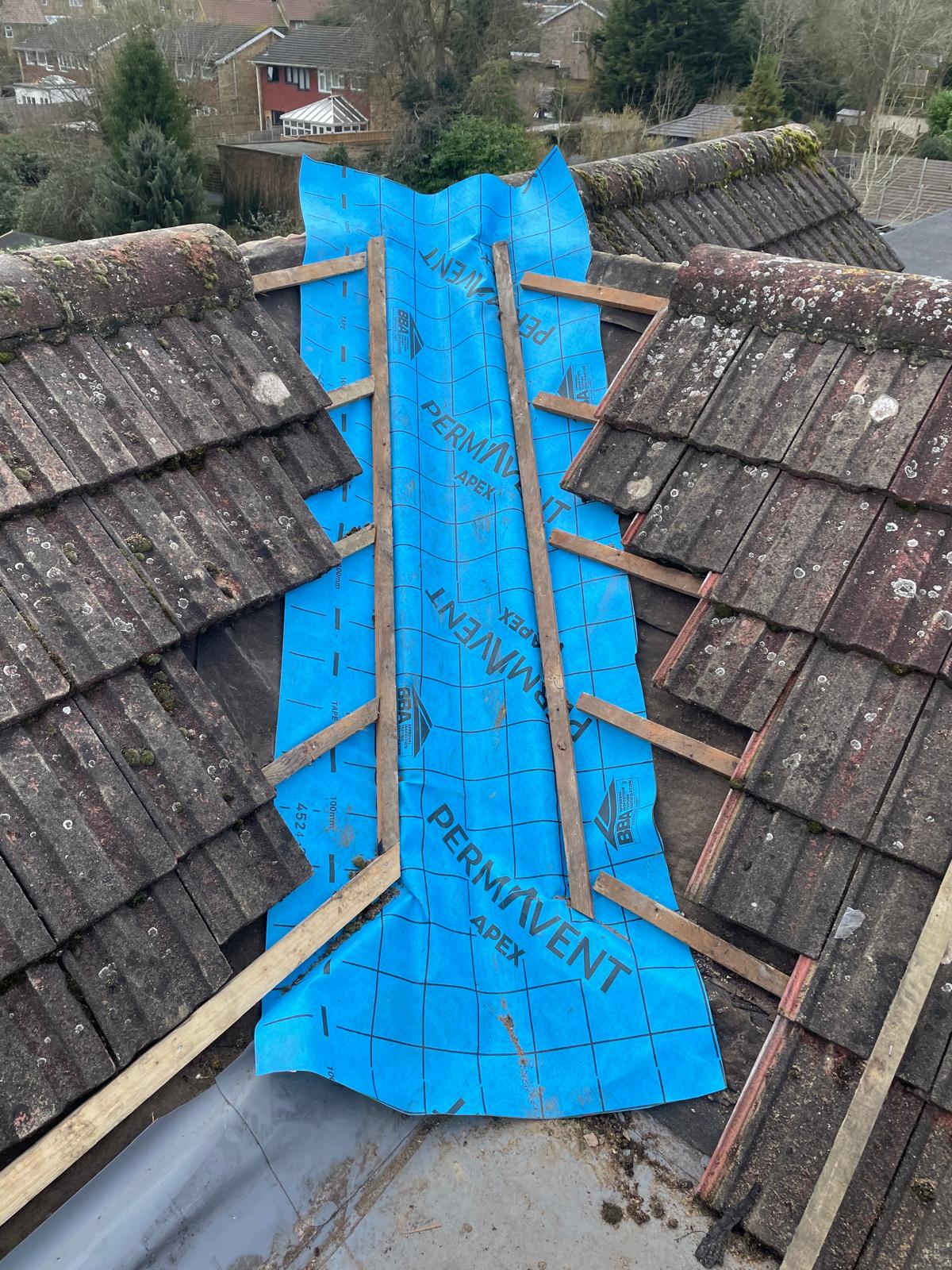
Ventilation is not simply punching in a mushroom vent and hoping for the best. Air needs a reason to move — temperature and pressure differences — and a path in and out. In a cold roof, this translates into continuous low-level intake and high-level exhaust, or opposed cross-ventilation across the full span.
For a typical single-storey extension with joists running front to back, soffit vents along two opposing sides can create cross-ventilation if the void is clear. Where a parapet prevents this, you might use over-fascia vents at the low side and continuous cavity vents at the high side, combined with proprietary flat-roof vents through the membrane to purge the high point. In practice, I aim for venting equivalent to 25 mm continuous at the eaves and 5,000 mm² per metre at high points, adjusting if the cavity is deeper than average. Numbers aside, the test is practical: can a gentle breeze find its way through the entire void without dead spots?
Obstructions defeat this. Noggin walls without notches, quilt insulation pushed hard against the deck, and bridged eaves are the common culprits. On one job in Wickford, we found that the loft conversion next door had blocked what used to be a shared cross-vent path over the party wall. The fix was to cut in two low-profile box vents on the sheltered side and open notches in the internal noggins to give the air somewhere to go. The damp smell faded within a week as the void dried out.
Warm roofs still need to breathe in a different sense. You are not venting a void, but you need the membrane to tolerate vapor pressure and the vapour control layer (VCL) to be continuous. If the VCL has gaps around service penetrations or edges, warm moist air finds a path up, hits the colder face of the insulation, and condenses. Because this happens within the sandwich, you can miss it for years until fasteners rust or boards delaminate. This is why taping and sealing the VCL matters. It is also why warm roofs can benefit from pressure-relief vents, particularly on dark membranes exposed to direct sun that pump air within the build-up daily. The vents are not a substitute for a VCL; they simply reduce blister risk.
Vapour control: the underrated layer
A VCL is not a casual polythene sheet tossed over joists. It is a designed layer with a specific water vapour resistance, sealed at laps, bonded to the deck, and turned up at edges to meet other air barriers. On jobs using PIR boards, I prefer a self-adhesive or torch-applied bituminous VCL with 150 mm sealed laps and neat upstands. It stands up to foot traffic during installation, tolerates minor deck irregularities, and ties in cleanly with metal trims.
In kitchens and bathrooms, the attention to detail makes or breaks the roof. Look at every service penetration: extractor ducts, recessed downlights if the ceiling below is not fire-rated and sealed, soil stacks, and even speaker cutouts in high-end builds. Each one needs a route that does not compromise the VCL, usually by sealing around pre-installed sleeves or boxing the services below the layer. In the absence of good planning, I have used EPDM pipe boots bonded to the VCL and membrane in tandem to re-establish continuity, but retrofits rarely match the performance of a correctly sequenced installation.
Condensation tied to indoor habits
Roofs do not make water; occupants do. In small terraced homes around Southend, I frequently find cold roofs above kitchens with no mechanical extraction. A gas hob without a ducted hood can push litres of water vapour into a home each day. That moisture finds the path of least resistance — often light fittings and ceiling voids — then rides convection currents straight to the coldest surface above.
Before you cut new vents into a roof, check the basics. Bathrooms need extractors that actually vent outdoors, not into a roof void. Kitchen extractors should be ducted, not recirculating. If the home has a modern condensing boiler, make sure the flue and condensate lines are properly sealed at the roof deck. Even closing trickle vents on windows can push vapour toward the roof if the house becomes too airtight without deliberate ventilation.
I once inspected a garage conversion in Colchester where a tumble dryer vented into the ceiling void through a perforated panel. The owner thought the flat roof had failed. We installed a rigid duct to the external wall, cut two small circular roof vents for the cold roof, and replaced the soggy quilt insulation. The roof stayed dry thereafter. Not a single membrane patch needed.
Material choices that help or hinder
Not all insulations behave the same. PIR boards give high thermal performance per thickness and are common in warm roofs. They do not absorb much water, but joints can open with thermal cycling if boards are poorly fixed, which gives vapour a path. Mineral fibre boards have better acoustic performance and a higher fire rating but can take on moisture if detailing is sloppy, adding weight and reducing thermal value. Phenolic foam boards perform well thermally at reduced thickness yet demand careful handling; they can be brittle and need consistent board support.
For membranes, single-ply systems like PVC and TPO often integrate proprietary vents easily and are lighter on older structures. Bituminous felt systems suit complex detailing and accept bituminous VCLs without chemistry conflicts. Liquid-applied systems earn their keep around awkward penetrations and heritage parapets but require dry, stable conditions during installation. In coastal Essex, I favour accessories and trims in aluminium or PVC over mild steel to slow corrosion from salt air — small decisions that extend the life of fixings around vents and outlets.
Realistic repair paths for existing roofs
Many enquiries begin with “I’ve got a leak,” and end with a conversation about vapour. Here is a plain sequence I use on flat roof repair Essex projects when condensation is part of the picture.
- Diagnose the build-up and moisture source: lift a small patch or core sample to confirm warm versus cold roof, check for a VCL, look at insulation type, and inspect the void with a borescope for mould or standing water. Use a hygrometer indoors to gauge background humidity. Dry and purge: if a cold roof is saturated, create temporary cross-ventilation using low-profile vents or, where possible, soffit vents. In a warm roof, relieve blisters, add pressure-relief vents if the membrane allows, and give the build-up time to dry. Close the vapour path: seal the VCL if present, repair laps, add collars to penetrations, and re-seat downlights with fire-rated, sealed hoods below the VCL line. Redirect or install mechanical extraction for kitchens and bathrooms. Decide on retrofit ventilation: for cold roofs that cannot achieve clear crossflow at the eaves, add proprietary through-deck vents at high points and ensure 50 mm air gaps above insulation across the entire span. Avoid token vents; plan the airflow. Upgrade at the right moment: if the membrane is at end of life or the deck is rotten, shift to a warm roof with a robust VCL, continuous insulation, and well-detailed perimeters. This is the point to re-route services and design out future vapour paths.
That list hides the iterative nature of the work. On a bungalow in Rayleigh, we staged the repair over three visits: first to stop active drips, second to dry and open air paths, third to upgrade edges and reinsulate. The owner saw steady improvement rather than a single disruptive tear-off.
Edge detailing, the silent culprit
Perimeters concentrate problems. Insulation often pinches thin near fascias, and vapour barriers fail to turn up far enough to meet the wall air barrier. On parapet roofs, cap flashing can trap moisture against the membrane if weep gaps are absent. I have seen three-year-old roofs with pristine centres and sodden outer 300 mm simply because the perimeter was cold and the VCL ended in mid-air.
For warm roofs, I like to see full-height upstands on the VCL, with insulation tight to the parapet, and a metal or GRP trim that does not compress the insulation at the edge. On cold roofs, the air path must pass the full perimeter. If masonry sits flush with the deck, carve a slot or use vented over-fascia products to maintain that 50 mm clear zone. Never let quilt insulation sag into the ventilation gap; staple netting to hold it back.
The Essex factor: wind, salt, and planning quirks
Wind exposure varies dramatically. In open coastal plots, mushroom vents can rattle and admit driven rain if poorly specified. I prefer low-profile box vents with baffles and internal cowls in these areas. In sheltered urban terraces, vents struggle to draw air on still, damp days; you compensate with more distributed venting rather than two large units.
Salt air accelerates fastener corrosion, particularly on steel vent fixings and outlet clamps. Stainless or aluminium components pay for themselves. Even bitumen caps benefit from UV-stable mineral finishes because the combination of salt and sun embrittles exposed surfaces faster than in inland counties.
Planning sometimes constrains roof thickness near boundaries, especially on side extensions tight to neighbours. Pushing for a warm roof height increase can provoke objections. When that happens, we have succeeded with high-performance phenolic boards to keep build-up slim and by trimming the fascia profile to retain gutter lines. If height cannot budge, you are in cold-roof territory, and the ventilation design must be bulletproof.
Energy efficiency versus breathability
It is tempting to seal everything in pursuit of airtightness and low bills. That is sound as long as you keep the vapour control strategy coherent. A leaky VCL under a perfectly airtight membrane is a recipe for trapped moisture. Aim for the opposite: a near-airtight interior with deliberate, controlled ventilation and a membrane happy to shed water, not to hold pressure. Mechanical ventilation with heat recovery (MVHR) in well-sealed homes reduces the vapour load that ever reaches the roof. In existing stock without MVHR, balance trickle vents and extractor fans so you do not pressurise the interior on wet days.
What a thorough survey should include
A good survey earns its fee by preventing half-measures. For flat roofing Essex properties, I want four pieces of data before recommending work: the exact build-up, the state of the deck, the moisture content of timbers, and the indoor humidity profile. The build-up and deck come from core samples and careful lifting at agreed spots, then reinstated properly. Moisture readings in joists and decking indicate whether you have a current problem or old damage that has stabilised. Indoor humidity readings over a week tell you whether occupant habits are driving the issue. I often leave a small logger behind if the client is unsure.
Photographs of soffits, parapets, outlets, and service penetrations complete the picture. If soffits are sealed or absent, you know cold-roof cross-ventilation will be hard. If outlets are undersized — a common sight on DIY refurbs — water can pond and chill the deck below dew point even on cool mornings.
Costs, timelines, and what to expect
For minor interventions — adding vents, sealing penetrations, improving extraction — budgets in the low hundreds to a couple of thousand pounds are typical, with work completed in a day or two. Warm roof conversions on modest extensions often land in the £80–£140 per square metre range depending on membrane choice, access, and edge detailing, with three to five days on site. If the deck and joists are rotten, carpentry adds cost and time. Coastal properties with scaffold and weatherproofing sometimes stretch a week to ten days because we avoid opening too much at once in changeable weather.
These are ranges, not promises, because access and hidden defects swing the total. I flag contingencies for wet-weather delays and for timber repairs once we open up — frequently five to ten percent of the budget.
Maintenance that prevents the backslide
Flat roofs don’t ask for much, but they do punish neglect. Gentle housekeeping keeps condensation at bay by maintaining the thermal and airflow balance. Twice a year, walk the roof if it is safe to do so, or have someone competent check it. Clear leaves from outlets, look for blistering, check vent cowls for blockages or nesting, and make sure metalwork is not loosening. Indoors, listen to extractor fans, clean their filters, and confirm they actually move air by holding a strip of tissue to the grille. None of this replaces a proper inspection, yet it catches small issues before they turn systemic.
When replacement is the sensible choice
There is a threshold where repairs chase their tail. If the deck is spongy across wide areas, if you can smell mould in the rooms below, or if fasteners are rusted throughout a warm roof build-up, patching vents and sealing laps buys only a short respite. A full strip, dry-out, and rebuild as a warm roof with a proper VCL pays back through stability and reduced heating costs. I recommend this path when more than a third of the roof shows moisture damage, when the membrane is near end of life, or when the detailing is so compromised that every penetration becomes a bespoke fix.
It is tempting to shy away from a larger job, but partial measures around a confused build-up tend to cost more over three winters than a single, clean upgrade.
Working with the right team
Ventilation and condensation rarely sit neatly in one trade. A flat roof specialist understands membranes and VCLs; an electrician knows downlight hoods; a plumber routes soil stacks and boiler flues; a general builder can open soffits and adjust fascias for airflow. On mixed-skill homes, especially where previous owners layered solutions, insist that your contractor coordinates these pieces. For flat roof repair Essex projects with real moisture history, I often schedule a single day where the electrician, roofer, and builder overlap to keep the VCL continuous while services shift. It is not glamorous work, but it avoids the classic situation where a perfect VCL is perforated next week to run a cable.
A short homeowner checklist before you call
- Note when damp appears: after cold nights, after showers, or after storms. Timing narrows the cause. Check your extractors: do they vent outside, and do they actually pull a tissue to the grille? Look under the eaves: are there soffit vents, and are they clear? Photograph parapets, outlets, and any visible vents on the roof for reference. Gather any past roofing invoices or specifications; they reveal the build-up more often than not.
Those few minutes of preparation speed the diagnosis and reduce exploratory work on site.
The practical bottom line
Flat roofs in Essex can be dry, durable, and quiet performers when their physics is respected. Ventilation is not an afterthought but a designed pathway for air, matched to the roof build-up and the habits of the home beneath it. Condensation is a symptom, not a mystery. Solve the pathway, not just the puddle, and you will stretch the life of any membrane — felt, single-ply, or liquid — far beyond the warranty card.
Whether you manage a row of shop units near Clacton or you are nursing a leaky kitchen extension in Basildon, approach the problem systematically. Confirm the build, measure the moisture, control the vapour, and only then choose vents, membranes, or a full warm-roof conversion. That is the difference between a quick fix and a roof that keeps its promise through Essex’s windy winters and bright, briny summers. If you need help, look for teams with hands-on experience in flat roofing Essex properties, not just generic roofing. The materials matter, but judgment earned on roofs like yours matters more.