
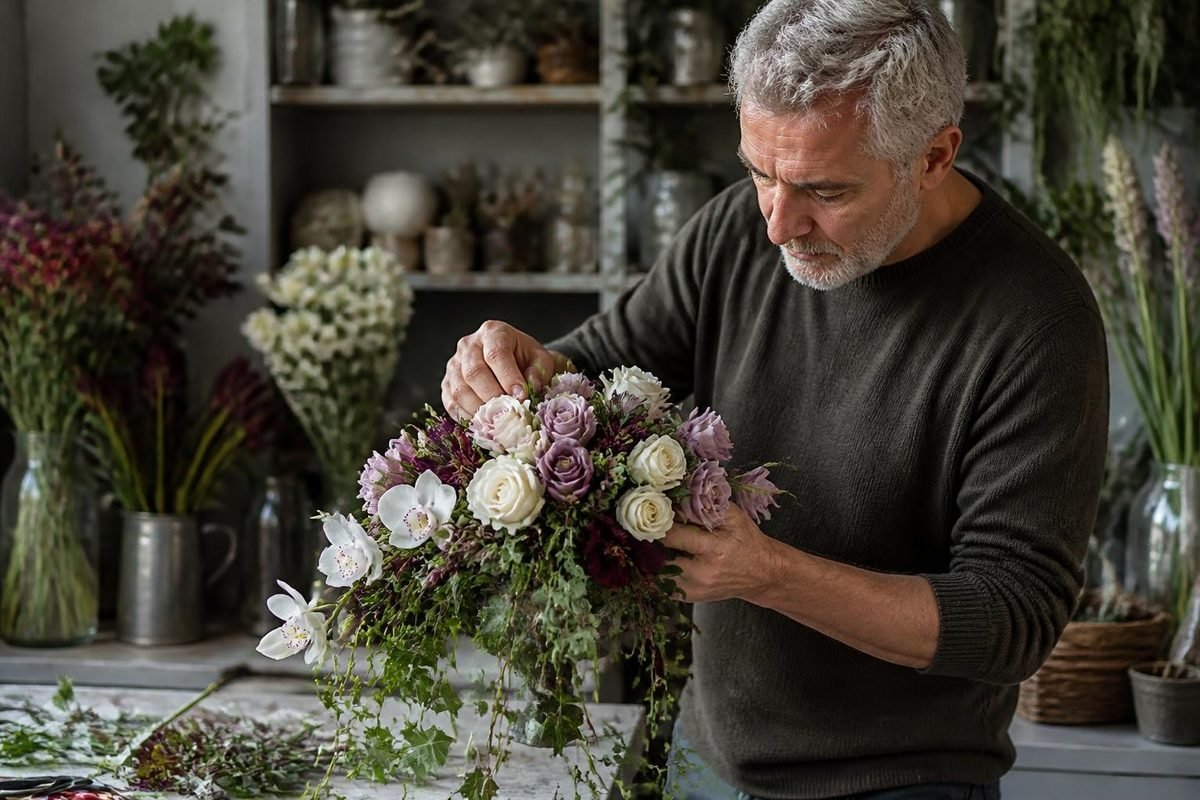
Choose flowers for a cascading bouquet by combining focal blooms with flexible, trailing stems and foliage. Pick materials that suit the bouquet\'s size, the occasion, and the conditions in which it will be carried.
Start with the shape and size
A cascading bouquet is fuller near the hand and tapers into a flowing point below. Before choosing individual flowers, decide how long and wide you want that point to be. A short cascade can be subtle, while a longer one creates a more pronounced line.
Consider the person's height and how they will carry the bouquet. A very long arrangement can obscure clothing or be awkward to hold. The flowers should look balanced from the front and feel manageable in the hand.
Choose the main flowers
Use a few larger blooms to give the upper part of the bouquet a clear focus. Roses, peonies, and dahlias can work well, depending on availability and the season. Choose flowers that are in good condition, with firm stems and petals that are not bruised.
Smaller flowers can fill gaps and connect the focal blooms to the trailing section. Spray roses and lisianthus are options. Repeat a few flower types throughout the arrangement rather than using a different flower in every space. This helps the bouquet read as one shape.
Add movement with trailing stems
Look for flowers or foliage with naturally arching, flexible stems. Orchids can create a graceful downward line, while trailing foliage such as ivy can help define the outer edge. Let some stems extend farther than others so the lower section tapers rather than ending abruptly.
Keep the trailing materials in proportion to the main blooms. Too much dense foliage can hide the flowers, and too many large blooms at the bottom can make the cascade look heavy. Check the shape from the front as well as the side.
Put the choices together
Use these steps to narrow the selection and test how the materials work as a bouquet.
Choose a color range, then select one or two focal flowers that fit it.Add smaller flowers that complement the focal blooms in color and scale.Select trailing flowers or foliage to create the desired length and outline.Hold the stems together loosely and check the shape, weight, and balance.Ask a florist how the chosen stems will receive water and hold up during the event.Availability can change with the season and location, so have a substitute in mind for an important flower. Heat, time out of water, and handling also affect freshness. A florist can suggest suitable materials and construction for the planned schedule.
Common questions
Do all cascading bouquets need greenery?
No. Trailing flowers can provide the downward line on their own, although foliage can add shape and help fill spaces.
Can a cascading bouquet be small?
Yes. Use a compact group of blooms and a short, tapered trail to create the shape without a large bouquet.
Are orchids required for the cascade?
No. Orchids are one option, but other flexible flowering stems or trailing foliage can create a similar direction.
More on this: Polish All Saints' Day traditions