
UAE Vascular Closure Device VCD Market Hits USD 65 Million : Ken Research Signals Cost-Training Divide
According to Ken Research, the UAE Vascular Closure Device VCD Market is valued at approximately USD 65 million. Demand is rising as hospitals in Dubai and Abu Dhabi perform more minimally invasive cardiovascular and peripheral interventions, yet adoption remains uneven because individual devices can cost roughly AED 1,500 to AED 3,000 and require physician familiarity, procurement approval, and reliable distributor support.
Research Basis: This analysis draws on Ken Research market sizing, medical-device channel assessment, hospital procurement review, product and access-site segmentation, and cross-referenced documentation from the UAE Ministry of Health and Prevention and Dubai Health Authority.
Key Takeaways
- Market Size: The report values the UAE market at approximately USD 65 million.
- Clinical Driver: The report estimates cardiovascular conditions affect about 1.5 million people in the UAE.
- Mortality Burden: MOHAP reported 89.9 coronary heart disease deaths per 100,000 population in its 2021 statistical report.
- Leading Access Site: Femoral access remains predominant, while radial access is gaining physician acceptance.
- Adoption Barrier: VCD prices of roughly AED 1,500 to AED 3,000 per unit intensify hospital scrutiny of clinical and operational value.
Market At A Glance
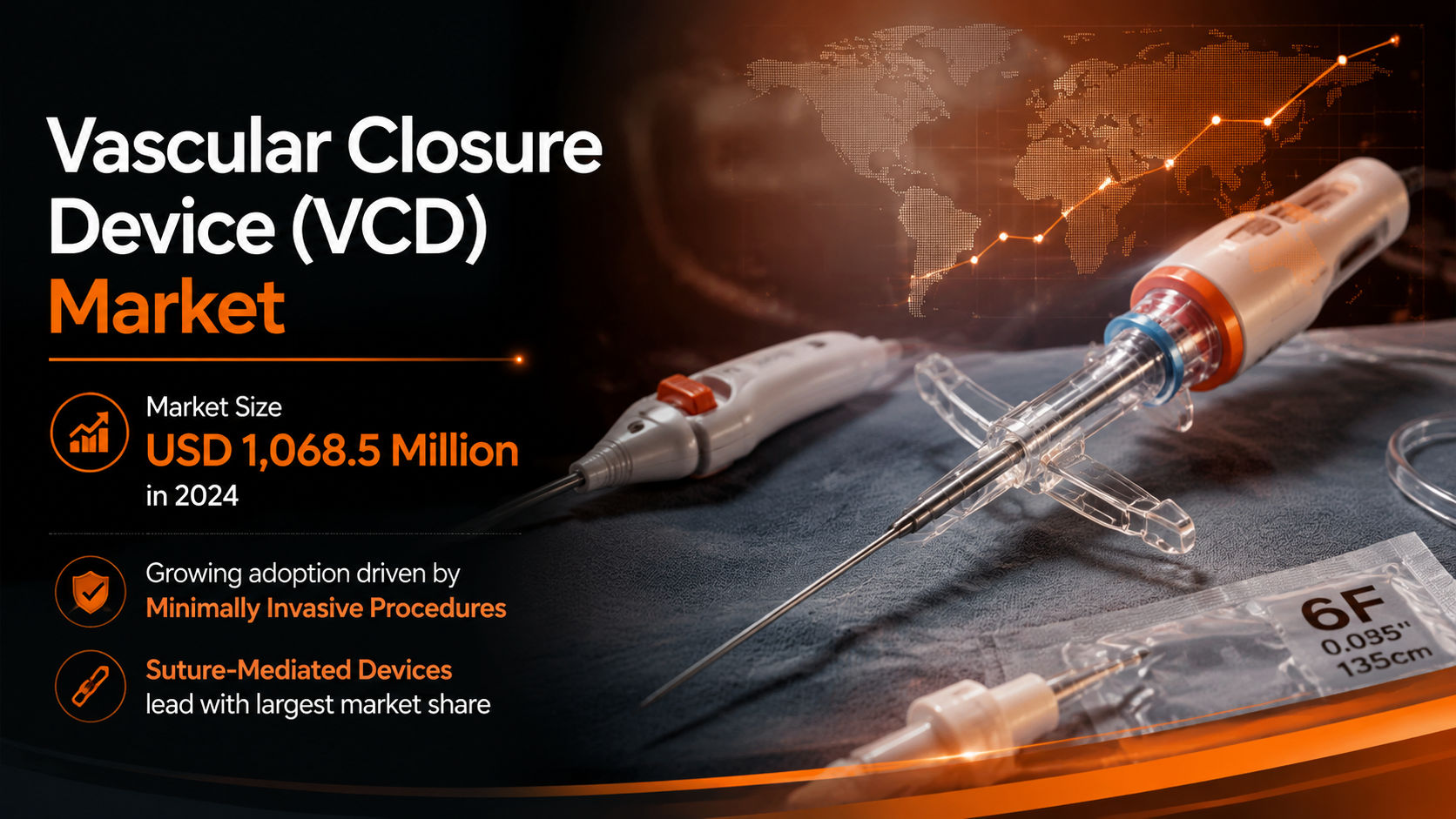
UAE Vascular Closure Device VCD Market Snapshot
- Market Value: Approximately USD 65 million in the report's base-year assessment.
- Leading Product Direction: Active vascular closure devices are gaining traction due to rapid hemostasis and earlier patient mobilization.
- Largest Geographic Hubs: Dubai and Abu Dhabi lead through advanced hospital infrastructure and higher interventional procedure volumes.
- Core Applications: Interventional cardiology, interventional radiology, vascular surgery, and peripheral procedures.
- Market Implication: Suppliers must prove that faster closure and discharge benefits justify the premium over manual compression and alternative hemostatic methods.
Market Size and Growth
The market's USD 65 million valuation reflects a concentrated but increasingly sophisticated medical-device category. Expansion is being supported by greater use of catheter-based interventions, hospital emphasis on shorter recovery times, and growing interest in same-day or outpatient pathways. Unlike broad consumable markets, however, VCD growth depends on procedure mix, access-site preference, operator confidence, and hospital protocol approval.
Cardiovascular Disease Creates a Structural Demand Base
The report estimates that cardiovascular diseases account for approximately 30% to 40% of deaths in the UAE and affect around 1.5 million people. An official MOHAP statistical report recorded 89.9 coronary heart disease deaths per 100,000 population for 2021. This burden sustains demand for angiography, angioplasty, structural-heart, peripheral vascular, and other catheter-based procedures in which secure access-site closure is essential.
Minimally Invasive Care Shifts the Procurement Equation
Hospitals increasingly evaluate closure devices against total episode economics rather than purchase price alone. A device that enables earlier ambulation, reduces compression time, limits nursing observation, and supports faster discharge may create value even when its unit price exceeds conventional closure methods. The strongest commercial cases therefore connect clinical outcomes with cath-lab throughput, bed utilization, recovery-room capacity, and patient experience.
Dubai and Abu Dhabi Concentrate Early Adoption
Dubai and Abu Dhabi dominate because they combine tertiary hospitals, specialist cardiology teams, international device distributors, and higher procedural volumes. The Dubai Health Authority open-data program publishes annual statistical yearbooks and capacity-planning resources for the public and private health sectors. This planning environment favors suppliers able to support structured training, inventory continuity, and evidence-based hospital procurement.
Product and Access-Site Segmentation
The market includes active and passive vascular closure devices, external hemostatic products, suture-based systems, clip-based devices, plug-based products, and compression solutions. Active devices are gaining momentum because they are designed to achieve hemostasis efficiently and support quicker mobilization. Bioabsorbable materials and extravascular sealing approaches are strengthening the value proposition for hospitals seeking predictable post-procedure workflows.
Femoral Access Remains the Commercial Anchor
Femoral access remains the leading access route because it is established across a wide range of coronary and peripheral interventions and can accommodate larger-bore procedures. This keeps femoral closure technologies at the center of VCD procurement. Hospitals assess deployment success, time to hemostasis, complication risk, compatibility with sheath sizes, and the learning curve required for different operator groups.
Radial Access Changes the Addressable Market
Radial access is gaining popularity because of its association with lower access-site complication risk and shorter recovery in suitable procedures. Its growth does not eliminate femoral VCD demand; instead, it changes the case mix. Suppliers must identify where femoral access remains clinically necessary, especially in complex, peripheral, and large-bore interventions, and position closure technologies around those higher-value use cases.
Regulation Raises the Value of Local Execution
Medical-device approval is a commercial capability, not merely a compliance step. MOHAP requires marketing authorization holders and manufacturing sites to be registered before products can be registered, while applicants must operate through an appropriately licensed medical warehouse or marketing office. The official process lists an average service time of 45 working days, an application fee of AED 100, and a medical-device registration fee of AED 5,000.
These requirements make regulatory readiness, documentation quality, and local representation decisive for market entry. Buyers can consult the official MOHAP registered medical devices resource, while manufacturers must plan for conformity documentation, product information, post-market monitoring, and safety and efficacy evidence where applicable.
Competitive Landscape
The report identifies a broad group of international participants, including Abbott Laboratories, Terumo Corporation, Medtronic, Boston Scientific, Cardinal Health, W. L. Gore & Associates, Teleflex, B. Braun, Merit Medical Systems, Siemens Healthineers, Philips Healthcare, Cook Medical, Edwards Lifesciences, Johnson & Johnson, and Stryker.
Scaled Multinational Device Leaders
- Companies: Abbott Laboratories, Terumo Corporation, Medtronic, Boston Scientific, and Cardinal Health.
- Strategic Position: These companies benefit from broad hospital relationships, established clinical-support structures, and the ability to bundle vascular products across multiple procedure categories. Their challenge is defending premium pricing through measurable workflow and outcome benefits.
Specialty Vascular and Procedure-Support Players
- Companies: W. L. Gore & Associates, Teleflex, B. Braun, Merit Medical Systems, Cook Medical, and Edwards Lifesciences.
- Strategic Position: These participants can compete through specialist product depth, targeted physician education, and focused distributor execution. Their limitation may be narrower account coverage relative to the largest diversified device groups.
Which vendors are best positioned across active, passive, and access-site segments? Download Sample Report for company benchmarking, segmentation, pricing analysis, and UAE distribution assessment.
Cost and Training Pressure on Hospital Adoption
The report places VCD prices at approximately AED 1,500 to AED 3,000 per unit. That cost can slow adoption in budget-sensitive facilities, especially when manual compression is viewed as an acceptable alternative. Vendors therefore need to demonstrate value through reduced time to hemostasis, lower staff intensity, earlier ambulation, fewer access-site complications, and improved patient turnover.
- Unit economics must be translated into total procedure and recovery cost.
- Physician training must cover patient selection, deployment technique, complication management, and device-specific limitations.
- Inventory reliability matters because cath labs cannot tolerate stock interruptions across sheath sizes and procedural categories.
- Clinical evidence must be localized into procurement language that hospital committees can compare against alternative closure methods.
Healthcare strategists can compare this category with wider medical-device industry reports and competition benchmarking studies to assess adjacent cardiovascular and hospital-procurement opportunities.
Analyst View
The market will be won through clinical implementation rather than product registration alone. A registered device without physician confidence, distributor inventory, and procurement evidence will struggle to generate repeat usage. Suppliers that combine regulatory execution with structured cath-lab training and clear cost-per-case evidence are more likely to secure protocol inclusion and defend margins.
Strategic Implications by Stakeholder
- For Manufacturers: Build a UAE-specific evidence package connecting closure performance to hospital throughput and recovery efficiency.
- For Distributors: Invest in clinical specialists, consignment planning, and rapid replenishment rather than relying only on transactional sales.
- For Hospitals: Evaluate devices by patient selection, complication profile, staff time, ambulation speed, and discharge impact.
- For Investors: Favor suppliers with strong regulatory records, physician-training capability, and durable relationships in Dubai and Abu Dhabi.
Strategic Outlook
Four forces will shape the UAE VCD market through the next planning cycle: rising cardiovascular intervention volumes, continued movement toward minimally invasive and outpatient care, greater scrutiny of total procedure economics, and tighter competition for trained interventional users. Femoral closure will remain the principal revenue pool, while radial adoption will push vendors to focus on the procedures where VCDs deliver the strongest clinical and operational value.
Planning a market-entry, distribution, or hospital-account strategy? Request a UAE Vascular Closure Device Market Assessment to evaluate competitors, pricing bands, access-site demand, regulatory readiness, and channel opportunities.
Frequently Asked Questions
Q1: What is the size of the UAE Vascular Closure Device VCD Market?
The report values the UAE vascular closure device sector at approximately USD 65 million. Dubai and Abu Dhabi account for the strongest adoption because of their advanced hospital infrastructure, high procedural activity, and concentration of specialist providers and international device suppliers.
Q2: Which device type is gaining the most traction?
Active vascular closure devices are gaining traction because they can support rapid hemostasis, earlier mobilization, and more efficient recovery workflows. The broader market also includes passive, suture-based, clip-based, plug-based, external hemostatic, and compression products.
Q3: Which access site leads demand?
Femoral access remains predominant because of its established role across coronary, peripheral, and larger-bore interventions. Radial access is growing in suitable procedures due to physician experience and its potential recovery and complication advantages, changing the mix rather than removing the need for femoral closure.
Q4: What is the biggest commercial barrier?
Cost and implementation capability are the main barriers. The report estimates prices of approximately AED 1,500 to AED 3,000 per device, requiring suppliers to prove that reduced compression time, earlier ambulation, better throughput, or fewer complications justify the premium.
Q5: Who are the major companies in the market?
The report identifies Abbott Laboratories, Terumo Corporation, Medtronic, Boston Scientific, Cardinal Health, W. L. Gore & Associates, Teleflex, B. Braun, Merit Medical Systems, Siemens Healthineers, Philips Healthcare, Cook Medical, Edwards Lifesciences, Johnson & Johnson, and Stryker among the companies active in the competitive landscape.
Data Source
Market size, segmentation, pricing, competitive interpretation, and growth drivers are based on Ken Research estimates. Cardiovascular mortality and health-system indicators are cross-referenced with UAE Ministry of Health and Prevention documentation, while Dubai healthcare capacity context is supported by Dubai Health Authority open-data resources.
This analysis is based on the underlying UAE Vascular Closure Device VCD Market report by Ken Research, supplemented by official UAE health-sector sources.