
A Taste of Tradition: Celebrating Christmas the Italian Way
There's a saying that cuts to the heart of how Italians feel about Christmas: "Natale con i tuoi, Pasqua con chi vuoi" — "Christmas with your family, Easter with whomever you wish." That one sentence explains everything. The holiday isn't primarily about gifts or decorations. It's about getting around a table, eating food your grandmother made, and staying there until someone falls asleep.
Walk through an Italian town in December and you'll catch the sound of zampognari — shepherds playing bagpipes in the streets — and spot presepe (nativity scenes) glowing in shop windows. It's genuinely beautiful. But the real action, the heart of it all, is happening behind closed kitchen doors, where each region of the country is doing something completely different and completely convinced it's the only right way to do things.
The Christmas Eve Cenone: A Meatless Masterpiece
The whole culinary buildup starts on Christmas Eve with the Cenone — literally "the big supper." By Catholic tradition, the meal is meatless, a nod to fasting before the birth of Christ. What that actually means in practice is a sprawling, multi-course feast built almost entirely around seafood, and it can run so late that families roll straight from the table into midnight Mass.
In Naples and throughout the south, the spread is serious business. You'll find classic Italian Christmas recipes like these anchoring the table:
- Spaghetti alle Vongole: Spaghetti with clams, made with good olive oil, garlic, and fresh parsley — deceptively simple, deeply satisfying.
- Capitone: Fried female eel. Polarizing, yes, but deeply symbolic in Naples and much of the south. You either love it or you're very politely declining seconds.
- Baccalà: Salted cod, showing up in at least three or four different preparations — fried, stewed with tomatoes, dressed with olives and capers.
- Seasonal Vegetables: Think broccoli with garlic and lemon, or cauliflower tossed with anchovies and olives. They cut through the richness of the seafood courses and give you room to keep going.
Between courses, families play tombola — Italy's version of bingo — and the whole evening stretches on in the best possible way.
Christmas Day: A Celebration of Richness
If Christmas Eve is about holding back, Christmas Day is about letting go entirely. The fast ends, and the menu swings hard toward slow-braised meats, stuffed pastas, and sweets that differ pretty dramatically depending on which part of the country you're in.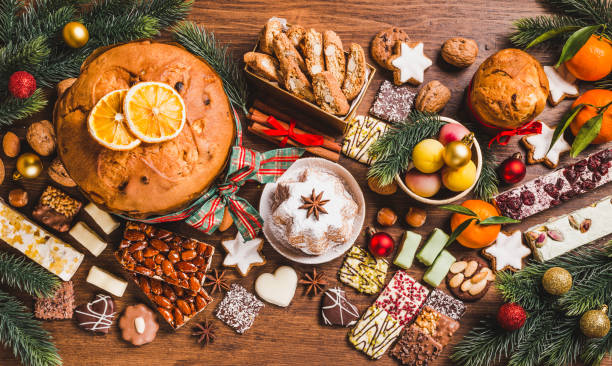

The Northern Influence
Up north, Christmas lunch is built for comfort. Capon — gelded chicken — is the traditional showstopper, served roasted or simmered into a deep, rich broth. And that broth matters, because stuffed pasta is the real star of the northern table.
- Tortellini: The iconic navel-shaped pasta from Emilia-Romagna, filled with pork loin, prosciutto, and mortadella, then served in brodo di cappone — floating in hot capon broth. Legend has it their shape was inspired by the navel of Venus. Whether that's true or just good marketing, they taste incredible either way.
- Agnolini: Mantua's answer to tortellini — small egg-based stuffed pastas often served in sorbir d'agnoli, a broth with a splash of red wine (usually Lambrusco) stirred in to kick off the meal. Honestly, this one might be my favorite discovery in Italian Christmas food.
The Central and Southern Traditions
Head south and the vibe shifts. Abbacchio — milk-fed lamb — is the centerpiece of choice in central Italy and around Rome, tied symbolically to sacrifice and seasonal renewal. Elsewhere across the south and center, tables fill up with roasts, sausages, and baked dishes that show off whatever the local land does best.
The Grand Finale: Italian Christmas Sweets
Here's where things get truly spectacular. Italian Christmas sweets are a category unto themselves — some go back centuries, most are intensely regional, and all of them are worth making room for even when you're already full.
The Titans of the Table: Panettone and Pandoro
Two cakes. Every Italian Christmas. No exceptions.
- Panettone: Milan's gift to the world. A tall, airy brioche-style cake packed with candied fruits and raisins, built on a dough that takes days to properly ferment and rise. A real one, made by someone who knows what they're doing, is genuinely unlike anything else.
- Pandoro: Verona's answer — a star-shaped "golden bread" with no dried fruit, traditionally buried under a snowfall of powdered sugar meant to echo the Alps. It's lighter, a bit more crowd-pleasing, and always causes a mild but passionate argument about which cake is better.
Regional Delights
Beyond those two, each corner of Italy brings something different to the dessert table:
- Struffoli: Naples again. Marble-sized balls of fried dough piled high, bound with honey, and covered in sprinkles and candied fruit. You eat them by pulling clumps apart with your hands, which is the whole point — they're messy, communal, and fun.
- Panforte: A dense, chewy fruit-and-nut cake from Siena that dates back to the Middle Ages. Loaded with almonds, candied peel, and warm spices, it's one of those things that pairs almost too well with a glass of Vin Santo.
- Torrone: Italian nougat — honey, sugar, egg whites, toasted nuts — ranging from crumbly to chewy depending on the region. It's a Christmas staple for gifts and dessert tables alike.
- Cuccidati: Sicilian fig cookies filled with a mixture of dried figs, dates, nuts, and spices. They take a while to make, so families usually bake huge batches and share them with neighbors. Worth every bit of the effort.
Keeping the Legacy Alive
Here's the thing about Italian Christmas food that doesn't fully come through in any recipe: the making of it is half the point. In the days before Christmas, the kitchen becomes the most crowded room in the house. Grandmothers direct, children get underfoot, pasta gets rolled, dough gets fried, and someone is always tasting something that isn't ready yet.
By cooking a dish that's been made the same way for two or three hundred years, Italians aren't just putting dinner on the table — they're holding onto something. A connection to their grandparents, to a specific town, to a version of themselves that only exists at Christmas. The spirit of Italian cooking lives exactly here, in that ordinary-extraordinary act of making something by hand because your family always has.
If you're looking for a way to bring a bit of that feeling to your own holiday table this year, you don't have to attempt a four-day panettone. Start smaller. Make a batch of struffoli, set out a good bottle of wine, and let the meal go slow. The whole point is lingering. The best part of Christmas, the Italians figured out a long time ago, isn't what's under the tree. It's who's still at the table at midnight.