Wassily Kandinsky was one of the most original and influential artists of the twentieth-century. His "inner necessity" to express his emotional perceptions led to the development of an abstract style of painting that was based on the non-representational properties of color and form. Kandinsky's compositions were the culmination of his efforts to create a "pure painting" that would provide the same emotional power as a musical composition. The exhibition "Kandinsky: Compositions", organized by Magdalena Dabrowski and on display at the Los Angeles County Art Museum until September 3, 1995, presents these monumental works together for the first and possibly last time and provides an opportunity to witness the creative process of Kandinsky.


(Black) is like the silence of the body after death, the close of life.

- Wassily Kandinsky, 1911


Kandinsky viewed the compositions as major statements of his artistic ideas. They share several characteristics that express this monumentality: the impressively large format, the conscious, deliberate planning of the composition, and the transcendence of representation by increasingly abstract imagery. Just as symphonies define milestones in the career of a composer, Kandinsky's compositions represented the culmination of his artistic vision at a given moment in his career.

Regrettably, the first three compositions were destroyed during World War II. They are represented in the exhibition by full-scale, black-and-white photographic reproductions. One of the strengths of the exhibition is the assembly of preliminary studies for most of the works. These were done in oil, watercolor, ink and pencil. These help convey a sense of the three lost compositions, but cannot hope to replace the actual canvasses. The viewer is left with a profound feeling of loss for the destroyed works.


"Composition IV", 1911
( 639 x 404 / 59 k / jpeg )

This feeling provides a contrast that enhances the impact of Composition IV, a maelstrom of swirling colors and soaring lines. The painting is divided abruptly in the center by two thick, black vertical lines. On the left, a violent motion is expressed through the profusion of sharp, jagged and entangled lines. On the right, all is calm, with sweeping forms and color harmonies. We have followed Kandinsky's intention that our initial reaction should result from the emotional impact of the pictorial forms and colors. However, upon closer inspection the apparent abstraction of this work proves illusory. The dividing lines are actually two lances held by red-hatted Cossacks. Next to them, a third, white-bearded Cossack leans on his violet sword. They stand before a blue mountain crowned by a castle. In the lower left, two boats are depicted. Above them, two mounted Cossacks are joined in battle, brandishing violet sabers. On the lower right, two lovers recline, while above them two robed figures observe from the hillside. Kandinsky has reduced representation to pictographic signs in order to obtain the flexibility to express a higher, more cosmic vision. The deciphering of these signs is the key to understanding the theme of the work. An awareness of Kandinsky's philosophy leads to a reading of Composition IV as expressing the apocalyptic battle that will end in eternal peace. Composition IV works on multiple levels: initially, the colors and forms exercise an emotional impact over the viewer, without need to consider the representational aspects. Then, the decoding of the representational signs involves the viewer on an intellectual level. I find that I can no longer view Composition IV without automatically translating the imagery to representational forms. Yet this solving of the work's mysteries does not draw the life from it; rather, the original emotional impact is strengthened in a new way.


"Composition V", 1911
( 639 x 446 / 61 k / jpeg )

Later in 1911, Kandinsky produced Composition V, a much more abstract work. Here, the theme is the Resurrection of the Dead. The iconography is much more difficult to discern. Comparison must be made to more representational works that treat this theme done by Kandinsky around the same time. Reference to these more literal depictions of the motifs allow us to perceive their abstracted forms within Composition V. Several angels blowing their trumpets are included in the upper portion of the canvas. The strong black line crossing from right to left can be felt as a representation of the blowing of the trumpets. Above this line, the towers of a walled-in city are visible. Below the line, the thin application of paint produces a luminescence that affects our perception of space in that portion of the canvas. The luminescence conveys a sense of infinity through the lack of volume and the absence of perspectival illusion. Out of this void, the viewer can sense the rising of the dead.


"Composition VI", 1913
( 640 x 421 / 60 k / jpeg )

Standing below the six by ten foot expanse of Composition VI, the viewer cannot help but brace himself against the impending crash of a tidal wave of colliding forms and colors. And, in fact, the theme of this work is The Deluge. Kandinsky defined three centers to this Composition, which are discerned sequentially by the viewer. Initially, the eye is drawn to the pink and white vortex in the left center. The multiple lines representing torrential rain carry the focus to the right section, where a darker center of discordant forms and stronger rain lines adds to the tumult. From this second center, the eye slides to the lower center, where a blue form outlined in black cowers below the torrents of rain and crashing waves. In this work, Kandinsky has pushed further beyond representation to the very limits of abstraction.


"Composition VII", 1913
( 640 x 426 / 69 k / jpeg )

Composition VII is the pinnacle of Kandinsky's pre-World War One artistic achievement. The creation of this work involved over thirty preparatory drawings, watercolors and oil studies. Each of these is included in the exhibition, documenting the deliberate creative process used by Kandinsky in his compositions. Amazingly, once he had completed the preparatory work, Kandinsky executed the actual painting of Composition VII in less than four days. The exhibition includes a series of four photographs taken between November 25 and 28, 1913, offering a fascinating record of Kandinsky's artistic procedure. Through all of the preparatory works and in the final painting itself, the central motif (an oval form intersected by an irregular rectangle) is maintained. This oval seems almost the eye of a compositional hurricane, surrounded by swirling masses of color and form. In Composition VII's final form, Kandinsky has obliterated almost all pictorial representation. Art scholars, through Kandinsky's writings and study of the less abstract preparatory works, have determined that Composition VII combines the themes of The Resurrection, The Last Judgment, The Deluge and The Garden of Love in an operatic outburst of pure painting.


"Composition VIII", 1923
( 640 x 442 / 53 k / jpeg )

The viewer receives quite a shock in moving from the apocalyptic emotion of Composition VII to the geometrical rhythm of Composition VIII. Painted ten years later in 1923, Composition VIII reflects the influence of Suprematism and Constructivism absorbed by Kandinsky while in Russia prior to his return to Germany to teach at the Bauhaus. Here, Kandinsky has moved from color to form as the dominating compositional element. Contrasting forms now provide the dynamic balance of the work; the large circle in the upper left plays against the network of precise lines in the right portion of the canvas. Note also how Kandinsky uses different colors within the forms to energize their geometry: a yellow circle with blue halo versus blue circle with yellow halo; a right angle filled with blue and an acute angle colored pink. The background also works to enhance the dynamism of the composition. The design does not appear as a geometrical exercise on a flat plane, but seems to be taking place in an undefined space. The layered background colors - light blue at bottom, light yellow at top and white in the middle - define this depth. The forms tend to recede and advance within this depth, creating a dynamic, push-pull effect.


"Composition IX", 1936
( 640 x 372 / 39 k / jpeg )

It was another ten years before Kandinsky completed another canvas that he would call a Composition. Composition IX reflects Kandinsky's exposure in Paris to Surrealist imagery. Although he denied any Surrealist influence in his work, the biomorphic shapes distinctly recall the pictorial language of Miro in particular. There is only one preparatory drawing for Composition IX and none for Composition X. According to Nina Kandinsky, the artist at this stage of his development was able to visualize a painting entirely in his head and then translate it directly to the canvas. This explains the paucity of studies for the late compositions. Composition IX is possibly the least impressive of the series. The wide diagonal colors serve as a solid background for the biomorphic and geometrical shapes that seem to float in front of it. There is an almost dream-like quality to the rhythm and unfurling of the forms. In the final analysis, however, Composition IX has a tangible decorative feel to it that makes it pale in comparison to the emotional intensity of the earlier compositions.


"Composition X", 1939
( 639 x 419 / 56 k / jpeg )

Five years before his death in 1944, Kandinsky completed the final work in the series. The outstanding characteristic of Composition X is obviously the stark, black ground. The colors and forms appear particularly sharp against the black background. The brilliance of the colored shapes brings to mind the cutouts done by Matisse over a decade later. The movement of the forms is distinctly upward and outward from both sides of a central axis running through the book-like form near the top of the canvas. This movement enhances the evocation of hot-air balloon forms rising into an infinite space. The round form between the book shape and the brown balloon shape has a lunar feel to it that even conveys a feeling of literal "outer space". Kandinsky had always expressed a strong dislike for the color black and it is significant that he chose it as the dominating color of his last major artistic statement.


口號之外的綠色行動:陣線一 另類防線
 
轉寄好友 友善列印
高千惠

此「邁向永續的藝術」,正足以說明有關地球生態和人類生存的想像、行動和維護,所涉及的「藝術性」,亦涵括科技、工程、化學、地理等知識。


梅爾.辛Mel Chin∣再生田野Revival Field 1989(本刊資料室)
生態藝術家多屬於新類文化行動的工作者,而女性參與的比例亦相當高。女性藝術家與生態藝術之連結,曾被放在女性原始主義的脈絡裡來討論;論者以為,站在視大地為母親角色的立場,女性對於守護自然的天性較高;激進者更認為,破壞自然和蹂躪女性是同樣的侵害行為。雖然沒有正式數據上的整理,但女性生態藝術家的「非作品」的確相當地多。

從公有土地的捍衛開始,舊金山巴爾金(Amy Balkin)的藝術實踐,結合了跨學科的研究及社會批判,目的在於找出一個看不見的系統。其研究在於如何創造人類、互動、影響的社會和物質景觀,目標則是創造「公共領域」。她進行中的「公共領域方案」,是試圖將一塊位於加州德哈夏皮(Tehachapi)無人認領的2.5畝土地,在司法決定前,爭取成為一塊常設國際公地,以便能合法化地過戶給全球大眾。她從17世紀英格蘭一塊公地的歷史發展文件中出發,到1970年代加州索諾馬(Sonoma)的晨星牧場,找出文獻、公地和公社執照產權、一系列公地爭奪史、公告信息和法規,做為其方案實踐的框架。此行動有著理想主義的濃厚色彩。


巴爾金Amy Balkin∣無形–5標誌 Invisible-5 Logo(地圖來源NASA World Wind Amy Balkin)
巴爾金近期方案還包括「公共煙霧」(Public Smog)、「無形–5」(Invisible-5)等,「公共煙霧」是屬於公園煙霧污染和經營的問題。南加州因地形與海風的關係,所有的污煙都被吹至東邊公園谷地,滯之不去,這也是盆地型都會的一大問題。巴爾金追蹤東邊谷地園區的空氣品質,提出淨化推動計畫;2004年加州南岸公園管理區開始進行空氣品管行動,在2008年的歐盟地區亦推行同樣的計畫。「無形–5」是以南北加州要道,舊金山和洛杉磯之間的5號公路為公共領域,這個方案,調查了民眾和社區的口述歷史,並以實地錄音、發現聲音、音樂錄音、音響檔案文件等方式,呈現這條自然、社會、經濟沿線的公路史。

在與野生環保聯結上,英國的高茲渥斯(Andy Goldsworthy)曾在英國、北極、日本、澳洲、美國活動,並提出全球生態教育等方案;胡爾(Lynne Hull)的「轉—類藝術」(Trans-species Art)除了致力於野外生態的保育,也在自家後院自製雕塑,打造出野生動植物的庇護物。另有喬涵森(Patricia Johanson)以超過20年的時間,介入土壤、公園、郊區生態的復甦計畫。她跟工程師、城市規畫者、科學家、市民團體合作,目標在於提出創造人類美好的居所,及保存文化和歷史等理想。

針對這類藝術行動,芝加哥大學斯瑪特藝術中心的史密斯(Stephanie Smith),組織了一個巡迴計畫,其主題是「超越綠色:邁向永續的藝術」(Beyond Green:Toward a Sustainable Art,註)此「邁向永續的藝術」,正足以說明有關地球生態和人類生存的想像、行動和維護,所涉及的「藝術性」,亦含括科技、工程、化學、地理等知識。


巴爾金Amy Balkin∣無形–5:加州舊金山到洛杉磯間的路線圖Invisible-5: Route map between San Francisco and Los Angeles, California


http://artouch.com/artco/project.aspx?issueid=2009030614493981&aid=2009030514092

概括地讲,环境可以区分自然环境(naturalenvironment)和人建环境(built environmen,t一般翻译为“建成环境”),而人建环境又可以区分为田园(rural environmen,t农村环境,当代西方称为“农业景观”)、园林(garden)、城市(最大、最复杂的人建环境)以及室内环境。这样,我们按照从自然到人化程度的高低顺序,总体上将环境区分为自然(山林)、田园、园林、城市、室内等5类。而“环境美学思想”是关于如下3个方面的思想观念与理论学说:

1.如何对环境进行审美鉴赏;

2.如何理解环境的审美功能与审美价值;

3.如何美化环境。

20世紀我們把地球變老了


高千惠

20世紀,我們把地球變老了。21世紀的今天,為地球從事綠色抗斑、夢想能春回大地,並非是一時興起的行動。事實上,回溯近十年來,曾經發生過的自然和人為災難,證明了解放地球的環保運動,趕不上追求現代物質生活的速度。


2007年夏,芝加哥市的濱湖街頭公共藝術:「涼化地球計畫」。(高千惠)
生態藝術(Ecology Art)是屬於現世的社會生活改善行動,如果沒有生態危機意識的產生,便不會出現生態藝術這個領域。儘管生態藝術與原始主義(Primitivism)、環境藝術(Environment Art)、地景藝術(Land Art)等同屬於一個發展脈絡,但生態藝術(Ecology Art)更涉及製造生產和消弭發生的過程。生態藝術一詞的出現,在於1950年之後(註1),經過近半世紀的政策條款爭取和後聲,生態議題已是當代藝術活動之一。從20世紀末開始,透過藝術理念,提出立足地球、放眼於永續生活的藝術家已愈來愈多,足夠建構出一支具有脈絡的藝術族群。


2007年卡塞爾文件展中,非洲藝術家哈魯梅(Romuald Hazoumé)的《夢》(Dream),利用塑膠油桶編織成船並置於水源短缺的背景之中,不但是對在地生態環境的回應,也是對全球化經濟的指控。(林宏璋)

如何界定與生態藝術有關的藝術家?由於藝術行動這個名詞常被濫用,許多具「公共性」的藝術行動,學界也賦予它們一個檢驗的標準。針對「公共性」,任教於瑞士Lucerne大學社會系,教授文化研究、社會運動與傳播理論等課程,也曾獲邀參與德國「卡塞爾文件展」(Documenta, Kassel)展覽策畫的馬夏特(Oliver Marchart,註2)乃堅持指出,能透過藝術行動而鬆綁政策或能影響生態的方案,才屬於「具公共性的作品」。(註3)在此認知下,一些因應據點而進行的方案,雖具有想像力和對話性,但若無法動搖政策或對政策產生影響,只能屬於是「個人性作品」。因此,真正的生態藝術行動,不會僅僅是因應展覽的需求而發生,而是在「之前」與「之後」,


德里爾Burak Delier | 反擊計畫:行動介入小組Kontratak : The Intervention Team裝置 2008(台北市立美術館)
都在追求可能造成的影響力。他們的目的不在於做社區節慶的動員活動,以消耗公款;不在於做符合大展主題的配套製作,以累積藝術的資歷,而是以常態性方式的藝術行動,長期介入所選擇的公共議題。
至今,「當代生態藝術群組」不僅是位居藝壇的前鋒、總體藝術史中的一部分,還與人類學、自然科學、經濟學等領域產生了互動關係。這些生態藝術家涉及的公共領域 很廣,包括了勞工問題、污染問題、人口問題、能源問題、動物保護、森林保護、人權問題、社區參與、人際溝通等方向。因此,以「地球是我們的家」為共同訴求的地 球解放陣線,可說是兼具了地域性及全球觀;除此之外,生態藝術家的行動,亦反映出兩者在交疊與矛盾下產生的共有場域。觀眾在他們搜集、羅列與再現的物質變化中 ,可看見生存環境的「過去」和「未來」。


環保運動的藝術進程

在論述方面,與生態藝術有關的文化論述同樣日益增多。例如,在阿多諾(T.L.W. Adorno)、巴特(Roland Barthes)、傅柯(Michel Foucault)等人談論空間和系統的著作中,可找到相關的議題。1980年代中期,杜威(John Dewey)提出的〈藝術即經驗〉(Art as Experience)也曾一度捲土而來,被文化論者視為生活實踐美學的重要理論依據。當代美學研究者雪特曼(Richard Shusterman)、戈德曼(Nelson Goodman)等人,乃將〈藝術即經驗〉的論述,申述成具有時代新意的「實用主義美學」(Pragmatism)。另外,一些原始主義或綠色無政府主義者,以行動做為實踐,亦先後提出「地球優先」(Earth First!)、「收復街道」(Reclaim the Streets)和「地球解放陣線」(Earth Liberation Front)等運動主張。

其間,原始主義是一種主張回歸工業時代和農業時代前的社會思想,它針對工業文明有諸多的批判,認為人類的科技和進步會造成人與人之間的疏離。這個早期的環保理論,曾導致19世紀英國的盧德派(Luddite)從事破壞紡織機器的激進行動。而綠色無政府主義(Green anarchism)則始自1970年代,歐美國家的一些無政府主義者,開始專注於自然環境的保護。支持自由市場的環境保護者認為,大多數的環境問題,都是因為公共災難和缺乏對財產權利的適當定義而造成的。至於生態無政府主義者,則傾向於選擇以直接行動,來對抗那些被他們視為是地球破壞者的制度。1980年代的地球優先運動跟隨著這樣的理念,其支持者曾以佔據樹林的行為,來阻止伐木作業的順利進行。


阿爾瑪雀紀Lara Almarcegui | 詹克荒地保存計畫A wasteland in Genk 2004-2014在比利時北方一名為詹克的城市,她成功的請地主簽下在十年內不對這塊照片中的荒地進行開發的協議書,這個交涉溝通始於2004年。(Lara Almarcegui)
經過近40年的努力,與地球有關的社會與藝術行動已有相當成績。至今,在許多當代藝術活動中,生態藝術家的作品檔案、相關影像文件亦常被受邀展出,顯示了生態藝術中不容忽視的前衛性。針對1970年以來,與公共空間和生態議題有關的藝術展覽及相關論述,曾於2007年「敏斯特雕塑大展」(Skulptur Projekte Münster)出版專書,除了爬梳了30多年的活動年表,並做了詞條的整理,此可視為當代藝壇有關「公共性」藝術的參考資料。


解放地球新陣線


生態藝術所涉及的領域,有無形與有形之分;可具物質性,也可去物質性;可以是作品,也可以是非作品;可以是有疆域,也可以是無疆域。

自1980年代開始,西方生態藝術行動便已起步,並多依附於政府的政策資源,與居民生存環境多有關聯。此類無牆、去物質化的公共藝術,往往從介入社區生活開始,力求社會系統和生活態度的轉化。(註4)至於其中所涉及的議題,則廣泛地包括性別、移民、動植物生態、經濟生態、工業生產、居住與勞工象徵等。(註5)

21世紀,生態行動已在藝術界佔一席位置,國際藝術家多在跨域中進行據點式的對話。例如,在2005年夏季,瑞典斯德哥爾摩當代藝術基金會曾在隆德美術館(Lund Konsthall)推出「生態藝術展」。四位外地藝術家以不同媒體提出介入當代郊區環境研究的行動,他們的作品分兩部分,一是為據點而做的微觀對話,二是具全球性的宏觀視野。內容方面,阿爾瑪雀紀(Lara Almárcegui)重譜了隆德美術館未被關注的野郊環境;宋嘉杜特(Asa Sonjasdotter)和在地集團進行討論,商請地方演溝者在展場自由地做公民發聲;史奈得(Sean Snyder)用錄影和文件匯集了地方生態裡的政治和經濟結構,剖析地方轉型的過程,也提出2001至2004年間北韓平壤的轉變;玆拉(Darius Ziura)聚焦於地區開發現象,在特定街道拍攝立陶宛村落的鄉民,記錄了人與村落的影像。2008年「台北雙年展」,也多藉外地藝術家之眼,進行地域生態的探索。例如,西班牙藝術家阿爾瑪雀紀的《台北淡水河無人島保留計畫》(An Empty Terrain in the Danshui River Taipei)和《台北市齊東街舊屋拆牆計畫》(Removing the Wall of a Ruined House Qidong Street , 2008);土耳其的德里爾(Burak Delier),對台北新店溪畔的溪洲部落進行的方案《反擊計畫:行動介入小組》(Kontratak : The Intervention Team);在地藝術家吳瑪悧,則以《台北明天還是一個湖》,進行綠化的地景行動。

在教育宣導方面,2007年4月,做為美國公共藝術重鎮──芝加哥藝壇又推出生態藝術國際論壇。其中「6C論壇」主題乃是「全球化的危機與契機:藝術世界是平的」(註6),共規劃出的三個主流議題,一是「新–資本」主義下的新文化結構挑戰;二是疆界是否在新游牧主義中消弭;三是藝術對綠色世界的環保意識及角色,因此,「6C論壇」亦具有新科技烏托邦的夢想。它認為在全球化的主導下、人口游牧的潮流下,疆域將逐漸消弭、平伸,而人類最核心的問題,乃是以世界大一同的理念為出發點,將地球生態視為大家共有的家園。


在2008台北雙年展中,她提出了《台北明天還是一個湖》的計畫,希望藉由民眾共同的參與和帶來改變,避免台北再度淪陷成為湖泊。(台北市立美術館)
此外,於2007年夏天,芝加哥市的濱湖街頭公共藝術,又出現了120多件五呎直徑的大球,創作者包括地方、全美、國際各藝術家,如黛安(Jim Dine)、恩格爾(Yair Engel)、凡森特(Tom Van Sant)及柏蘭西(Jaume Plensa)等人。他們以不同材料,在球面上畫出和全球暖化相關的生態景觀議題。這個由「涼化地球計畫」(Cool Globes)所策畫的行動,除了成立網站討論全球暖化對日常生活的影響、可能的解決方案外,也進行選擇性的義賣,所獲的50萬美元則成立文教基金,在芝加哥各公立學校進行生態保護教育。2008至2009年,「涼化地球計畫」又進一步擴展領養計畫,期待更多個人、業界、政府單位能加入,領養一項項簡易而可行的「抗暖」方案。此方案亦在華盛頓特區的聯邦植物園(United States Botanic Garden)、舊金山的奎西場(Crissy Field)展出,且將巡迴到聖地牙哥、倫敦等地,期間,華盛頓特區的藝術地球之義賣,是以綠色的「地球日」做為募款的名稱。

在科技、藝術和社會的交集中,透過公共藝術、綠色無政府主義和生態觀念行動藝術家等相互連結,廣泛的生態藝術運動群組,在今日已成為一支地球生態的守護軍。在「後911」年代,可以看到藉著高科技與綠意識的實踐條件,正使歐美各國、全球化與反全球化各組織,逐漸邁向一個「以地球為共識」的基點。


註1:

1955年,美國通過「淨化空氣行動」(Clean Air Act);1964年,又通過「野生保育行動」(Wilderness Preservation Act)。1970年,威斯康辛州參議員尼爾森(Gaylord Nelson),在許多環保集團的抗議聲言行動中,提出制訂4月22日為「地球日」,並將生態議題公共化、普及化。經過這些政策條款的爭取過程,美國藝術界對生態議題不再陌生。


註2:

馬夏特(Oliver Marchart)在奧地利維也納大學哲學系以及英國艾賽斯(Essex)大學政治系取得博士學位,其專長為政治哲學、傳播/溝通理論、文化研究。他已出版了超過十本的德、英文著作,以及20多篇期刊著作,多數與政治理論、文化研究理論有關。


註3:

參見Sculopture Projects Muenster 07, Glossary: The Public / Publicness, p.429.


註4:

1983年,「雕塑芝加哥」(Sculpture Chicago)成立,其宗旨是在透過社區雕塑的建設,推廣群眾對於當今與未來的公眾藝術之新認識。這個組織並非一般具有空間侷限的機構,它在美術館的體系之外,意圖建立一條藝術與教育的「無牆式」溝通管道。


註5:

1992至1993年,由「雕塑芝加哥」與「國家文化藝術基金會」所支助的「文化行動」,更是以歷經兩年的深入研究時間,由八個藝術家及其配合的單位人員,從芝加哥既有的城市性格當中,訂出八個相關主題,即性別、移民、動植物生態、經濟生態、工業生產、居住與勞工象徵等相關議題,做為與公眾交換的一種進行式的公眾藝術展等。


註6:

「6C論壇」的6C是「Conversations, Creativity, Collaboration, Culture, Community, Chicago」。


【小辭典】

環境藝術與地景藝術的區別?

關於「環境藝術」(Environmental Art)與「地景藝術」(Land Art),往往會使一般人困惑這兩者之間到底有何不同。簡單來說,興起於1960至1970年代的環境藝術,指的是處理關於生態議題,或是具自然、社會脈絡的藝術作品,大多與廣義的雕塑,如特定場域作品、地景藝術及貧窮藝術(Arte povera)等有關。在反權威(Anti-Establishment)的1960年代中,這些藝術主張將藝術與生活做結合,藝術不應只是人為的創作,而是要走到戶外廣大的空間裡與自然產生關連。之後在1970至1980年代,環境污染趨於嚴重,環境藝術便更受重視,其範疇與媒材也愈顯寬廣。

而地景藝術又稱為「大地藝術」(Earth Art),廣義來說是環境藝術下的一支。地景藝術始於1960年代末至1970年代初、具有豐富景觀資源的美國,藝術家主要以大地為創作素材,往往以自然為主、人為輔,保持材料的自然本質與美感,如森林、山嶽、河流、沙漠、峽谷、平原,另外還包括石柱、牆、建築物、遺跡等,因此作品多位於露天、遠離城市的偏僻地點,易受天候影響。藉此,藝術家試圖打破藝術與生活的界限,並強調人與自然的關係。此外,地景作品往往生命有限,其目的在於讓人們參與,而此參與行為完全脫離了實用性,可讓人們獲得一種全新的體驗。著名的作品有史密森(Robert Smithson)的《螺旋防波堤》(Spiral Jetty, 1970)、侯特(Nancy Holt)的《九頭蛇的頭》(Hydra's Head, 1974)等。(文/吳嘉瑄)


【小辭典】

盧德派?

19世紀初英國手工業者組成的集團,他們反對以機器為基礎的工業化,認為新機器是對他們工作的直接威脅,減少就業機會,於是在諾丁漢等地從事破壞機器的活動,在其他國家也發生了同樣的運動。(文/編輯部)

不願意社會批判性的藝術落入嘲弄或是戲謔的虛無化,或是消費「批判」這一個議題,近幾年來,吳瑪悧選擇以一種推動者的身分,進入到社區和學校中,做為她對於創作的一種延伸方式。在2008台北雙年展中,她提出了《台北明天還是一個湖》的計畫,希望藉由民眾共同的參與和帶來改變,避免台北再度淪陷成為湖泊。在「專業者都市改革組織」(OURs)共同合作下,這個計畫一共包含了三個方案,其中,在《台北好好吃》裡,他們利用美術館一樓戶外空地做為栽種區,將食物生產過程帶回都市當中。(文/高子衿.圖/台北市立美術館)

ist

1

Andy Goldsworthy
2
Rivers and Tides
3
Isamu Noguchi
4
Spiral Hill
5
The Umbrellas
6
Wrapped Coast
7
Robert Smithson
8
Robert Morris
9
Spiral Jetty
10
Amarillo Ramp
11
Gordon Matta-Clark
12
Walter De Maria
13
Space of Unknown Growth
14
Europos Parkas
15
Richard Long
16
Christo
17
Spiral Jetta
18
Chair Pool
19
Drinking Structure With Exposed Kidney Pool
20
James Turrell
21
Lawrence Weiner
22
Wolfgang Laib
23
Betty Beaumont
24
Asphalt Rundown
25
Jean Verame
26
Miguel Barcelo
27
spiral-jetty.blogspot.com
28
Michael Heizer
29
Incidents of Mirror Travel in the Yucatan
30
Tadashi Kawamata
31
Dennis Oppenheim
32
Peter Hutchinson
33
Jocke Berglund
34
Nils Udo
35
Jean-Pierre Brazs
36
Michelle Siboun
37
Roden Crater
38
The Broken Kilometer
39
Scarlett Hooft Graafland
40
www.suenbutohcompany.net
41
Hans Haacke
42
Valley Curtain
43
Carl Andre
44
Hamish Fulton
45
Broken Circle
46
Paul Armand Gette
47
Benoit Tremsal
48
Earthworks
49
Lightning Field
50
Cathy Astolfi
51
www.landarts.fr
52
Richard Serra
53
Nancy Holt
54
Jan Dibbets
55
Glue Pour
56
Barry Flanagan
57
Junichi Kakizaki
58
Patrick Dougherty
59
Stephen Kaltenbach
60
Arbre des Voyelles
61
www.landarts.info
62
Observatoire du Land Art
63
Giuseppe Penone
64
Christo et Jeanne-Claude
65
Surrounded Islands
66
Le Reichstag Empaqueté


Surrounded Islands


《雨傘》(The Umbrellas1984~1991 (at Japan) (at USA)


Earth art and earthworks


Earth art (also called "land art") refers to a movement of artists with wide ranging goals, but all created in nature, employing such materials as stones, dirt, and leaves. "Earthworks" is the same movement. Most works are sculptural. Earthworks often refer to phenomena such as the slow process of erosion or to the movement of planets or stars, especially the sun. Many earthworks are intended to help us to better understand nature. Some demonstrate the inherent differences between nature and civilization, often pointing out artists' desires to understand, conquer, and control natural processes.
During the late 1960s and early 1970s art began to move outdoors from galleries. Some earthworks have been small enough to be gallery pieces, but many involve huge land masses, as did Michael Heizer's Nine Nevada Depressions, 1968: big, curved and zigzagging trenches, like abstract doodles on the earth, placed intermittently over a span of 520 miles. Another example is the 1970 piece by Robert Smithson (American, 1938-1973) titled Spiral Jetty, which extended 1500 feet into the Great Salt Lake, though today it can be witnessed only through documentation.


Images of earthworks:


There is a long history to the formation of mounds of earth. Some have served burial and other functions, while others have been made for entirely aesthetic reasons. An example of the latter type is the Mud Man sculpture in The Lost Gardens of Heligan of Cornwall, England. Its soil supports various plants, carved stone [or are they cement?] ears, and glazed ceramic eyes. Another photo, taken earlier. See implied.


Joseph Beuys (German, 1921-1986), 7000 Eichen (7000 Oaks), 1982-1996, gingko, linden, bradford pear, sycamore, and oak trees, each paired with a column of basalt stone.


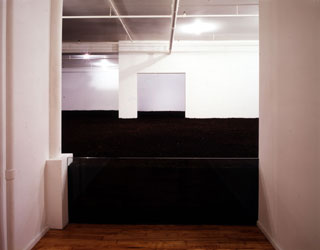
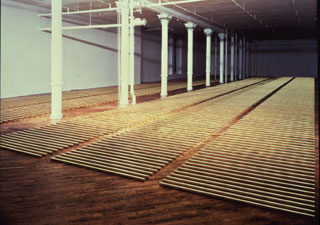
Walter De Maria (American, 1935-), The New York Earth Room, 1977, an interior earth sculpture: 250 cubic yards of earth (197 cubic meters), 3,600 square feet of floor space (335 square meters), 22 inch depth of material (56 centimeters), total weight of sculpture: 280,000 lbs. (127,300 kilos), Dia Center for the Arts, 141 Wooster Street, New York City. The New York Earth Room is the third Earth Room sculpture executed by the artist, the first being in Munich, Germany in 1968. The second was installed at the Hessisches Landesmuseum in Darmstadt, Germany in 1974. The first two works no longer exist. Also see environment art.


Walter De Maria, The Lightning Field, 1977. Isolated in and interacting with the high desert of southwestern New Mexico, the sculpture consists of 400 stainless steel poles situated in a rectangular grid array one mile by one kilometer. A full experience of The Lightning Field depends upon the opportunity to view it alone or with a small group of people over an extended period of time. Dia Center for the Arts, which commissioned and maintains The Lightning Field, schedules overnight visits in advance, limiting groups to six or fewer persons. Also see environment art.


Dennis Oppenheim (American, 1938-), Salt Flat, 1968, photograph, map and typewritten text on cardboard, 28 x 22 inches (71.1 x 55.9 cm), Tate Gallery, London. This work is the documentation of an earth art activity that Oppenheim carried out in New York on 28 November 1968 when he spread 1000 pounds of finely granulated baker's salt on a vacant asphalt parking lot in a rectangle 50 x 100 feet. It comprises a map of Manhattan on which the site is marked with a cross and a circle, a color photograph of the salt in position, with the artist standing beside it, and an explanatory text. The text reads:

SALT FLAT 1968
Location: (part 1) 6th Avenue and 25th Street New York City
1000 pounds of bakers salt 50 x 100 feet on asphalt surface. Identical dimensions are to be transferred in 1 x 1 x 2 feet salt lick blocks to ocean floor off Bahama coast xx and dug to a depth of 1 foot - Salt Lake Desert, Utah.


The Spiral Jetty


Robert Smithson (American, 1938-1973), Spiral Jetty, 1970, black basalt rocks, earth and salt crystals, coil: 1,500 x 15 feet, stretching out counterclockwise into the translucent red water of Great Salt Lake, UT. As yet this has not been done. Spiral Jetty was acquired by Dia Center for the Arts as a gift from the artist's estate in 1999. Robert Smithson's estate maintains a page about this and other works. See volute.


Robert Smithson, Broken Circle, Emmen, Holland, 1971, green water, white and yellow sand flats, diameter 140 feet, width of canal approximately 12 feet, depth of quarry lake 10 to 15 feet.


Robert Smithson, Spiral Hill, Emmen, Holland, 1971, earth, black, topsoil, white sand, c. 75 feet at base.


James Turrell (American, contemporary), Roden Crater, 1972-2000, a natural cinder volcano situated on the southwestern edge of the Painted Desert in northern Arizona. James Turrell is transforming the crater into a large-scale artwork that relates, through the medium of light, to the universe of the surrounding sky, land, and culture.


Richard Long (English, 1945-), A Line Made by Walking, 1967, photograph and pencil on board, image: 37.5 x 32.4 cm, Tate Gallery, London. Long created this earth work by walking back and forth along the same line in a grassy field in Somerset, England, wearing away a thin path, which lasted until the grass grew back again. Long took this photo of his work in order to document it.


Richard Long, Turf Sculpture, 1967, photograph on paper, image: 22.9 x 22.9 cm, Tate Gallery, London.


Andy Goldsworthy (English, 1956-), Cairn, 1997, Herring Island, Australia. See more earth and environmental art on Herring Island.


Andy Goldsworthy, Storm King Wall, 1997-1998, a site-specific sculpture in field stone, 5 x 2,278 feet overall, Storm King Art Center, NY.


oak stacks

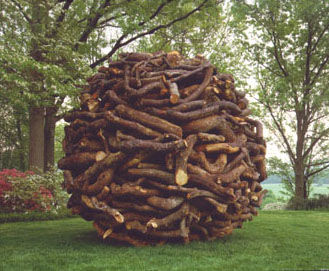
Andy Goldsworthy, one of Two Oak Stacks, 2003, two large balls of stacked and knitted oak sticks, Storm King Art Center, NY. This ball of sticks is directly outside the museum building, visible through the window of the gallery where the other identical ball of sticks was constructed and exhibited. See ephemera, sphere, and wood.


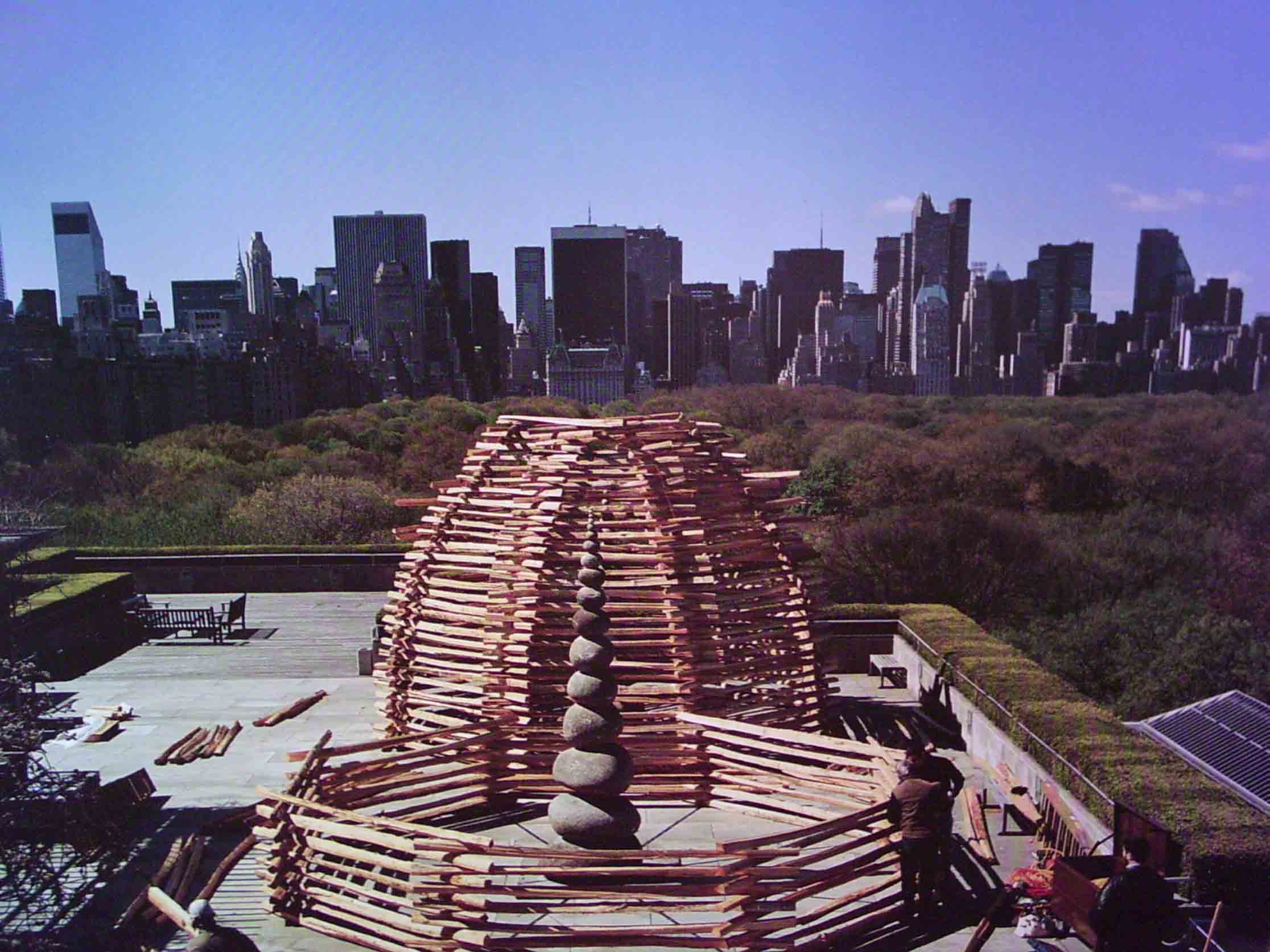
Andy Goldsworthy, Stone Houses, 2004, two monumental domes constructed of wood (split rails from New England agricultural sources) and stone (from Scotland), each 18 feet in height and 24 feet in diameter, Metropolitan Museum, NY. This installation is in the museum's Roof Garden, an outdoor space for sculpture with a great view of the city. The museum says the work was "inspired by Central Park and its architectural backdrop. Inherent in these seemingly simple forms are the implicit power, beauty, mystery, and elemental aspects of nature, marked by the passage of time and by human contact." See sculpture garden.


Wim Delvoye, four pieces:
SUE, IN BAR ROUND CORNER SEE YOU THERE. A.
MUM, KEYS ARE YOU KNOW WHERE
DAVID, JUST POPPED OUT FOR A MOMENT, BACK IN TEN MINS.
TIME TO GO. CATCH YOU LATER, A.
photographs altered so that texts appear to have been carved into living rock, published in the printed and web-based art periodical TRANS> arts.cultures.media, Vol.1/2, No.3/4, 1997.


Earth art's emergence in the 1960s was simultaneous with that of the ecological movement, Arte Povera and process art, with each of which it had a kinship. Earthworks can be considered part of the category of works known as environment art.


Also see conceptual art, entropy, interdisciplinary, and living rock.


Contemporary land artists


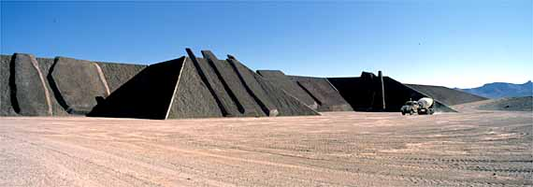
Michael Heizer, a complex in City (1999)Vito Acconci

Betty Beaumont
Eberhard Bosslet
Mel Chin
Walter De Maria
Lucien den Arend
Agnes Denes
Harvey Fite
Andy Goldsworthy
Michael Heizer
Junichi Kakizaki
Richard Long
David Nash
George Papageorge
John Pfahl
Andrew Rogers
Robert Smithson
Alan Sonfist
James Turrell
Nils Udo
Bill Vazan
Elisabeth Wierzbicka Wela
Seth Wulsin

Environment art


- Refers to art which involves the creation or manipulation of a large or enclosed space, many effectively surrounding its audience. Architectural (including landscape architectural) design might be said to qualify as environment art, although the term usually refers to artworks which do not function as either of these kinds of environmental design typically do. Several artists, many associated with American Pop Art — like Edward Kienholz (American, 1927-) and Lucas Samaras (Greek-American, 1936-) — created tableaus in the 1960s and 1970s which were called environments. Many earthworks would qualify as environment art too.


Some examples:


Walter De Maria (American, 1935-), The New York Earth Room, 1977, an interior earth sculpture: 250 cubic yards of earth (197 cubic meters), 3,600 square feet of floor space (335 square meters), 22 inch depth of material (56 centimeters), total weight of sculpture: 280,000 lbs. (127,300 kilos), Dia Center for the Arts, 141 Wooster Street, New York City.


the new york earth room, 1977
250 cubic yards of earth
3,600 square feet of floor space
127300 kilos


lightningfield-top


Walter De Maria, The Lightning Field, 1977. Isolated in and interacting with the high desert of southwestern New Mexico, the sculpture consists of 400 stainless steel poles situated in a rectangular grid array one mile by one kilometer. A full experience of The Lightning Field depends upon the opportunity to view it alone or with a small group of people over an extended period of time. Dia Center for the Arts, which commissioned and maintains The Lightning Field, schedules overnight visits in advance, limiting groups to six or fewer persons.


The broken kilometer, 1979
the broken kilometer, 1979
500 solid brass rods
spaces between rods increase by 5 millimeters with each consecutive space

Walter De Maria (American, 1935-), The Broken Kilometer, 1979, 500 highly polished, round, solid brass rods, each measuring two meters in length and five centimeters (two inches) in diameter. The 500 rods are placed in five parallel rows of 100 rods each. The sculpture weighs 18 3/4 tons and would measure 3,280 feet if all the elements were laid end-to-end. Each rod is placed such that the spaces between the rods increase by 5 mm with each consecutive space, from front to back; the first two rods of each row are placed 80 mm apart, the last two rods are placed 580 mm apart. Metal halide stadium lights illuminate the work: width 45 feet, length 125 feet. Dia Center for the Arts, 393 West Broadway in New York City.


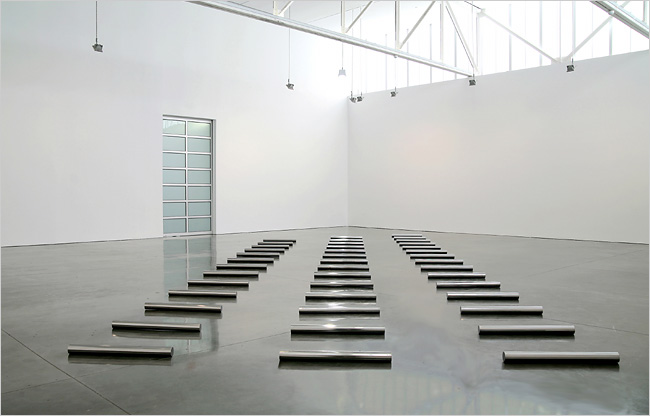
Walter De Maria's "13, 15, 15 Meter Rows," at Gagosian, is one example of the hyperimmaculate big box style of installations in Chelsea.
WALTER DE MARIA AT GAGOSIAN GALLERY, 522 West 21st Street, (212) 741-1717, and 555 West 24th Street, (212) 741-1111. Through May 5.


Gordon Matta-Clark (American, 1943-1978), Splitting: Four Corners, 1974, four building fragments, approximately 57 x 42 x 42 inches (144.8 x 106.7 x 106.7 cm) each, San Francisco Museum of Modern Art. With a chainsaw, Matta-Clark made cuts through entire buildings, and called actions "interventions." He referred to the practice of exposing ambiguities within familiar spaces and ways of seeing "anarchitecture." Most of which we can see today only through photographic documentations, although Splitting: Four Corners is an exception to that rule.

Gordon Matta-Clark, "Splitting: Four Corners", 1974 Four building fragments: wood, plaster, asphalt shingles, saturated felt building paper, tar, asbestos shingles, iron pipe, steel nails, masonite, drywall, paint  The San Francisco Museum of Modern Art; purchased through a gift of Phyllis Wattis, the Art Supporting Foundation to the San Francisco Museum of Modern Art, the Shirley Ross Davis fund, and the Accessions Committee Fund: gift of Mimi and Peter Haas, Niko and Steve Mayer, Christine and Michael Murray, Helen and Charles Schwab, Norah and Norman Stone, and Danielle and Brooks Walker, Jr. © Estate of Gordon Matta-Clark / Artists Rights Society (ARS), New York


Gordon Matta Clark Imitation by amorphity.


Louise Bourgeois (American, born France, 1911-), Articulated Lair, 1986, painted steel, rubber, and metal, overall 9 feet 3 inches x 21 feet 6 inches x 16 feet 1 inches (281.7 x 655.7 x 555.6 cm), Museum of Modern Art, NY. See feminism and feminist art.

"Articulated Lair"


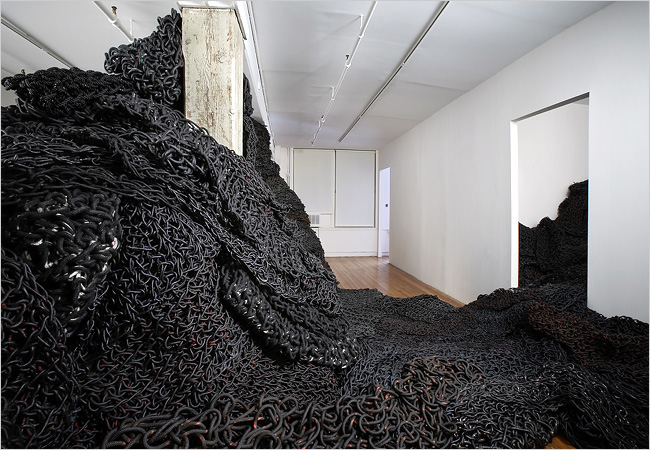
Orly Genger's "Masspeak" piles three tons of nylon climbing rope around the Larissa Goldston Gallery.
ORLY GENGER AT LARISSA GOLDSTON, 530 West 25th Street, third floor, (212) 206-7887. Through May 5.


Also see conceptual art, entropy, gemütlichkeit, installation, interdisciplinary, measure and measurement, and nature.

Electronic art


From Wikipedia, the free encyclopedia


The term electronic art is almost, but not entirely, synonymous to computer art and digital art. The latter two terms, and especially the term computer-generated art are mostly used for visual artworks generated by computers. However, electronic art has a much broader connotation, referring to artworks that include any type of electronic component , such as works in music, dance, architecture and performance. It is an interdisciplinary field and so artists often collaborate with scientists and engineers when creating their works. The art historian of experimental new media art, Edward A. Shanken is documenting current and past experimental art with a focus on the entwinement of art, science, and technology, as are, in France, virtual historians Frank Popper and Dominique Moulon.

Electronic art is often, but not always, interactive. ."


Artists make use of technologies like the Internet, computer networks, robotics, wearable technology, digital painting, wireless technology and immersive virtual reality. As the technologies used to deliver works of electronic art become obsolete, electronic art faces serious issues around the challenge to preserve artwork beyond the time of its contemporary production. Currently, research projects are underway to improve the preservation and documentation of the fragile electronic arts heritage (see DOCAM - Documentation and Conservation of the Media Arts Heritage).

Art Festivals that use the term Electronic Art in their Name
International Symposium for Electronic Art (ISEA), organized approximately every two years since 1988, international;
Ars Electronica Symposium, organized yearly since 1979 by Ars Electronica in Linz, Austria;
Dutch Electronic Art Festival (DEAF), organized yearly since 1994 by V2 Institute for the Unstable Media in Rotterdam, the Netherlands.
Electronic Language International Festival (FILE) organized yearly since 2000 in São Paulo, Brazil.
The Prix Ars Electronica is a major yearly award for several categories of electronic art.


Artists
Notable artists working in electronic art include:

Laurie Anderson
Roy Ascott
Maurice Benayoun
Angie Bonino
Douglas Cooper
Heiko Daxl
Elizabeth Diller and Ricardo Scofidio
David Em
Ken Feingold
Ingeborg Fülepp
Peter Gabriel
Pietro Grossi
Perry Hoberman
Jodi (internet artists)
Eduardo Kac
Knowbotic Research
Liu Dao
George Legrady
Rafael Lozano-Hemmer
Chico MacMurtrie
Sergio Maltagliati
Jennifer & Kevin McCoy
Joseph Nechvatal
Yves Netzhammer
Graham Nicholls
Melinda Rackham
Ken Rinaldo
David Rokeby
Stefan Roloff and * Martin Rev
Don Ritter
Lillian Schwartz
Michael Snow
Stelarc
Survival Research Laboratories
Gianni Toti
Bill Vorn
Norman White

Environmentalism can also be defined as a social movement that seeks to influence the political process by lobbying, activism, and education in order to protect natural resources and ecosystems. In recognition of humanity as a participant in ecosystems, the environmental movement is centered on ecology, health, and human rights.


An environmentalist is a person who may advocate stewardship of the natural environment and the sustainable management of its resources through changes in public policy or individual behavior by supporting practices such as recycling. In various ways (for example, grassroots activism and protests), environmentalists and environmental organizations seek to give the natural world a stronger voice in human affairs.


In recent years environmentalism has frequently been called, or compared to, a religion by its detractors. This is usually done at the same time as pointing out what are perceived as extremist viewpoints or actions of self-identified environmentalists or groups.


Site-specific artフラワー


Site-specific art is artwork created to exist in a certain place. Typically, the artist takes the location into account while planning and creating the artwork. The actual term was promoted and refined by Californian artist Robert Irwin, but it was actually first used in the mid-1970s by young sculptors, such as Lloyd Hamrol and Athena Tacha, who had started executing public commissions for large urban sites (see Peter Frank, “Site Sculpture”, Art News, Oct. 1975). Site specific environmental art was first described as a movement by architectural critic Catherine Howett (“New Directions in Environmental Art,” Landscape Architecture, Jan. 1977) and art critic Lucy Lippard (“Art Outdoors, In and Out of the Public Domain,” Studio International, March-April 1977).


Outdoor site-specific artworks often include landscaping combined with permanently sited sculptural elements (the movement is linked with Environmental art). Outdoor site-specific artworks also include dance performances created especially for the site. Site-specific dance is also created to exist in a certain place. The choreography is generated through research and interpretation of the site’s unique cultural matrix of characteristics and topographies, whether architectural, historical, social and/or environmental; discovering the hidden meaning in a space and developing methods to amplify it. Some artists make a point of commissioning music created by a local composer especially for the dance site. Indoor site-specific artworks may be created in conjunction with (or indeed by) the architects of the building.


More broadly, the term is sometimes used for any work that is (more or less) permanently attached to a particular location. In this sense, a building with interesting architecture could be considered a piece of site-specific art. Artists producing site-specific guikworks include Robert Smithson, Andy Goldsworthy, Christo, Dan Flavin, Richard Serra, Olga Kisseleva, Patricia Johanson, Athena Tacha, Alice Adams, Mary Miss, Jackie Ferrara, Nancy Holt, Rowan Gillespie, Marian Zazeela, Guillaume Bijl, Betty Beaumont and younger artists like Eberhard Bosslet, Mark Divo, John K. Melvin, Leonard van Munster, Luna Nera, Simparch, Sarah Sze, Stefano Cagol and Seth Wulsin. Choreographers who have made important site-specific contributions to the field of dance include Trisha Brown, Meredith Monk, Ann Carlson, Stephan Koplowitz, Joanna Haigood, among others. Contemporary choreographers working primarily in site-specific dance include: Noemie LaFrance; Tom Pearson and Zach Morris of Third Rail Projects; Andrea Haenggi/AMDaT; Tamar Rogoff; Collage Dance Theatre; and Clarinda Mac Low, Paul Benny, and Alejandra Mortorell of TRYST.