Classification of Proteins

Level of Organisation


i) Primary Structure

-the sequence of amino acids in the polypeptide chain

-linked by peptide bonds

Image result for primary structure of protein 


ii) Secondary Structure

-the folding of polypeptide chains into specific shape

- α -helix: coiled polypeptide chain

- β -pleated: folded polypeptide chain

-hydrogen bonds hold the peptide chains in place

-eg:keratin:present in hair and nails


Image result for primary structure of protein


iii. Tertiary structure

-protein is folded into a three-dimensional shape

-shape is stabilized by hydrogen bonds,hydrophobic intereactions,disulphide bridges and ionic bonds

-eg:enzyme,myoglobin
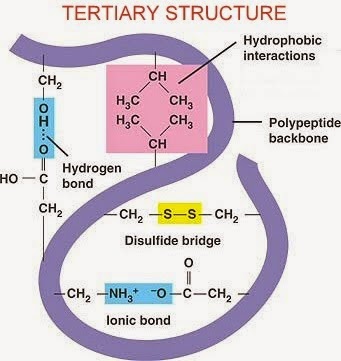
 

Image result for tertiary structure of protein


iv. Quartenary Structure

-more than one polypeptide chain

-forms a three dimensional shape

-hydrogen bonding,ionic bonds,hydrophobic interactions holds maintains its shape

-eg:haemoglobin,an oxygen carrying molecule which is made up of 2 α -helix and 2 β -pleated polypeptides,consists of 4 iron haem group for oxygen binding.


Structure of haemoglobin


Image result for quaternary structure of a protein 


Fibrous vs Globular Protein

 
http://pediaa.com/wp-content/uploads/2018/09/Difference-Between-Fibrous-and-Globular-Protein-Comparison-Summary.jpg
 
Practice Essay Question
Discuss the importance of protein structure for determining enzyme specificity and its mode of action. (6)
 
Suggested Answer:
-enzyme is a globular protein
-each enzyme has precise amino acids sequence,tertiary structure
-hydrophilic R group outside the molecule-soluble in water
-active site of enzyme,catalyses chemical reactions has specific shape and functional groups to bind to substrate
-substrate can bind to active site of enzyme via non-covalent interactions;hydrogen bonding,hydrophobic interactions,Van der Waals interactions
-Changing the protein structure of enzyme will result in denaturation