
Polysaccharides
1. Formed by condensation of monosaccharides.
2. Linked by glycosidic bonds,can be branched or unbranched.
3. Examples are starch,glycogen and cellulose.
Starch
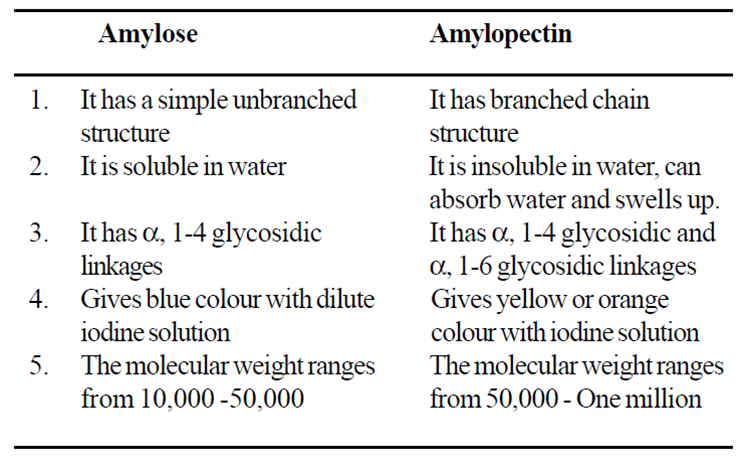
Major storage component in plants.
Consists of amylose and amylopectin.

Glycogen
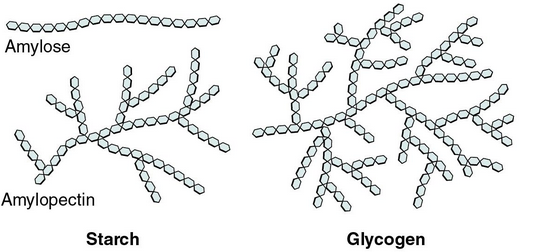
Major storage component in animals.
Has more α -1,6-glycosidic bonds compared to starch (branches)
The branches can be rapidly hydrolyzed for energy requirements
Cellulose
Structural polysaccharide in plant cell walls
Consists of long unbranched ß glucose linked by ß -1,4-glycosidic bonds.
Insoluble in water,thus giving the cell wall its rigidity
Hydrogen bonds form between hydroxyl group of ß glucose molecules on adjacent chains.

Chitin
Structural polysaccharide,component of cell wall in fungi and exoskeletons of arthropods.
A polymer of polymer of N-acetyl-D-glucosamine.
Essay Practice
1. (a)Starch and glycogen are storage components in living organisms. Describe how these components differ from each other.(10)
(b)The term 'insoluble fiber' can be found on some food packages. Explain the meaning of this term and the importances in our diet.(5)