
Joseph-Maurice Ravel (1875-1937)
Joseph-Maurice Ravel – The French composer and conductor, one of the most prominent musicians of the first half of the 20th century, worked in an Impressionist style characterised by elegance and technical excellence. Music theorists consider Ravel one of the best conductors of the century for his ability to create a kaleidoscopic set of sounds in the orchestra.
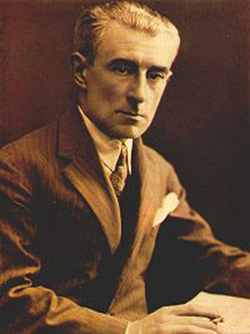 Maurice Ravel was born on March 7, 1875 in Sibur (a city in the Basse-Pyrénées region of France, near the border with Spain). He was the firstborn in the family of Pierre-Joseph Ravel and Marie Deloir. His father had French and Swiss roots, his mother was from an old Basque family. From his father, an engineer by profession, he inherited a sincere passion for music and precision, which became a characteristic feature of Ravel the musician. His mother sang Spanish folk songs to him, in the future, many of Ravel's compositions will be based on the musical heritage of this country.
Ravel grew up in Paris, where his family moved 3 months after his birth. The family lived in the bohemian district of Montmartre, Maurice Ravel began his first piano lessons at the age of seven with the respected composer and performer of the time, Henri Guis. Since 1887, Charles René became his teacher, who taught Ravel, in addition to the technique of execution, harmony, counterpoint and composition. It was during this period that Ravel wrote Variations on a theme by Schumann and the first part Piano Sonatas.

In 1889, Ravel entered the Paris Conservatoire, where he studied piano first with Ch. Antiaume, and from 1891 with C. Berio, studied harmony with E. Pessard. Ravel's first plays (1893) have clearly expressed features of his style, although they are influenced by the music of E. Chabrier and E. Satie, the unusualness of which he admired. In 1897, Ravel studied in the composition class of Gabriel Fauré, at the same time he began to practice counterpoint with André Gédalge. While studying at the conservatory, Ravel made three attempts (1901-1903) to win the prestigious Rome Prize, but unsuccessfully, in 1905 he was denied the right to participate. In connection with this refusal, which was unfounded, a scandal broke out in the Parisian press, which, ultimately, led to the resignation of the director of the conservatory T. Dubois and the appointment of G. Fauré to this position.
Ravel's first work to gain fame was “Pavane to the death of the infanta” (1899 In 1901, a piano cycle appeared “Water play”, This is a new type of French piano piece. String Quartet, four-part work, Ravel dedicated to his teacher G. Fauré.
“Mirrors” – a collection of five plays (musical sketches of nature (“Night Butterflies", "Sad Birds", "Boat in the Ocean", "Valley of Church Bells”) and one is the genre scene (“Alborada”), that offer the listener a considerable amount of refined sensory elements that can be evaluated according to his imagination.

In 1906-1908, such works as vocal “Natural stories”, orchestral “Spanish Rhapsody”, Opera “Spanish Hour”, Piano “Night Gaspard” and “Mother Goose”. In the same years, Ravel began to work on the ballet “Daphnis and Chloe”.
During the First World War, Ravel volunteered for the front and served as an ambulance driver. The hardships of war, combined with the loss of his mother in 1917, left him physically and spiritually weakened. In 1921, feeling the need for solitude, Ravel moved to Montfort-L'Amaury at the Villa Belvedere, fifty kilometres from Paris. There he writes, although less prolific than in previous years, he is engaged in gardening. Ravel was elegant, it is said that he was the first in France to wear shirts in pastel shades, he was distinguished by impeccable manners, he was an excellent conversationalist, but he was never married, believing that artistic temperament was not suitable for marriage.

In 1925, Ravel completed work on the opera-ballet “Child and Magic”, in collaboration with the French writer Colette, it premiered in Monte Carlo in March 1925. In 1928, Ravel toured America - New York, Los Angeles and San Francisco, conducted the best orchestras.
22 November 1928 in Paris on the stage of the Grand Opera took place the premiere of “Bolero”. Dancer Ida Rubinstein invited Ravel to orchestrate pieces with “Iberia” Albeniza. “Bolero” considered the most frequently performed work ever written for orchestra.
In 1932, Ravel began working on a new work - a ballet «Joan of Arc». Starting in 1933, Ravel suffered from a serious brain disease, possibly the result of an injury he suffered in a car accident. The composer's last work was «Three songs» to the film “Don Quixote”.
The composer died on December 28, 1937 in Paris after an unsuccessful brain operation. He was buried in the cemetery of the suburb of Levallois-Perret, in Paris.