Guitar shredding in Japan -2ページ目

Guitar shredding in Japan

.... well, sort of.....

I write this small post to start recording the proceedings of my new "completely crazy" project: I'm tring to build my own guitar!

One day, when I was looking for a way to modify my neck to accomodate some LED I stumbled upon this website: Eguitarplans. The owner of the site started making guitars as an hobby but now he is selling design plans for a fair low price. I guess he is also selling handmade custom guitars.
If you head to the tutorials page you will find a gold mine of tutorials with a very very (very) good, step by step guide to how to build your guitar from scratch. An that's what I started doing right a couple of days ago.

I went to "Conan" department store looking for some cheap wood as I didn't want to spoil some good wood for trying to build my instrument. As I thought, crappy pinewood aplenty was awaiting me for a very low price. I bought wood for making the body, the neck and the fretboard with just 1300 yen!! I found some good looking pieces of wood so I was ready to begin the planning stage.
Fisrt of all, this is the initial shape I designed for my custom guitar, with some measurements to make it feel more comfortable during playing:


I know that it looks like a really crappy design but I wanted some "fancy" shape while keeping things simple for jigsawing the whole thing. For this reason I just used a combination of ellipses and circles. Easy! Well, cutting will not be easy so...
Second step was starting to glue together the wood for the body. I bought three small pieces and glued them together with some wood bond for more than 24 hours. The result is a block big enough to host my guitar body and 3.9 cm thick (a size that can be easily cut out with a standard jigsaw).

While all the parts were gluing together I started measuring my Washburn guitar's neck size and scale to transfer everything on the plans so I ended up with a schematic representation of the neck too which I already transferred on the wood and started sculpting. Here it is:


You can see the tools I used for making the fret marks and for opening the holes for the inlays. For the holes I used those tools widely used for opening holes in the belts and other leather things... I don't know the name, sorry, but you can see one in the pic. The result are 0.5 cm holes that I will fit with 12 abalone inlays. The abalone is shiny but yet dark so I think it will go perfectly with the bare pinewood after the finishing is applied. I just have to look for cheap pre-cut abalone which unfortunately sells pretty high... (._.)

However... that's it for this post: I will try to report my proceedings as soon as I make an advancement in the building process.

Rock on!
Last week I bought a new guitar!

It's a very good one, with custom made pickups and abalone inlets in the neck! And that made me remember that in this blog I've always wrote about the ZO-3 and I have never done a review of my previous guitar!! So, this will not be a post about my new guitar, I will talk you about my "slightly new guitar".

The axe I'm talking about is a Washburn XM DLX2 FRFBB. Of course no way I remember the name of this thing so I had to go and check at the official page here. To make a brighter post I also link here the official image:


As you can see in the picture, my model is the one with the flame black burst (slightly purple to be honest) and the Floyd Rose bridge. Ah, I was about to forget to mention the Ebony fingerboard. It's the first time for me to play on such a dark fingerboard so it was a bit of a shock at the beginning but once you get used to that, well... it's just a fretboard!
The guitar itself has some of a classical body design which for somebody seems to be "boring" or "not aggressive enough" but I find that it just blends a classical feeling with a modern polished design which I like very much. I especially like the headstock with black lined-up machine heads and a really edgy design. By the way the Black Grover 18:1 ratio pegs are really a joy to fiddle with! Compared to those used by Fernandes in the ZO-3 are smooth and sturdy while they can be regulated precisely with the slightest touch. Very nice pegs, it's really a pity that this guitar always stays in tune and I don't need to use them more then every once in a while!
As I mentioned above and as you can see in the picture, this monster is equipped with a Floyd Rose tremolo bridge which was mainly the reason why I found it. I was in fact looking for a spare bridge to try and modify my ZO-3 as I was a bit dissatisfied with the hard tail bridge. After playing a little bit with this guitar I can say that, both bridges have their pros and cons, so I changed my opinion about both the hard tail and the Rose... Bending with a Floyd Rose is a breeze but on the contrary, all the strings get a lower tension and mixing bands and not bends makes an awful mix of sounds... I got accustomed to this thing but I still don't like it very much. Of course is not a guitar-related problem rather a "style vs equipment" matter.
The pups are a couple of custom made Duncan USM Alnico-5 Humbucker pickups which sound great out of the box without any need for an upgrade to get a good sound. I believe that there are of course a lot of better pickups out there but these things are great especially if you think that they came bundled on a low price guitar.

Yes, even if looking at the specs you may be baffled, this is actually a really low price guitar. I got mine in Ishibashi Gakki in Sannomiya (イシバシ楽器三宮店) for the humble price of 23000 yen!!! I dare to say it was almost a robbery; if you go in the shop and play that for some seconds, you immediately realize that this thing is worth more (more) money that the price they are applying so I strongly suggest everybody to go there and buy one. Unfortunately japanese people never read English blogs and will never know this!
If you try to play this guitar in the shop you probably end up plugged to a bad amp and you will definitely have to play it with its ultra high factory string action settings; despite these evident problems, playing some chords will immediately reveal the hidden qualities of this beast. Foremost, the sustain and the tone just "out of the box" are incredible; second, guitar ergonomics (shape and weight) make playing a breeze and the guitar just fits in your hands like if it was your long time favourite. I was amazed by this feeling and bought it immediately.
When I got the guitar home, the VERY FIRST thing I've done was to lower the action. I don't actually understand why makers tend to set that high action on the guitars. I know that the average player does not shred and maybe lowering the action brings out more problems than advantages. BUT! Zero point five centimetres are an exaggeration! Especially on a guitar that was "Bred for shred" as they state on the website. As a result, after lowering the action the guitar I actually unleashed the hidden power of this axe. Riffs really flow free through the slick neck and the tone/sustain vibrations reflects through guitar's body towards yours!
I've always heard that Wasburn guitars were good gear but that doesn't match well with the very few artists that use them.. so I was always wondering whether the reputation was a real or a hype generated one. Now I have one, a cheap one, and basing on my direct experience I just can say only one thing: Go out and buy a fucking Washburn! They're a really good deal for the bucks... I would like to play an expensive one.

In conclusion: Playing a 33000 yen ZO-3 along with a 23000 yen Washburn XM is a mystical experience. It makes you realize the real value of things.... especially if you think that the ZO-3 is 10000 yen (!!) more expensive than the Washburn.

Rock on!
As I don't have time to write down all the guitar-related yak I would like to, I always end up writing about my favourite Japanese band: D_Drive (official site here).

These guys are running all across japan playing in various live houses as they are slowly climbing the road to fame... however, in the meanwhile they're producing a lot of instructional DVD where they try to explain to the widest possible audience some tips about instruments and playing techniques. You can see all of them listed here in the first group on the ATOSS International Instructors page.

The other day (Sunday October 28th) they came to Sannomiya in Kobe again as the new instructional DVD from Shimataro hit the stores on the 27th. It was an event to promote their DVDs but they always make fans happy by playing some of their songs. This time I was particularly happy as they played "Unkind Rain" which is, by any means one of the best songs I have ever heard... not from them, but among all the other bigs! I always get the goose bumps when I listen to that, especially when it is live. I still have to understand why but....OMFG... it is awesome.


Of course when you attend all their events like this you can see a common thread between all of them and, of course they need to do like this to try and capture the more fans they can. According to the last post on Yuki's blog, they seem to be attracting new people, and that's great. I dare to say that they deserve more that "some fans" as the philosophy underlying their music is outstanding and I just discovered that. Yes, in this last mini live.
It seems that the leader of the group (Seiji) is being always asked "why an instrumental band and no vocals" by magazines and the people around, so he tried to explain this choice during the live. Nowadays, it seems that no emphasis is placed on the music-band itself while, technically speaking, before the advent of choruses and so on, music was without lyrics! He used as an example of this concept, the Japanese band AKB48 (google it if you don't know them: at least you can see some pretty girls!!). Here in Japan they're incredibly famous; so famous that they sell millions of CDs every year... yet, they're (all 48) singers. So, the question is: who is playing the music??? There are guitars, keyboards, drums, bass, everything but nobody knows the name of those musicians who, by any means are the guys responsible for the band to be actually capable of "singing". Seiji says to be convinced that an accent should be placed on those behind the curtains, to attract more youngsters towards music and musical instruments and I believe he is damn right.
Probably this is the best thing you can reply to somebody who asks you "why instrumental" as you are actually digging in a big problem.
It seems to me that the "order of importance" in the band comes out reversed somewhat.... for example, how many people thinks that the bass is the coolest element of the band??? Nobody? Nope, I don't think I will have many candidates for this question. The reason is that, nobody listen to the bass! Shimataro said something about always being ignored by the people who always concentrate their attention on the guitars... and of course if you have a vocalist he/she steals the attention even from the guitars! How do people believe that the music can reach their guts?? That's the bass... you remove the bass from a track and you end up with a noisy crappy copy of your favourite song.

People need to be re-educated to listening to music.

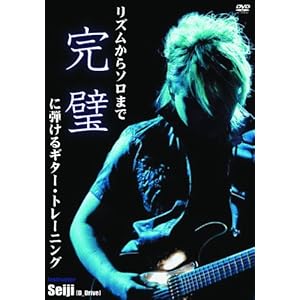
For this reason I feel like suggesting all those interested, to buy D_Drive instructional DVDs as they're really well made. I already went through the first DVD from Yuki and just bought the DVD from Seiji:


In this DVD you can find a dumb proof approach to guitar rhythmics and a kick-ass song break down of their last single 「Russian Roulette」(with TAB!!) which is the perfect tool for studying and applying the lessons in the first part of the DVD. It is very nice to see how easily you can follow this tuition and how all the band members join Seiji during the recording.... (Shimataro: 5+3=?? Seiji.... mmm?? 5???). I've just started to study the song but I don't dare to say that it will be an easy task. It is not a TAB for the faint hearted!!!

Rock on!