
Digital transformation gets discussed in terms of cloud platforms, cybersecurity, analytics, and automation. Yet the physical layer is often where the success or failure of those investments first shows up. A company can buy excellent software and modern network hardware, but if the underlying data cabling is poorly planned, the user experience will still feel slow, unstable, and unpredictable. Video calls freeze. Wi-Fi access points underperform. VoIP phones crackle. Security cameras drop out. Production systems lose visibility for a few seconds at the worst possible moment.

I have seen organizations spend heavily on new applications while treating network cabling as a commodity purchase to be handled late in the project. That approach usually costs more in the long run. A cable plant is not glamorous, but it shapes how resilient, scalable, and serviceable the network will be for years. Good planning in structured cabling tends to disappear into the background, which is exactly what you want. Bad planning becomes a constant source of tickets, workarounds, and renovation costs.
A sound cabling strategy starts with a simple idea: digital transformation changes traffic patterns, device density, uptime expectations, and power requirements. The cabling system has to support not only what the business needs today, but what it is likely to add over the next seven to ten years. That includes collaboration platforms, access control, IP cameras, wireless infrastructure, smart building systems, and sometimes industrial devices that all share the same low voltage cabling pathways.
Why cabling decisions deserve executive attention
Most business leaders do not need to know the difference between CAT6 cabling and CAT6A cabling in technical detail, but they do need to understand how those choices affect budget, performance, and future flexibility. Cabling is one of the few infrastructure investments that usually remains in place through several generations of switches, servers, and wireless hardware. Switches might be replaced every five to seven years. Cabling often stays much longer. If the wrong standard is installed, the building can become the bottleneck.
This matters most during renovation, relocation, or major expansion. Once ceilings are closed, furniture is installed, and departments move in, making changes becomes disruptive and expensive. Running an extra cable during a planned buildout may cost a modest amount. Running it after occupancy often means after-hours labor, ladder work over staff, patching finishes, and finding pathways that were not properly reserved. The same is true for telecom room sizing, rack space, conduit fill, and cable management. Early planning is cheap. Retrofitting is not.
There is also a hidden operational issue. When office network cabling is inconsistent, undocumented, or patched together over time, every future move, add, or change takes longer. Technicians spend time tracing mystery drops, identifying mislabeled patch panels, or discovering that the cable route shares space with electrical noise sources. Those hours rarely appear in the original budget, but they show up month after month in support costs.
Digital transformation changes the load on the physical layer
Traditional office networks were once built around desktop PCs, printers, and a modest number of servers. That model is gone in most environments. A modern floor may include PoE phones, badge readers, digital signage, conference room systems, occupancy sensors, security cameras, wireless access points, and laptops that depend on dense Wi-Fi coverage. In industrial or healthcare settings, the count can climb much higher, with specialized equipment requiring dedicated connectivity and stricter uptime.

The demands are not just about bandwidth. Power over Ethernet has changed network cabling installation in practical ways. Access points, cameras, and building systems increasingly rely on the data cable for both connectivity and power. That affects cable bundling, heat buildup, switch selection, and patching standards. I have walked into projects where the cabling itself met baseline spec, but the design never fully accounted for PoE loads across a dense bundle in a warm ceiling plenum. The result was avoidable performance instability and a hard conversation after occupancy.
Wireless growth has also not reduced the need for ethernet cabling. It has increased the importance of it. Every Wi-Fi access point still needs a cable back to the network. In many refreshed offices, wireless is now the primary edge service for users, which means cabling to those access points needs to be placed deliberately. Mounting location, cable route, telecom room distance, and future access all matter. If access points are installed based only on where a cable is easiest to pull, coverage and roaming suffer.
Cloud adoption creates another misconception. Some teams assume that because applications have moved offsite, the local cabling matters less. In practice, the local network often matters more. The user experience of cloud applications depends on fast, stable access from endpoint to switch to uplink. A weak local foundation can make a high-quality cloud service look bad.
Start with business intent, not cable type
The first question is not whether to deploy CAT6 cabling or CAT6A cabling. The first question is what the space needs to support, now and later. A small professional office with moderate user density, limited PoE, and a five-year lease may justify one design. A healthcare clinic, warehouse, school, or corporate campus expecting high wireless density, surveillance growth, and a ten-year occupancy horizon may justify another.
A practical planning process usually begins with these five areas:
Device count by area, including future growth Application demands, such as voice, video, access control, and high-density Wi-Fi Power requirements for PoE and likely increases over time Building constraints, including pathways, ceiling type, and telecom room locations Service expectations, especially uptime, change frequency, and expansion plansThat sounds straightforward, but it is where many projects go off track. If departments are not interviewed properly, cabling plans often reflect an outdated workplace model. A conference room that once needed two wall outlets might now need a table box, a display connection, an in-room compute device, a touch panel, a camera, and a wireless access point nearby. A warehouse office may need extra drops for scanners, time clocks, cameras, and future automation. A reception area may need redundancy for critical systems and visitor management.
I generally advise clients to think in zones rather than just desks. Desks change. Zones tend to reveal the actual operational pattern of the business.
The practical difference between CAT6 and CAT6A
For many readers, this is the decision that receives the most attention. Both CAT6 cabling and CAT6A cabling can be appropriate, but the right answer depends on distance, speed goals, PoE demands, environment, and budget. Broadly speaking, CAT6 is often suitable for many office applications and can support high performance at typical office distances depending on the use case. CAT6A is bulkier and usually more expensive to install, but it offers stronger headroom for 10 gigabit applications over the full standard channel distance and is often favored for higher-performance, higher-density, or longer-term deployments.
What matters in the field is not just the category on the box. Installation quality determines whether the system performs as intended. Bend radius, pair integrity, termination technique, pathway fill, patch panel quality, and testing all count. I have seen expensive cable underperform because it was installed carelessly, and I have seen well-installed CAT6 outperform expectations because the design and workmanship were disciplined.
CAT6A often makes sense in spaces with a long occupancy horizon, substantial wireless growth, large numbers of PoE devices, or a strong likelihood of 10 gigabit access needs. It can also be the safer choice where future renovations would be highly disruptive. On the other hand, some smaller offices pursue CAT6A everywhere without a clear need, only to discover that larger cable diameter affects tray capacity, patch panel density, and labor time. There is no virtue in overbuilding blindly. The goal is not maximum specification. The goal is appropriate capacity with room to grow.
Pathways, spaces, and the parts people forget
When a business says it needs network cabling, the conversation often focuses on the horizontal runs to outlets. The less visible components are just as important. Conduit, trays, sleeves, ladder rack, patch panels, racks, grounding, labeling, and telecom room layout determine whether the system remains serviceable over time.
Telecom rooms deserve careful attention. If the room is too small, badly ventilated, or shared with unrelated building equipment, operational headaches follow. A cramped room makes every patching change harder and increases the chance of accidental disconnection. Poor cooling shortens equipment life. In some older renovations, I have seen network racks squeezed into janitorial spaces or electrical rooms because no one protected dedicated IT space early in design. That decision tends to haunt the site for years.
Pathway planning is equally important. Cable should not be routed wherever there is an open ceiling tile and a bit of luck. Good pathways reduce strain, improve safety, protect separation from electrical interference, and make future changes manageable. That matters for low voltage cabling in every environment, from offices to schools to light industrial buildings.
Documentation is another underappreciated asset. A labeled, tested, and well-documented structured cabling system saves time every time a change is made. Without that, the business pays repeatedly in troubleshooting labor.
Planning for PoE and device density
Power over Ethernet has become one of the main drivers of cabling design. A single office floor can now include dozens of powered endpoints. Wireless access points, security cameras, intercoms, card readers, and smart lighting controls all change the thermal and power profile of the cabling system.
This is where design judgment matters. A basic business network installation may support current devices comfortably, yet struggle when a client later upgrades to newer access points with higher power requirements. The same issue appears in surveillance projects. A client may start with a few fixed cameras, then add pan-tilt-zoom cameras, analytics appliances, and extra storage connectivity. If the original network cabling installation left no headroom in cable count, rack power, or patching space, expansion becomes messy.
I encourage planners to ask two practical questions. First, what devices are likely to be added even if they are not in the current budget? Second, what would it cost to support them later if no allowance is made now? The answer usually justifies some spare capacity.
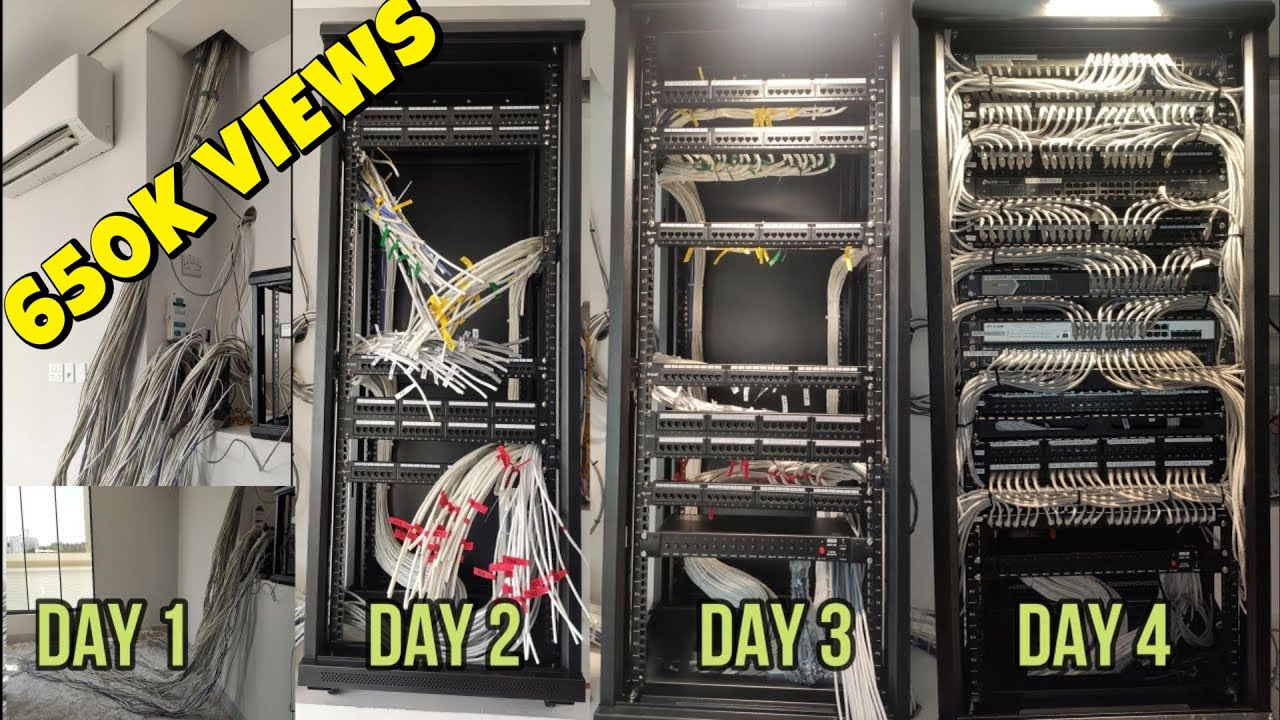
A sensible reserve does not mean turning every office into a data center. It means leaving enough pathway space, patch panel capacity, rack space, and strategic cable coverage to absorb likely growth without tearing open finished spaces.
Renovation projects are where mistakes get expensive
New construction gives teams room to do things properly. Renovation is less forgiving. Existing buildings often come with unknowns: undocumented cable routes, legacy backbone issues, asbestos concerns, overcrowded conduits, or telecom closets that no longer match code or operational needs.
One of the most common errors in renovation work is assuming the old cabling can simply be reused because it "still works." That can be true in limited cases, but it needs verification, not optimism. Age, termination quality, labeling gaps, and unknown damage from previous trades all affect reliability. If the space is central to business operations, relying on old cable without proper testing is risky.
The second common mistake is underestimating disruption. Pulling new data cabling through an occupied office is a very different exercise from working in an empty shell. Noise, access windows, furniture movement, dust control, and user coordination all become part of the project. An experienced installer plans around the business day. A poor one treats the office like a construction site and leaves the client to absorb the disruption.
For renovation work, a few disciplines consistently pay off:
Survey the existing environment thoroughly before final design Verify pathway capacity and telecom room constraints early Test any cable proposed for reuse, then document the results Coordinate closely with other trades, especially electrical and ceiling contractors Phase work to protect business operationsThat list looks simple, but it reflects hard-earned lessons. On occupied sites, coordination failures tend to create the biggest surprises.
Choosing the right installer matters as much as the material
A business can select the correct cable category and still get a poor result if the installer lacks discipline. Structured cabling is a craft as much as a specification. Good installers think ahead https://networkruns108.yousher.com/office-network-cabling-essentials-for-new-commercial-spaces about support, routing, separation, labeling, testing, and maintainability. They do not pull cable like they are trying to finish a race.
When evaluating providers for office network cabling or a broader business network installation, I look for signs of maturity in their process. Do they ask about growth plans, device power, and documentation needs? Do they produce clear as-built information? Do they test every link and provide results in an organized way? Are they careful about cabinet layout and patch management, or do they leave behind a room full of future confusion?
Price pressure often pushes owners toward the lowest bid, especially when cabling appears interchangeable on paper. The problem is that bad workmanship hides well at handover and reveals itself later. Intermittent faults are among the most expensive network problems to chase. A clean certification report, coherent labeling, and a tidy rack are not cosmetic extras. They are signs that the installer took the physical layer seriously.
Design for serviceability, not just day-one operation
The best cabling systems are easy to understand six years later by someone who was not present on install day. That should be the standard. Serviceability affects every MAC, every troubleshooting call, and every small expansion.
This means labels that correspond to drawings, patch panels that match outlet records, logical room layouts, and spare capacity that can actually be used. It also means not packing racks so tightly that simple changes become risky. I have seen beautifully specified projects undermined by cabinets with no working room, no cable slack strategy, and no practical way to add a switch without major rework.
A serviceable system also anticipates that technologies will evolve. Perhaps the company moves toward more cameras, denser Wi-Fi, more segmented security zones, or hybrid work rooms with heavier AV demands. The cable plant should not need to be reinvented every time the business changes direction.
The value of doing it once, properly
There is a budget reality to all of this. Cabling decisions compete with visible items such as furniture, finishes, collaboration tools, and end-user hardware. Yet the least visible investment often supports all the others. Strong data cabling gives the business freedom. It allows IT teams to add services, rearrange spaces, upgrade wireless, and support growth without constant physical limitations.
That is why the best planning discussions tie cabling directly to business outcomes. Faster move-ins. Fewer support incidents. Better meeting room reliability. Smoother adoption of cloud services. Easier security system expansion. Lower disruption during future changes. Those are outcomes executives understand, and they are driven in part by choices made above the ceiling and inside the telecom room.
Digital transformation is often framed as a software journey. In practice, it is also an infrastructure discipline. The companies that handle network cabling, ethernet cabling, and low voltage cabling thoughtfully tend to experience fewer surprises later. Their systems scale more gracefully. Their IT teams waste less time on preventable physical-layer problems. And when the business decides to add the next tool, service, or location, the building is ready rather than resistant.
That is the real goal of cabling planning. Not just passing a test on installation day, but creating a physical foundation that keeps supporting the business long after the ribbon cutting, the migration weekend, and the first round of upgrades are over.
Fontana Tech Pros provides professional network cabling installation, structured cabling, fiber optic installation, commercial WiFi, access control, security camera installation, alarm systems, and phone system solutions for businesses throughout Southern California. Learn more at https://fontanatechpros.com/.
Fontana Tech Pros specializes in reliable network cabling solutions for commercial offices, warehouses, schools, and industrial facilities. Our experienced team delivers high-quality structured cabling and low-voltage installations designed for long-term performance.