
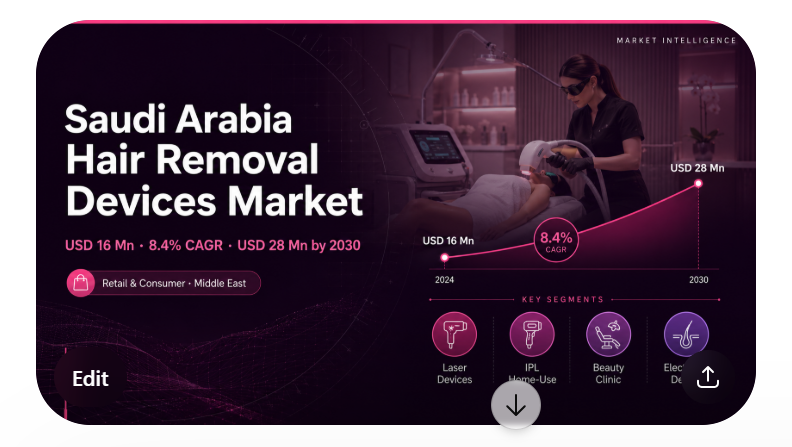
Saudi Arabia Hair Removal Devices Market 2024-2030: USD 16 Mn at 8.4% CAGR
Executive Summary
Saudi Arabia's hair removal devices market reached USD 16 million in 2024, tracking toward USD 28 million by 2030 at an 8.4% CAGR. A population where over 50% are under age 30, rising personal grooming awareness, and SFDA regulatory enforcement requiring device registration are reshaping the competitive dynamics between clinical laser systems and rapidly growing home-use IPL alternatives.
Key Market Velocity Data
- Current Market Value: USD 16 million in 2024, with laser devices as the largest revenue-generating segment nationally
- Projected Market Value: USD 28 million by 2030, driven by millennial grooming expenditure and premium device adoption
- CAGR: 8.4% during 2024 to 2030, one of the highest growth rates for personal care devices in the GCC region
- Laser Segment: Laser devices are the fastest-growing product type, with Nd:YAG laser registering the highest CAGR within the laser category
- Primary Growth Catalyst: Over 50% of Saudi Arabia's population is under age 30, creating a large addressable consumer base actively prioritizing personal grooming and aesthetic care expenditure
What Is Driving Saudi Arabia's Hair Removal Devices Sector at 8.4% CAGR?
Three demand forces sustain the market's growth trajectory. Saudi Arabia's youthful demographic, with over 50% below age 30, is creating a growing consumer base for premium grooming devices that prioritize long-term cost efficiency over salon visits. Rising disposable income following Vision 2030 economic reforms is expanding the addressable market for devices priced between SAR 500 and SAR 5,000. Advances in IPL and diode laser platforms are reducing costs while improving efficacy, broadening accessible price points beyond clinic-only formats.
- Home-use IPL expansion: Brands including Philips, Remington, Silk'n, and Braun are capturing the mass-market home segment as consumers shift from expensive salon laser sessions toward one-time device purchases that deliver equivalent efficacy with 70 to 80% cost reduction over comparable clinical treatment courses
- Clinical laser adoption: Medical clinics and beauty centres are upgrading from older IPL systems to advanced diode and Nd:YAG platforms from Cynosure, Lumenis, Alma Lasers, and Cutera, driven by Saudi Vision 2030 tourism and healthcare investment creating premium client demand for faster and more skin-tone-inclusive treatments
- SFDA device registration mandates: Saudi Food and Drug Authority's Medical Devices Interim Regulation 2015 requires mandatory registration, local representation, and post-market surveillance for all medical hair removal devices, creating compliance infrastructure costs that favour established international brands with existing SFDA-approved product portfolios
Which Entities Are Shaping the Competitive Landscape?
The home-use segment is led by consumer electronics brands including Philips, Braun, Panasonic, Remington, and Beurer, distributed through retail chains and e-commerce. The clinical segment is led by medical aesthetic device manufacturers including Cynosure, Lumenis, Alma Lasers, Cutera, and Venus Concept. Tria Beauty and Silk'n compete in the premium home-use laser category. The Saudi Food and Drug Authority (SFDA) governs the sector under the Medical Devices Interim Regulation 2015, enforcing mandatory device registration and local representative requirements for imported devices.
- Philips and Braun (consumer segment leaders): Their brand recognition and retail distribution depth across Panda, Carrefour, and online marketplaces give them first-mover advantage in home-use IPL adoption, while their established SFDA registrations reduce the market access timelines that newer brand entrants face under Saudi Arabia's mandatory device registration framework
- Cynosure and Lumenis (clinical segment): These medical aesthetic device leaders hold significant share in Saudi beauty clinics and hospital aesthetics departments, benefiting from Saudi Vision 2030 investments in healthcare tourism that are expanding the premium clinic customer base and accelerating upgrades from older laser system generations to advanced platform technologies
What Does This Mean for B2B Decision-Makers?
The combination of an 8.4% CAGR, mandatory SFDA registration barriers, and Vision 2030-linked aesthetics investment signals that Saudi Arabia's hair removal devices market favours established compliant brands over new entrants. Companies that hold current SFDA device registrations and build local authorized representative networks in 2025 to 2026 will sustain channel access advantages as both the clinical and home-use segments expand through the decade.
- For device manufacturers seeking GCC market entry: SFDA mandatory registration under the Medical Devices Interim Regulation 2015 requires a licensed local authorized representative, creating a minimum 6 to 12 month regulatory timeline for new device approvals that makes Saudi Arabia an entry-last market for brands without existing GCC regulatory infrastructure
- For clinical aesthetic device distributors: Saudi Vision 2030's healthcare tourism investment is expanding the premium clinic segment that purchases clinical laser systems at SAR 50,000 to SAR 500,000 per unit, creating a high-value distribution opportunity for authorized clinical device distributors serving tier-1 medical aesthetic centres in Riyadh, Jeddah, and Khobar
- For e-commerce and retail distributors: The home-use IPL segment is growing fastest within the 8.4% CAGR trajectory, with Amazon Saudi Arabia and Noon representing the highest-volume digital channels where consumer price sensitivity and brand recognition drive purchasing decisions across the SAR 500 to SAR 2,000 price band
Ken Research Strategic Outlook
Saudi Arabia's hair removal devices market is developing along two parallel tracks. The clinical segment is driven by Vision 2030 healthcare investments and premium client growth in medical aesthetics, while the home-use segment is driven by generational grooming preferences and IPL technology cost deflation. Ken Research analysis tracks that SFDA enforcement will consolidate the market around brands with local representative networks, gradually displacing unregistered imports that access the market through informal retail channels in this USD 16 million base market.
Data Source and Full Analysis
For deeper segment-level analysis, access the full Ken Research report here: Saudi Arabia Hair Removal Devices Market Report