
Whether you are powering a home router, an office desktop monitor, an external hard drive array, or a network switch, the power adapter doing the job is a component whose quality determines both the reliability and the safety of the equipment it serves. Power adapters fail quietly — often without obvious warning signs — and when they do, the consequences range from mildly inconvenient to seriously damaging. This guide covers what you need to know to select, use, and maintain power adapters for any application.
Fixed-Voltage vs Adjustable-Voltage Adapters
Power adapters come in two fundamental variants: fixed-voltage models that deliver a single predetermined output voltage, and adjustable-voltage models that can be set to multiple output levels via a switch or dial. Fixed-voltage adapters are the appropriate choice for any specific device that requires a precise, regulated voltage — laptops, monitors, printers, and most consumer electronics fall into this category. Adjustable adapters offer flexibility for users who need to power a variety of devices with different voltage requirements, but they introduce the risk of incorrect voltage selection, which can damage equipment. For most home and office applications, fixed-voltage adapters are safer and more appropriate than adjustable alternatives.
Understanding Input Voltage Range: 100-240V
Most quality power adapters sold today are marked with an input range of 100V–240V AC, 50/60Hz. This specification means the adapter is universally compatible with wall outlet voltages found anywhere in the world — from the 100V outlets common in Japan to the 240V supply standard across most of Europe and Australia. This universal input capability is enormously practical for travelers and for businesses that procure equipment from multiple international markets. An adapter marked with only a single input voltage (e.g., "120V") is not universally compatible and will be damaged if connected to a higher-voltage outlet without an additional voltage converter.
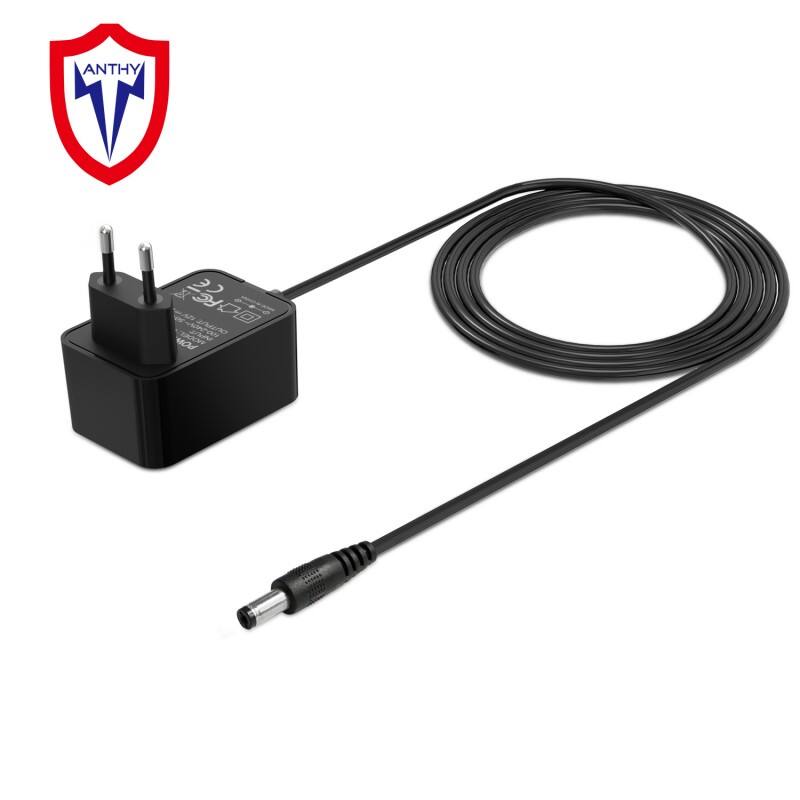
Efficiency Ratings and Operating Cost
Power adapter efficiency — the ratio of usable DC output power to the AC input power consumed — varies significantly between quality tiers. A low-efficiency adapter wastes a meaningful portion of the electricity it consumes as heat, increasing your electricity bill and generating excess heat in your workspace. Energy efficiency standards like Energy Star Level VI require adapters to operate at 87% efficiency or higher under load and to draw less than 0.1W in no-load standby mode. When comparing power adapters, efficiency ratings are a useful proxy for overall build quality: a highly efficient adapter uses better core components and will generally be more reliable and longer-lasting than a low-efficiency equivalent.
Polarity: The Specification Nobody Checks Until It's Too Late
DC output polarity — whether the center pin of the barrel connector is positive or negative — is a specification that is easily overlooked but critically important. Most consumer devices use center-positive polarity (the inner pin of the barrel connector carries positive voltage), but a minority use center-negative configurations. Connecting a center-negative adapter to a center-positive device — or vice versa — will damage or destroy the device's internal circuitry instantly. The polarity standard is indicated by a small diagram on the adapter label showing a circle with a + and − symbol indicating which terminal carries which charge. Always verify polarity matches your device's requirement before connecting any barrel-connector power adapter.
Surge Handling and Electrical Transient Protection
Quality power adapters include components designed to absorb electrical transients — sudden spikes in the incoming AC supply voltage caused by lightning strikes, utility switching events, or large appliances cycling on and off. Varistors (MOV components) are the most common transient-suppression component used in quality adapters. Without adequate transient suppression, voltage spikes pass through the adapter to the connected device, where they can damage sensitive microelectronics. This protection is particularly important for always-on equipment like network infrastructure, external storage systems, and professional workstations that cannot afford unexpected hardware failures. Verify that any power adapter you purchase for critical equipment explicitly lists transient voltage surge suppression in its feature documentation.