
The poultry industry depends on a stable supply of nutritious, safe, and cost-effective feed. As commercial poultry farming expands, feed manufacturers are facing increasing pressure to improve production efficiency, maintain consistent feed quality, and control operating expenses. Establishing a well-designed feed manufacturing facility is therefore an important investment for businesses supplying broiler farms, layer farms, hatcheries, and integrated poultry operations.
Modern poultry feed manufacturing involves more than simply grinding and mixing ingredients. It requires coordinated processing equipment, accurate formulation, controlled conditioning, efficient pellet formation, and reliable finished-product handling. A pellet mill for poultry feed is one of the key machines in this process because it transforms prepared mash into compact feed pellets that are convenient to transport, store, and consume.
However, the performance of a pellet mill depends on the entire production system. Raw material quality, grinding fineness, mixing uniformity, moisture control, and cooling conditions all influence the final product. Understanding these factors helps feed manufacturers select appropriate machinery and develop a production line that meets their specific requirements.

Different Types of Poultry Feed and Their Processing Needs
Poultry feed formulations vary according to bird species, age, production purpose, and nutritional requirements. A commercial feed plant may manufacture several types of products using the same basic processing system.
Broiler Feed
Broiler feed is designed to support rapid growth, muscle development, and efficient feed conversion. It is commonly divided into starter, grower, and finisher feed.
Starter feed is formulated for young chicks and generally requires a suitable fine particle structure or small crumbles. Grower and finisher feed may be produced as mash, pellets, or crumbles according to farm management practices.
Pellet quality is particularly important in commercial broiler production because uniform feed particles can help reduce selective feeding and feed wastage.
Layer Feed
Layer feed is designed to support egg production, eggshell development, and the maintenance of healthy laying hens.
Calcium is an important component of layer diets, while energy, protein, phosphorus, amino acids, vitamins, and trace minerals must also be balanced.
Some layer operations prefer mash feed, while others use pellets or other processed feed forms. The production equipment should be configured according to the customer's preferred product and feeding system.
Breeder Feed
Breeder feed must meet nutritional requirements related to reproductive performance, body condition, and egg production.
Feed manufacturers need accurate batching and mixing systems to ensure that vitamins, minerals, amino acids, and other additives are evenly distributed throughout the finished feed.
Starter Feed for Young Poultry
Young chicks have smaller beaks and different feeding requirements from mature birds. Their feed is often manufactured as fine mash, mini pellets, or crumbles.
A crumbler can be installed after the pellet cooling stage to reduce pellet size and produce a more suitable particle structure.
Main Raw Materials Used in Poultry Feed
The raw material selection process has a direct influence on nutritional value, production stability, and finished feed quality.
Cereal Grains
Corn, wheat, sorghum, and other grains are commonly used as energy sources in poultry feed. Corn is especially popular because of its energy content, availability, and processing characteristics.
Before grinding, grains should pass through cleaning equipment to remove stones, dust, metal fragments, and other impurities.
Plant Protein Ingredients
Soybean meal is widely used as a protein source. Depending on regional availability and formulation requirements, feed manufacturers may also use rapeseed meal, sunflower meal, and other plant-based protein ingredients.
These materials should be evaluated for protein content, moisture, fiber, and other relevant quality indicators.
Animal Protein Ingredients
Some poultry formulas may include fish meal or other permitted animal-derived protein ingredients. Their use depends on local regulations, nutritional requirements, and customer preferences.
Minerals and Premixes
Mineral ingredients, vitamins, amino acids, enzymes, and other additives are incorporated to balance the nutritional profile of the feed.
Because some additives are included at relatively low levels, accurate weighing and effective mixing are essential.
How a Complete Poultry Feed Production Line Works
A commercial poultry feed production line generally consists of receiving, cleaning, grinding, batching, mixing, conditioning, pelletizing, cooling, screening, and packaging systems.
The exact configuration depends on whether the plant produces mash feed, pellet feed, crumbled feed, or a combination of these products.
Raw Material Receiving and Storage
Bulk raw materials are delivered to the factory and unloaded into receiving pits. Bucket elevators, screw conveyors, and other conveying equipment transport them to storage bins or silos.
Storage capacity should be determined according to daily consumption, purchasing arrangements, and production planning.
A well-organized storage system helps maintain a continuous supply of ingredients and reduces unnecessary handling.
Cleaning and Impurity Removal
Raw materials may contain stones, metal pieces, dust, and other foreign materials. A cleaning system removes these impurities before the ingredients enter the grinding process.
Common equipment includes rotary screens, vibrating cleaning machines, and magnetic separators.
Removing contaminants helps protect downstream machinery and improves the reliability of the manufacturing process.
Grinding and Particle Size Reduction
The grinding system reduces the size of cereal grains and other ingredients.
Hammer mills are commonly used in poultry feed plants because they can process various grains and provide adjustable particle sizes.
The required grinding fineness depends on the bird's age, feed formula, and final product specifications. Young poultry generally require a finer particle structure than mature birds, although the ideal size should be determined by nutritional and production considerations.
Grinding equipment should provide consistent output without excessive energy consumption.
Batching and Ingredient Weighing
After grinding, ingredients are transferred to individual batching bins. An automatic weighing system measures each ingredient according to the selected formulation.
Accurate batching is essential for maintaining nutritional consistency. The weighing system should be designed to handle both major ingredients and small quantities of premixes or additives.
Computerized control can simplify formula management and reduce manual operating errors.
Mixing and Homogenization
The weighed ingredients are transferred into a feed mixer.
A double-shaft paddle mixer or another suitable industrial mixer can blend different ingredients into a uniform mash. Mixing performance depends on equipment design, loading rate, mixing time, and ingredient characteristics.
Liquid ingredients such as oils or molasses can be incorporated through controlled spraying systems when required.
Uniform mixing is especially important for formulas containing small quantities of vitamins, minerals, and amino acids.
The Importance of Pelletizing in Poultry Feed Production
Pelletizing converts loose mash into compact particles through mechanical compression. The process can improve feed handling, reduce ingredient separation during transportation, and provide a more uniform product.
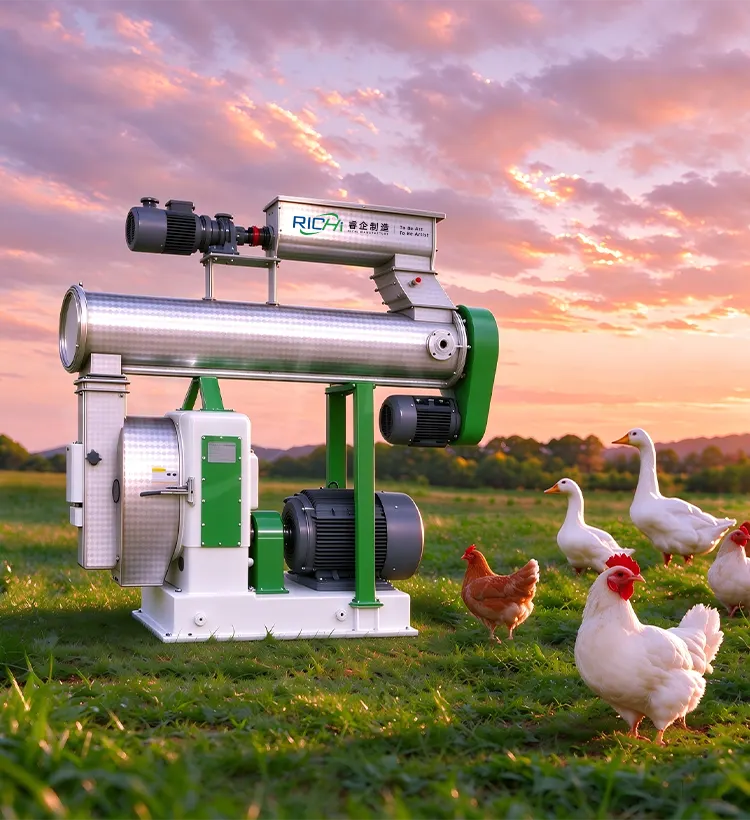
A pellet mill for poultry feed generally uses a feeding system, conditioning chamber, compression rollers, die, and drive mechanism to produce pellets.
How the Pelletizing Process Works
Prepared mash enters the conditioner, where steam and moisture may be added under controlled conditions.
The conditioned material then moves into the pelletizing chamber. Rollers press the mash against the die, forcing it through the die holes. As the material passes through the holes, it forms cylindrical pellets that are cut to the required length.
The finished pellets are discharged from the machine and transferred to the cooling system.
The production process must be adjusted according to the formula, moisture content, pellet dimensions, and desired product characteristics.
Ring Die and Roller Design
Ring die pellet mills are widely used in commercial poultry feed manufacturing.
The ring die contains precision-machined holes that determine pellet diameter and influence compression performance. Rollers apply pressure to push conditioned material through the die.
The quality of the die and rollers affects production stability, pellet consistency, and wear resistance.
For continuous industrial operation, manufacturers should pay attention to die material, heat treatment, machining precision, roller surface design, and maintenance accessibility.
Selecting Suitable Die Specifications
Different poultry products may require different pellet diameters.
Starter feed, grower feed, finisher feed, and layer feed do not necessarily share the same pellet specifications. The die should therefore be selected according to the intended product.
When a plant manufactures several pellet sizes, interchangeable dies can provide greater production flexibility.
The final pellet length can also be adjusted through the cutting system.
Conditioning and Its Influence on Pellet Quality
Conditioning prepares the mash before compression. It can improve material binding characteristics, increase processing stability, and influence pellet durability.
Steam conditioning is commonly used in commercial feed plants. The steam adds heat and moisture to the mash, helping soften the ingredients before they enter the pelletizing chamber.
Several factors should be monitored:
-
Steam pressure and quality.
-
Mash moisture content.
-
Conditioning temperature.
-
Retention time.
-
Ingredient composition.
-
Material flow rate.
Different formulas may require different conditioning parameters. For example, formulas with varying fiber, starch, or fat contents may behave differently during pellet formation.
Operators should avoid using identical settings for every feed product without evaluating actual processing results.
Cooling, Screening, and Crumbling
Pellets discharged from the pellet mill are generally hot and contain elevated moisture. They need to be cooled and stabilized before storage.
Counterflow Cooling
A counterflow cooler is commonly used to reduce pellet temperature and moisture content.
The cooling air moves through the pellet bed to remove heat and moisture. Proper airflow and residence time help prevent excessive temperature differences and reduce the risk of condensation during storage.
The cooler capacity should be matched to the pellet mill output.
Pellet Screening
After cooling, pellets pass through a vibrating screener to remove fines and separate acceptable products.
Excessive fine particles may indicate problems with conditioning, compression, cooling, or material handling. Manufacturers should identify the source of the problem rather than relying only on screening to improve the appearance of the finished feed.
Crumbled Feed Production
When the plant needs to manufacture chick feed, a crumbler can be installed after the cooler.
The machine breaks larger pellets into smaller particles. The resulting material passes through a screening system to obtain the required crumb size.
This configuration allows one production line to manufacture both conventional pellets and crumbled feed, provided that the process and equipment capacities are appropriately designed.
Finished Feed Packaging
Finished feed can be transferred to storage bins before packaging.
Automatic weighing and bagging equipment is commonly used in commercial plants. Depending on customer requirements, feed may be packed into different bag sizes or delivered in bulk.
Dust collection and suitable material handling systems help maintain a cleaner working environment.
How to Select the Right Pellet Mill for a Poultry Feed Plant
Selecting a pellet mill requires evaluating several technical and commercial factors. The machine should match the planned output, raw materials, pellet specifications, and operating conditions.
Production Capacity
Production capacity is one of the first factors to consider.
Small feed workshops may need a compact machine with a relatively low output, while commercial manufacturers often require equipment capable of continuous operation at higher capacities.
RICHI can provide customized poultry feed processing solutions with production capacities ranging from 1 to 100 T/H, depending on the project configuration.
When calculating capacity, buyers should consider daily feed demand, working hours, expected utilization, and future expansion plans.
Feed Formulation
Different formulas have different processing characteristics.
High-fiber materials, high-fat ingredients, and formulas with varying starch contents may influence pelletizing performance. The machine should be selected based on the main ingredients and the expected range of formulations.
Pellet Diameter and Product Type
The required pellet diameter affects die selection and production configuration.
If the plant manufactures several poultry feed products, it may need interchangeable dies, adjustable cutting systems, and additional crumbling equipment.
Machine Construction and Durability
Industrial pellet mills operate under considerable mechanical loads. Buyers should examine the main drive, bearings, rollers, die materials, lubrication system, and safety protection.
Easy access to wear parts and convenient maintenance arrangements can also reduce downtime.
Energy Consumption
Power requirements depend on machine capacity, material characteristics, die specifications, and operating conditions.
A suitable machine should balance output, pellet quality, and energy consumption. Buyers should evaluate the complete production system rather than comparing motor power alone.
(click here:

)
Factors That Affect the Price of Poultry Feed Pelletizing Equipment
The cost of a pellet mill or complete feed processing system varies according to its technical configuration and manufacturing requirements.
Important factors include:
Machine capacity: Higher-capacity equipment generally requires larger drive systems and stronger mechanical components.
Die and roller specifications: Material selection, machining precision, and wear-resistant treatment can affect manufacturing costs.
Conditioning configuration: Different conditioner designs and steam systems may be required for different production applications.
Automation: Automatic feeding, lubrication, control, and monitoring systems may increase the initial investment but can improve operational convenience.
Supporting equipment: A complete production line may include grinders, mixers, conveyors, coolers, screens, crumblers, and packaging machines.
Installation requirements: Electrical connections, foundations, steam supply, workshop conditions, and commissioning arrangements can influence total project investment.
For a more accurate quotation, buyers should provide their desired output, raw materials, feed types, pellet specifications, and available factory space.
Common Problems and Practical Solutions
Even a well-designed feed plant may experience operational problems. Regular inspection and process adjustment are important for maintaining stable production.
Low Pellet Durability
Weak pellets may be caused by unsuitable grinding fineness, insufficient conditioning, poor formulation balance, or worn die and roller surfaces.
The operator should check raw material characteristics, steam conditions, and compression performance before changing machine settings.
Excessive Fine Particles
High fines content can result from weak pellet structure, inadequate cooling, excessive mechanical handling, or incorrect screening settings.
Checking the complete process helps identify the actual source of the problem.
Low Production Output
Low output may be related to inconsistent feeding, blocked die holes, inappropriate moisture content, worn components, or unsuitable raw material preparation.
A balanced production line and regular maintenance schedule can help reduce these problems.
High Equipment Wear
Die and roller wear is a normal part of pellet mill operation. However, abrasive impurities, poor lubrication, incorrect clearances, and unsuitable operating conditions may accelerate wear.
Cleaning raw materials, checking lubrication, and following maintenance procedures can help extend component service life.
Designing a Flexible Facility for Multiple Poultry Feed Products
Many commercial feed manufacturers need to produce more than one type of poultry feed. Some may also plan to manufacture pig, cattle, or aquaculture feed in the same facility.
A flexible plant design should consider the differences in grinding, batching, mixing, conditioning, and pelletizing requirements.
For a facility producing broiler, layer, and chick feed, the process may include:
-
Separate raw material storage for different ingredients.
-
Adjustable grinding fineness.
-
Automatic batching with multiple formulas.
-
Mixing equipment designed for uniform blending.
-
A pelletizing system with suitable die options.
-
A crumbler for young poultry feed.
-
Screening and finished-product storage systems.
-
Packaging equipment suitable for different product specifications.
If the plant also manufactures other animal feed products, additional production arrangements may be necessary to prevent cross-contamination and maintain product quality.
The layout should provide convenient material flow, sufficient maintenance space, and room for future expansion.
Why Choose RICHI for Poultry Feed Processing Projects
Building a commercial poultry feed plant requires more than purchasing individual machines. Equipment selection, process engineering, workshop layout, installation, and technical support all influence the success of the project.
RICHI Manufacture specializes in feed and biomass pelletizing equipment and provides individual machines as well as complete production line solutions.
For poultry feed manufacturing projects, RICHI can assist with:
Customized Process Design
The production flow is developed according to raw material characteristics, feed formulas, capacity requirements, and finished product specifications.
Equipment Manufacturing
The equipment configuration may include cleaning machines, hammer mills, mixers, batching systems, pellet mills, coolers, crumblers, conveyors, and packaging machines.
Overseas Shipping and Logistics Support
Equipment preparation and international transportation arrangements can be coordinated according to the project location and delivery requirements.
Installation and Commissioning
Technical support can be provided for equipment installation, system connection, and production testing.
Operator Training
Training helps local operators understand machine operation, routine inspection, lubrication, troubleshooting, and basic maintenance.
Long-Term After-Sales Service
Technical assistance and follow-up support help customers maintain equipment performance and address operational questions.
Whether the project involves a small poultry feed workshop or a large industrial feed factory, the solution should be designed around actual production requirements.
Frequently Asked Questions
What Is a Pellet Mill for Poultry Feed Used For?
It is used to compress conditioned poultry feed mash into cylindrical pellets. The finished pellets are easier to handle, transport, and store than loose mash.
Can the Same Machine Produce Different Poultry Feed Formulas?
Yes. A suitable pellet mill can process different formulas when the operating parameters and die specifications are appropriate. However, production performance may vary depending on raw material composition and pellet requirements.
What Is the Difference Between Mash Feed and Pellet Feed?
Mash feed consists of ground and mixed ingredients without compression into pellets. Pellet feed is produced by compressing conditioned mash through a die. The two formats have different physical characteristics and may suit different farm feeding systems.
Can One Production Line Make Both Pellets and Crumbles?
Yes. A line can be equipped with a pellet mill and a crumbler to produce both products. Additional screening and conveying arrangements may be required.
What Capacity Should I Choose for a Poultry Feed Mill?
The required capacity depends on the number of poultry farms served, daily feed consumption, production hours, and future business plans. A project-specific capacity calculation is recommended before purchasing equipment.
How Can I Improve Pellet Durability?
Focus on raw material quality, grinding fineness, formula balance, conditioning conditions, die and roller condition, and cooling performance. Pellet durability should be evaluated through appropriate testing.
Does a Poultry Feed Pellet Mill Require a Steam Boiler?
Many commercial pelletizing systems use steam conditioning. A boiler or suitable steam supply system may therefore be required, depending on the machine configuration and process design.
Can I Purchase Only a Pellet Mill Instead of a Complete Production Line?
Yes. Buyers can purchase an individual machine if they already have suitable grinding, mixing, conveying, and cooling equipment. However, the existing equipment should be checked to ensure that it can supply and handle the required output.
What Information Is Needed to Get a Quotation?
Buyers should provide the required capacity, raw materials, feed types, pellet diameter, automation requirements, and workshop conditions. These details help the manufacturer recommend an appropriate machine or complete production line.
Building a Reliable Poultry Feed Production System
A successful poultry feed manufacturing operation depends on the coordination of raw material preparation, accurate formulation, effective mixing, stable conditioning, pelletizing, cooling, and packaging.
A pellet mill for poultry feed is central to pellet production, but its performance is closely connected to the machines and processes before and after it. Selecting equipment based on actual production requirements helps manufacturers achieve more consistent output and manage operating costs.
With suitable machinery, customized process design, and reliable technical support, feed manufacturers can establish production facilities capable of supplying mash, pellets, and crumbled feed for different poultry farming applications.