
Everest Base Camp Helicopter Tour with Kala Patthar Landing: Standing at 5,545 Meters Beneath Everest
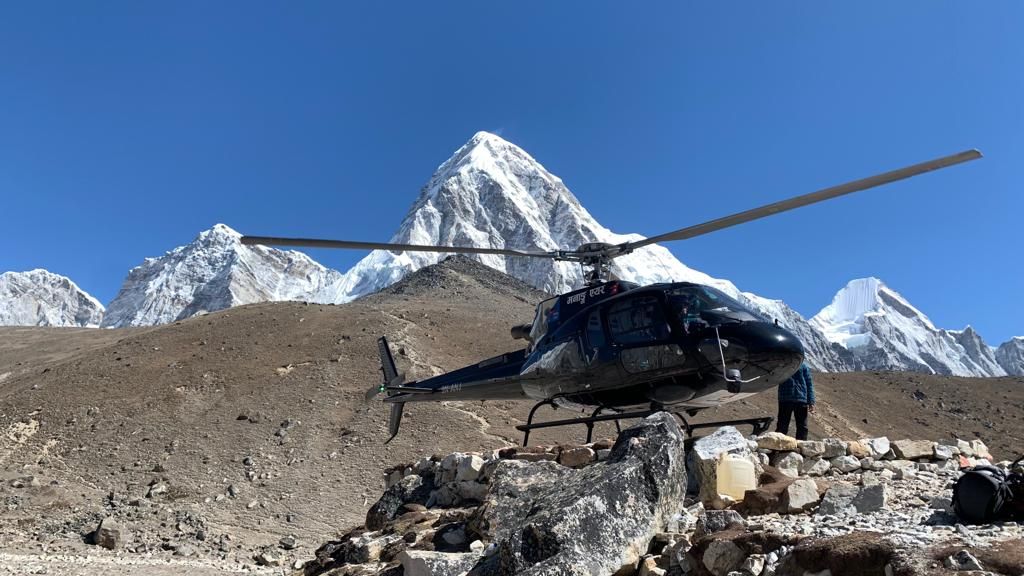
Of all the vantage points in the Everest region, none delivers quite the same view as Kala Patthar. Standing at 5,545 meters, this rocky outcrop offers an unobstructed, eye-level view of Everest’s summit pyramid, a view that Base Camp itself, tucked beneath the Khumbu Icefall, actually doesn’t provide. The Everest Base Camp helicopter tour with Kala Patthar landing builds its entire itinerary around reaching this specific point, flying Kathmandu to Lukla by helicopter before continuing deeper into the Khumbu to land where trekkers typically need days of acclimatized hiking to arrive.
This guide explains why Kala Patthar is the preferred landing point for many helicopter tours, how the journey from Kathmandu unfolds, and what to expect from this specific version of the Everest flying experience.
Why Kala Patthar Instead of Everest Base Camp Itself
Many travelers assume a helicopter tour lands at Everest Base Camp, but Base Camp’s actual terrain, strewn boulders, shifting ice and glacial debris near the Khumbu Icefall, makes it a poor and genuinely risky landing site for aircraft. Kala Patthar, by contrast, offers a flatter, more stable surface and, crucially, a far better view.
From Base Camp at around 5,364 meters, Everest’s summit is largely hidden behind the shoulder of Nuptse. From Kala Patthar, significantly higher and positioned differently relative to the mountain, the summit pyramid of Everest stands fully visible, alongside Nuptse, Lhotse and a sweeping panorama of the Khumbu region. For this reason, most reputable helicopter tour operators land at or near Kala Patthar rather than attempting to touch down at Base Camp itself, even while marketing the trip under the broader “Everest Base Camp helicopter tour” name.
The Journey: Kathmandu to Lukla by Helicopter
Every version of this tour begins with the same dramatic opening leg: the flight from Kathmandu to Lukla.
What Makes This Flight Segment Distinctive
Departing Kathmandu at around 1,400 meters elevation, the helicopter climbs steadily toward the Khumbu region, tracing a path over terraced hillsides, winding rivers and increasingly forested, mountainous terrain. Within thirty to forty minutes, the landscape transforms from the Kathmandu Valley’s dense urban sprawl into the dramatic high-altitude scenery of the Solu-Khumbu district.
Lukla, home to the famously short runway of Tenzing-Hillary Airport, typically serves as a brief stop, either for refueling, a change of passengers, or simply as a waypoint before continuing further into the mountains. Helicopters offer a meaningfully different experience here than fixed-wing aircraft servicing the same general route: lower flight paths, larger windows and far greater flexibility around Kathmandu’s often congested and weather-affected morning flight schedule.
Continuing Beyond Lukla
After Lukla, the helicopter continues further into the Khumbu, often with an additional stop in Namche Bazaar, the main Sherpa trading town and gateway to the higher Everest region, sometimes for a mountain-view breakfast before pressing on toward Kala Patthar itself.
The Kala Patthar Landing Experience
This is the centerpiece of the tour, and for most travelers, the moment that defines the entire trip.
What Happens on Landing
The helicopter typically lands for around 15 to 20 minutes at or near Kala Patthar, enough time to step out onto Himalayan ground at over 5,500 meters, take in the thin, cold air, and photograph a 360-degree panorama that includes Everest’s summit, Lhotse, Nuptse and the broader Khumbu glacier system below.
This brief window is intentional rather than restrictive. Landing at this altitude without gradual acclimatization carries genuine physiological risk if ground time extends too long, so operators limit the stop specifically to minimize exposure to altitude-related symptoms while still allowing a meaningful, unhurried experience of the view.
What the View Actually Includes
Unlike the partially obscured view from Everest Base Camp, the Kala Patthar vantage point offers:
● A direct, unobstructed view of Everest’s summit pyramid, rather than the lower slopes visible from Base Camp
● Clear sightlines to Nuptse and Lhotse, framing Everest within the broader ridge
● A sweeping view down toward the Khumbu Glacier and Base Camp area itself, giving a sense of the terrain trekkers cover on foot
● Views back toward Pumori and the Khumbu region’s western peaks, completing a near-complete mountain panorama
A Typical Full-Day Itinerary
While specifics vary slightly between operators, the standard structure looks like this:
1. Pre-dawn or early morning departure from Kathmandu, timed to take advantage of typically clearer morning mountain weather
2. Flight to Lukla, often with a brief stop
3. Continued flight to Namche Bazaar, sometimes paired with a breakfast stop with mountain views
4. Flight onward to Kala Patthar, with a landing of roughly 15 to 20 minutes
5. Return flight to Kathmandu, retracing the route with sweeping aerial views the entire way
Total trip time generally runs between three and five hours, making this feasible as a single-day excursion even for travelers with limited time in Nepal.
Why Weather Timing Matters So Much for This Specific Tour
Because the Kala Patthar landing is the trip’s defining feature, weather conditions at this specific high-altitude point matter more than for a simple scenic flyover.
● Morning departures are standard, since cloud buildup typically increases through the day, often obscuring the summit view entirely by early afternoon.
● Visibility at Kala Patthar itself can differ from conditions in Kathmandu, since localized mountain weather systems can clear or cloud over independently of the broader forecast.
● Operators frequently build a buffer day into itineraries, allowing a tour to be rescheduled if conditions aren’t favorable for landing or for the summit view itself, rather than proceeding with a flight that reaches Kala Patthar in clouds.
Travelers should avoid scheduling this tour for the same day as an international departure, given the real possibility of a weather-related delay.
Altitude and Safety Considerations
Standing at over 5,500 meters within hours of leaving Kathmandu represents a significant and rapid elevation change, well beyond what the body would typically encounter without days of gradual acclimatization on foot. This is a key reason the landing window is kept brief.
● Report any symptoms immediately, including headache, dizziness or nausea, to the flight crew during the ground stop
● Travelers with underlying heart or lung conditions should consult a doctor before booking
● Reputable operators carry supplemental oxygen on board as a safety precaution
● Comprehensive travel insurance covering high-altitude activity is typically required before booking
Who This Specific Tour Suits
● Travelers who specifically want to see Everest’s summit clearly, rather than the partially obscured view from Base Camp itself
● Photographers seeking the most complete and dramatic Himalayan panorama achievable without a multi-week trek
● Time-limited visitors to Nepal who still want a genuine high-altitude Himalayan experience
● Those physically unable to trek but wanting an authentic encounter with the Everest region’s highest terrain
● Trekkers who’ve completed a shorter regional trek and want to add the Kala Patthar summit view without extending their itinerary further
What to Bring
● Warm, windproof layers, since temperatures at Kala Patthar remain well below freezing even on clear days
● Sunglasses rated for high-altitude UV exposure
● A fully charged camera with ample storage, since the landing window is brief and photo opportunities are concentrated
● Any personal altitude medication, discussed in advance with a doctor if you have a relevant medical history
Conclusion
The Everest Base Camp helicopter tour with Kala Patthar landing offers something genuinely distinct from both a standard scenic flyover and the trekking route itself: a brief but complete, unobstructed encounter with Everest’s summit from one of the best vantage points in the entire Khumbu region. Flying Kathmandu to Lukla by helicopter and continuing on to Namche Bazaar and Kala Patthar compresses what would normally take trekkers over a week of acclimatized hiking into a single, carefully timed day.
Weather remains the deciding factor on any given morning, and the altitude demands genuine respect and preparation. But for travelers seeking the clearest possible view of the world’s highest mountain, without the multi-week commitment a trek requires, this specific helicopter itinerary delivers one of the most remarkable few minutes available anywhere in the Himalayas.