
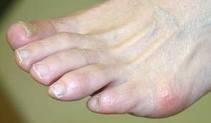
 A bunion is an abnormal bump, or bony enlargement that forms at the base of your big toe. In the early stages, the bunion may be small and the side of your foot may be slightly swollen. As it progresses, the bump gets larger and becomes increasingly painful. Your big toe may point towards your other toes, rather than straight. Shoes may be uncomfortable to wear and add to the irritation of the joint.
 Causes
Wearing footwear that is too tight or causing the toes to be squeezed together are the most commonly blamed factor for the cause of bunions and hallux valgus and is undoubtedly the main contributing factor. This probably is the reason for the higher prevalence of bunions among women. However, studies of some indigenous populations that never wear footwear, show that they also get bunions but they are very uncommon. As they do get bunions, factors other than footwear must play a role in the cause, even though footwear is the main culprit for providing the pressure that causes the symptoms.
Symptoms
Bunions are an often painful condition that may become even more painful as extra bone and a fluid-filled sac grow at the base of your big toe. Some of the most frequently experienced signs and symptoms associated with bunions, besides pain, include redness in your affected area. Blistering over your bunion. Callus formation around your bunion. Bursitis. Nerve damage (numbness and/or sharp pains) in your involved area. Bunions may also cause pain within and below your first metatarsophalangeal, or MTP, joint. Your bunion may become further dislocated and unstable as it progresses and may overload your adjacent joints.
Diagnosis
Bunions are readily apparent, you can see the prominence at the base of the big toe or side of the foot. However, to fully evaluate your condition, the Podiatrist may arrange for x-rays to be taken to determine the degree of the deformity and assess the changes that have occurred. Because bunions are progressive, they don't go away, and will usually get worse over time. But not all cases are alike, some bunions progress more rapidly than others. There is no clear-cut way to predict how fast a bunion will get worse. The severity of the bunion and the symptoms you have will help determine what treatment is recommended for you.
Non Surgical Treatment
In most cases the symptoms of bunions can be reduced or relieved without surgery. Reducing pressure on the bunion is the first step in reducing the pain associated with the condition. Wearing correctly fitting shoes is important in achieving this. A referral to a podiatrist may be made in order to assess the need for special orthotic devices, such as custom-made arch supports and shoe inserts (eg: metatarsal pad or bar). These can help to relieve tension on the base of the big toe and help prevent flat-footedness. Specific exercises and bunion pads available over-the-counter at pharmacies may also be of benefit. Anti-inflammatory medicines can help to ease pain in the short term. Steroid injections may be used to relieve severe pain. If a sufficient reduction in symptoms is not achieved by non-surgical treatment, then surgery may be recommended.
Surgical Treatment
Depending on the severity of the deformity, this osteotomy can be done either at the end of the metatarsal (a distal osteotomy) or if the deformity is more severe, the osteotomy is performed at the base of the first metatarsal (a proximal osteotomy). One of the more common distal metatarsal osteotomies that is performed is called the chevron osteotomy. Typically a small screw is inserted into the bone to hold the metatarsal head in place and speed up bone healing. Following a chevron osteotomy, walking is permitted in a surgical shoe the next day after surgery and the shoe is worn for approximately three to four weeks before a more comfortable walking/running type shoe is worn.
Prevention
There are some steps that may help prevent, or at least slow, the progression of bunions. Avoid shoes with a narrow toe box. If your foot flattens excessively, make sure you wear supportive shoes, and if necessary, get custom orthotics from your podiatrist. See your podiatrist at the first signs or symptoms of a bunion deformity, as early treatment may stop or slow its progression.