
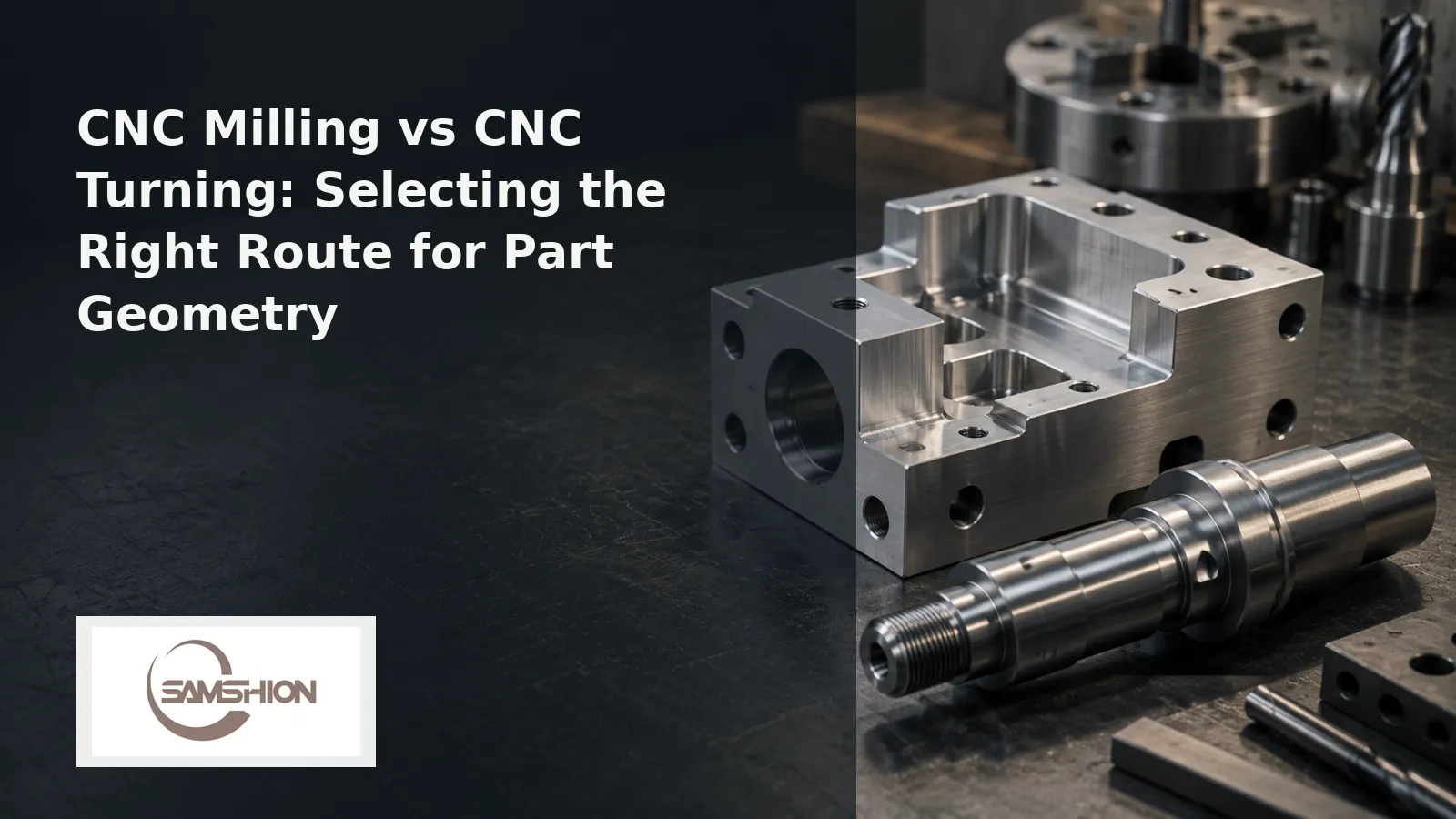
CNC milling and CNC turning are often presented as competing options, but they solve different geometry problems. The best route follows the part’s dominant form, the features that determine function, and the number of controlled setups needed to produce and inspect it.
Choosing the wrong starting process can add avoidable handling, datum-transfer risk, and cost. A buyer does not need to prescribe a machine strategy, but understanding the distinction leads to a better drawing review and a more useful supplier conversation.
Begin with the dominant geometry
Milling removes material with a rotating cutting tool and is a natural starting point for prismatic or multi-face parts: plates, housings, brackets, pockets, holes, threads, and contoured faces. Turning rotates the workpiece and is typically the starting point for shafts, sleeves, flanges, bores, and other geometry organized around a central axis.
The distinction is not absolute. A cylindrical part can have flats, cross holes, or keyways; a prismatic housing can contain precision bores. The practical question is which route establishes the primary functional geometry most efficiently.
Count the setups, not just the operations
Every re-clamping step can introduce a new relationship to manage. A simple part may be economical on three-axis milling even if it needs a flip. Features placed around multiple sides, compound angles, deep cavities, or related datums can justify rotary or multi-axis access when it reduces unnecessary repositioning.
Similarly, a part whose primary concentric features are turned first may later receive milled flats, holes, or side openings. Combining turning and milling can preserve the relationship between axial and non-axisymmetric features when the drawing requires it.
Use functional features to guide the route
Identify the features that control assembly: bearing bores, sealing faces, locating holes, threaded interfaces, mating surfaces, and critical profiles. Then consider tool access, workholding support, deburring, finishing allowance, and inspection access. A process is not “better” simply because it uses more axes; it is better when it can make and verify the required relationships with a sensible plan.
Buyers comparing multi-face parts can review CNC milling services as a starting point for how feature access, setups, and datum relationships affect a milling review.
Account for material and finish before finalizing
Thin walls, flexible plastics, deep pockets, and hard materials change holding and cutting considerations. Surface treatments may affect fitted bores, threads, or grounding areas. These details do not dictate milling or turning alone, but they can change the preferred sequence and where a final operation belongs.
A short drawing note explaining the functional purpose of an interface can be more valuable than an assumed machining route. Suppliers can then discuss a practical sequence before a quote turns into a commitment.
Know when to ask for a hybrid plan
A cylindrical lens barrel with side ports, a flange with complex passages, or a shaft with radial patterns may need both turning and milling. Ask whether the supplier would establish the main rotational geometry first and then finish secondary features in the same controlled plan. For broader prototype-to-production support, SAMSHION outlines CNC, multi-axis, and complementary manufacturing routes that can be evaluated against the part.
A practical comparison
|
Part characteristic |
Likely starting route |
Questions to confirm |
|
Flat faces, pockets, multi-sided holes |
CNC milling |
How many setups are needed? |
|
Shafts, sleeves, concentric diameters |
CNC turning |
Which axis and bore relationships matter? |
|
Cylindrical body plus side features |
Turning + milling |
How will datum transfer be controlled? |
|
Deep cavities or compound angles |
Multi-axis milling review |
Is tool access and inspection practical? |
Before you send the request
-
Circle the features that control assembly.
-
Separate rotational geometry from non-axisymmetric geometry.
-
Mark the drawing datums used for critical relationships.
-
Ask how many setups the proposed route needs.
-
Confirm whether finishing changes any functional dimension.
Questions buyers often ask
Is five-axis milling always more accurate than three-axis milling?
No. Accuracy depends on the complete plan: geometry, workholding, datum strategy, tooling, inspection, and the features being controlled. Five-axis access can reduce setups for suitable parts.
Can a turned part include milled holes and flats?
Yes. Many parts combine rotational primary geometry with secondary milled features. The supplier can determine whether a combined route is appropriate.
What should a buyer provide before asking which process is best?
A current model, drawing, material, quantity, finish, critical features, and an explanation of the intended assembly or function.
The earliest process conversation is most valuable when it happens before a delivery date is fixed. It gives the buyer room to consider geometry changes, alternate stock forms, and inspection access while the CAD model can still be updated without disrupting a release.
A sensible next step
Use the table when reviewing your next drawing, then ask the supplier to explain the proposed route in terms of feature access, setups, and verification.