A new superbug that is resistant to even the most powerful antibiotics has entered UK hospitals, experts warn.

They say bacteria that make an enzyme called NDM-1 have travelled back with NHS patients who went abroad to countries like India and Pakistan for treatments such as cosmetic surgery.

Although there have only been about 50 cases identified in the UK so far, scientists fear it will go global.

Tight surveillance and new drugs are needed says Lancet Infectious Diseases.

Start Quote

The fear would be that it gets into a strain of bacteria that is very good at being transmitted between patients”

End Quote Dr David Livermore Researcher from the HPA

NDM-1 can exist inside different bacteria, like E.coli, and it makes them resistant to one of the most powerful groups of antibiotics - carbapenems.

These are generally reserved for use in emergencies and to combat hard-to-treat infections caused by other multi-resistant bacteria.

And experts fear NDM-1 could now jump to other strains of bacteria that are already resistant to many other antibiotics.

Ultimately, this could produce dangerous infections that would spread rapidly from person to person and be almost impossible to treat.

At least one of the NDM-1 infections the researchers analysed was resistant to all known antibiotics.

Similar infections have been seen in the US, Canada, Australia and the Netherlands and international researchers say that NDM-1 could become a major global health problem.

Infections have already been passed from patient to patient in UK hospitals.
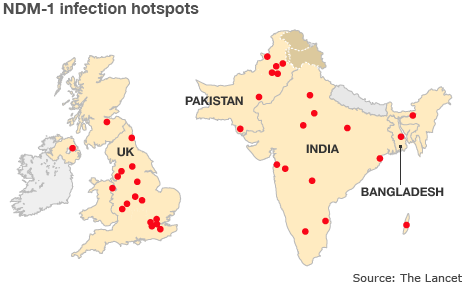
Map showing infection hotspots in the UK and India

The way to stop NDM-1, say researchers, is to rapidly identify and isolate any hospital patients who are infected.

Normal infection control measures, such as disinfecting hospital equipment and doctors and nurses washing their hands with antibacterial soap, can stop the spread.

And currently, most of the bacteria carrying NDM-1 have been treatable using a combination of different antibiotics.

Analysis

The Indian health ministry and the medical fraternity are yet to see the Lancet report but doctors in India say they are not surprised by the discovery of the new superbug.

"There is little drug control in India and an irrational use of antibiotics," Delhi-based Dr Arti Vashisth told the BBC.

Doctors say common antibiotics have become ineffective in India partly because people can buy them over the counter and indulge in self-medication. They also take small doses and discontinue treatment.

Gastroenterologist Vishnu Chandra Agarwal says in the past year he has come across many patients with E.coli infections who have not responded to regular antibiotics.

"In about a dozen cases, I have used a chemical - furadantin - to treat my patients. And it has worked. It makes them horribly nauseous, but it works," he says.

But the potential of NDM-1 to become endemic worldwide is "clear and frightening", say the researchers in The Lancet infectious diseases paper .

The research was carried out by experts at Cardiff University, the Health Protection Agency and international colleagues.

Dr David Livermore, one of the researchers and who works for the UK's Health Protection Agency (HPA), said: "There have been a number of small clusters within the UK, but far and away the greater number of cases appear to be associated with travel and hospital treatment in the Indian subcontinent.

"This type of resistance has become quite widespread there.

"The fear would be that it gets into a strain of bacteria that is very good at being transmitted between patients."

He said the threat was a serious global public health problem as there are few suitable new antibiotics in development and none that are effective against NDM-1.

The Department of Health has already put out an alert on the issue, he said.

"We issue these alerts very sparingly when we see new and disturbing resistance."

Travel history

The National Resistance Alert came in 2009 after the HPA noted an increasing number of cases - some fatal - emerging in the UK.

The Lancet study looked back at some of the NDM-1 cases referred to the HPA up to 2009 from hospitals scattered across the UK.

At least 17 of the 37 patients they studied had a history of travelling to India or Pakistan within the past year, and 14 of them had been admitted to a hospital in these countries - many for cosmetic surgery.

For some of the patients the infection was mild, while others were seriously ill, and some with blood poisoning.

A Department of Health spokeswoman said: "We are working with the HPA on this issue.

"Hospitals need to ensure they continue to provide good infection control to prevent any spread, consider whether patients have recently been treated abroad and send samples to HPA for testing.

"So far there has only been a small number of cases in UK hospital patients. The HPA is continuing to monitor the situation and we are investigating ways of encouraging the development of new antibiotics with our European colleagues."

The Welsh Assembly Government said it would be "fully considering" the report.

"The NHS in Wales is used to dealing with multi-resistant bacteria using standard microbiological approaches, and would deal with any new bacteria in a similar way," said a spokesperson.

Brain works more like internet than 'top down' company


The brain appears to be a vastly interconnected network much like the Internet, according to new research.

That runs counter to the 19th-Century "top-down" view of brain structure.

A novel technique to track signals across tiny brain regions has revealed connections between regions associated with stress, depression and appetite.

The research, in Proceedings of the National Academy of Sciences, may lead to a full map of the nervous system.

Larry Swanson and Richard Thompson from the University of Southern California in Los Angeles, US, isolated a small section of a rat's brain in the nucleus accumbens - a brain region long associated with pleasure and reward.

Their technique hinges on the injection of "tracers" at precise points in the brain tissue. These are molecules that do not interfere with the movement of signals across the tissue, but can be illuminated and identified using a microscope.


Loops not lines

What is new is that the researchers injected two tracers at the same point at the same time: one that showed where signals were going, and one that showed where they were coming from. The approach can show up to four levels of connection.

If the brain has a hierarchichal structure like a large company, as neurology has long held, the "to" and "from" diagram would show straight lines from independent regions up towards a central processing unit: the company's boss.

But instead, the researchers saw loops between differing regions, feeding back to and directly linking regions that were not known to communicate with one another. This is a better fit with the model of vast networks such as the internet.

The region of the brain studied by the researchers displays a network connecting regions associated with stress, appetite and depression.


Such a highly interconnected structure has been hypothesised for some time, and could prove to be a powerful tool in analysing how the brain processes information. But it had not, until now, been demonstrated experimentally.

"You would be amazed at how much of the current experimental neuroscience literature is dominated by 'top down-bottom up thinking', which goes back to the 19th Century, especially in neurology," Professor Swanson told BBC News.

"The bottom line is that no matter what you might think, the circuitry we've shown - that specific set of structural connections - has not been demonstrated before."

The work illuminates just one tiny corner of the vast number of connections present even in a small mammal's brain. But by slightly overlapping one mapped region with another, and mapping that, a far greater picture could emerge.

"This method is repeatable in a sensible way so that neural networks can be followed as far as they go - ultimately to the whole wiring diagram of the brain," Professor Swanson said.

Such a diagram would be boundlessly complex, and the degree to which it could shed light on the more slippery questions of consciousness and cognition is still up for debate.

"We have no idea right now, but the direct analogy is with the Human Genome Project: taking on faith that knowing the complete sequence of human DNA would be a foundation stone for biology, no matter how long the understanding may take to realise in practical terms."

Men and women with large waists are at increased risk of dying young, a US study has found.

This is true regardless of their body mass index (BMI), research published in Archives of Internal Medicine suggests.

But very high waist measurements equivalent to UK size 24-26 in women and XXXXL in men appear to double the risk of mortality.

For the study researchers tracked more than 100,000 men and women aged 50 and older over nine years.

They also found that in women the link between a larger waist and a higher risk of death was strongest for those of normal weight.

More research is needed to find out why this is so, say the authors of the study.

Dr Eric Jacobs and his team at the American Cancer Society in Atlanta examined the link between waist circumference and risk of death among 48,500 men and 56,343 women.

Participants were predominantly white. At the start of the study, the average age of the men was 69 years and of the women, 67 years.

From 1997 until 2006 the deaths of any participants were tracked and the causes noted.

A total of 9,315 men and 5,332 women died during this time.

Whether participants were of normal weight, overweight or obese, researchers found that risk of death increased with increasing waist circumference.

This risk significantly increased in men with waists measuring 110cm or more and in women with waists measuring 95cm or more, the study found.

But it is only in men and women with very large waists (120cm or larger in men and 110cm in women) that the risk of death appears to double during the nine-year study.

The most common cause of death in those with the strongest link between mortality and waist size was respiratory disease, followed by cardiovascular disease and then cancer.

The study concludes: "Our results suggest that, regardless of weight, avoiding gains in waist circumference may reduce risk of premature mortality."

Dr David Haslam, chair of the National Obesity Forum, said the research is important.

"This underlines the message that fat inside the belly is dangerous.

"Even if you have a normal BMI and a big tummy then you are just as much at risk as someone who is classified as obese with a large tummy."

Previous studies have shown that abdominal obesity is a strong indicator for the development of coronary artery disease and is associated with insulin resistance and the development of Type 2 diabetes.

The risk is associated with the fat stores, which are not just under the skin but deep within the abdominal cavity.