


Hello again.,
It's been long time i didn't write anything here, ok.. I'm From Pontianak.. a small city of Indonesia, and i know when we talk about Indonesia. your subconscious mind it will direct to Jakarta or Bali, right ? so maybe you never know about my town... and now let me tell you something about Pontianak city...
Pontianak (Jawi: ڤونتيانق, Chinese: 坤甸市; pinyin: Kūn diān shì) is the capital of the Indonesian province of West Kalimantan. It is a large trading port city on the island of Borneo. Pontianak occupies an area of 107.82 km² in the delta of the Kapuas River. It is located almost precisely on the equator, hence it is widely known as Kota Khatulistiwa (Equator City). The city center is actually less than 3 kilometres (2 mi) south of the equator.
The city was formerly the capital of the independent Sultanate of Pontianak and was founded in 23 October 1771 around an old trading station on the Borneo coast. It is built on swampy ground that is subjected to regular flooding by the river, requiring buildings to be constructed on piles to keep them off the ground. It has its name due to the story that the founder had seen an appearance of Pontianak ghost at the place to be built for the palace, which he fought to save the people. The Japanese massacred much of the Malay and Chinese elite of Pontianak and other Sultanate on Kalimantan in the Pontianak incidents.
Lying directly on the equator with many canals crisscross the city and one of Indonesia’s longest rivers, the Kapuas (1,143 km long) divides the town in two, providing an essential and historical communications link. Stone carvings and ceramics can be traced as far back as the 5th century, but it is the influence of Islam that has had the most impact on this region.
West Kalimantan covers an area of over 146,607 sq km, rich in a variety of minerals and precious stones, and remains largely unexplored. Coastal areas are mainly swamp lands with more than 100 rivers sculpting the flat plains. In the mountainous eastern parts of the province, away from the city and plains, there are many Dayak villages. A large Chinese population, Malays and other Indonesian ethnic groups account for the rest of the inhabitants of the province. West Kalimantan has a tropical climate with the average daily minimum temperature of 220,9 C and maximum 310,05 C. A light rainy season from March - May and the heavy rain from November - January.
What we Can Find in My Town ?
Actually there are many tourist destination in my town, so basically there are no different with other city in Indonesia..

The Equator Monument
The Equator monument is located on the equator in Pontianak, Indonesia. It marks the division between the northern and southern hemispheres. First monument built in 1928 by a Dutch geographer.
The monument consists of four iron wood poles, each with a diameter of about 0,30 metre, with frontage bollard height is two pieces as high as 3,05 radian place backside bollard and the signpost dart as high as 4,40 metres.
Among all countries in the world, only twelve straddle the Equator. While among the countless cities within those twelve countries, only one sits right on this invisible line that separates the earth's southern from the northern hemisphere. Pontianak, capital of the province of West Kalimantan – formerly known as West Borneo - has the distinction of being the only city in the world that sits right on the Equator, a fact that needs no international approval nor agreement. This is the very reason why the Equatorial monument was built here, although Pontianak’s founder, Syarif Abdurrahman Alkadrie was not in the slightest aware of this fact.
Using simple tools and methods, an unnamed Dutch geographer and explorer spearheaded a mission to find a city on the Equator. Eventually, in 1928, he found this city by the longest river in the Indonesian archipelago that was the sole urban setting right on the line of the Equator. He immediately marked the spot on the river bank of Kapuas Kecil (small Kapuas) with a simple pole and an arrow. Only 70 years later, when the monument had passed many renovations and reconstructions, that Indonesia's Agency for Applied Technology made precise studies, made corrections to the exact spot of the Equator using geographic positioning system. Although the difference proved to be quite considerable, yet admiration to the original team of explorers remains and will never be forgotten.
The Equatorial monument was initially built from four ironwood pillars. The ironwood was locally obtained and constructed to keep up an arrow as symbol of orientation or reference. The Dutch word: ‘EVENAAR’ is clearly written on the arrow, meaning ‘equator’, or ‘Khatulistiwa’ in Bahasa Indonesia. It was later recorded that a globe was affixed to it in 1930, and a Dutch officer, by the name of Herman Neijenhuis was assigned to guard the monument from 1936 to 1940. Twice a year, the shadowless sunlight occurs here, as the sun reaches its zenith on the Vernal Equinox (March 21st – 23rd), and the Autumnal Equinox (September 21st – 23rd). These bi-annual events are comemorated here as visitors and locals enjoy a five-minute shadowless moment in the best ‘hot spot’ of Borneo.
The word Borneo is believed to originate from a remark made by Pigafetta and the explorer Magellan’s companions in 1521, giving the name ‘Burne’ to the entire island , described as being an extremely large island, for it took the sailors three months to circumnavigate it. Today, Borneo is a land found to be rich in coal, oil, and gas deposits, and remains one of the largest remaining tropical rainforest reserves in Indonesia.
Most sought after place of interest for tourist visiting Kalimantan. Check out some of the miracle which the caretaker may demo you with the egg thing. At least u get the satisfaction of knowing that u neither on the north or south hemisphere...


Kapuas River
The Kapuas River (or Kapueas River) is a river in the Indonesian part of Borneo island, at the geographic center of Maritime Southeast Asia. At 1,143 kilometers (710 mi) in length, it is the longest river of Indonesia and one of the world's longest island rivers. It originates in the Müller mountain range at the center of the island and flows west into the South China Sea creating an extended marshy delta. The delta is located west-southwest of Pontianak, the capital of West Kalimantan province. This Kapuas River should be distinguished from another Kapuas River, which starts on the other side of the same mountain range in central Borneo, but flows to the south, merging with the Barito River and discharging into the Java Sea.

It's Festival Not War
In every last week of Ramadhan Month, there will be always a special event in here. it called Mariam Karbit.. I think it's very interesting.. because based on history. Sultanate of Pontianak has beating ghost "Kuntilanak" by Mariam and Takbir as we know Sultan Abdurrahman Alkadrie Fought against Ghost in 1771 before he built this town.. In Modern Day, to celebrate that moments Pontianak government made a festival which known as Mariam Karbit. Mariam is Cannon which made by Wood Karbit is Carbide. So It's safety.. because we using a big wood to make Mariam.
Singkawang

If you're Indonesian people which has Chinese descent, you may know Singkawang, so what is Singkawang ?
Located 145 km north of Pontianak , capital of West Kalimantan, Singkawang is the second largest city in the province, bordering the State of Sarawak, Malaysia. Unlike other towns in Indonesia, Singkawang has a distinct oriental atmosphere with hundreds of Chinese temples found around almost every corner of town. This is because over 70% of Singkawang’s population is of Chinese descent, predominantly of the Hakka tribe with some Teochew. Others are Malays, Dayaks and other Indonesian ethnic groups.
In the 18th century, West Borneo lured many from mainland China to the gold mines at Monterado (today called the Bengkayang district). The Chinese came by the thousands, and on their way there they used to overnight in Singkawang. Most settled here and their descendents today form the majority population of Singkawang.
One of the oldest temples here is the Tri Dharma Bumi Raya temple , established in 1878 dedicated to the god of the forest, or Tua Peh Kong.
Normally a quiet city, Singkawang comes alive each Chinese New Year, reaching its climax at Cap Goh Meh, or the fifteenth day of Chinese New Year, closing the celebrations. For this event, Chinese from around the region, including those from Java and Sumatra but also from Singapore and Malaysia flock to Singkawang to celebrate the event with family and friends.
During these celebrations the Tatung or Chinese shamans will perform their supernatural prowess to the thousands gathered along the streets, while remaining totally unharmed. However, before performing their feats they first pray for blessing at the temple of Toa Peh Kong. (Tatungs are people endowed with supernatural powers performing during the Cap Go Meh Festival in Singkawang, ‘the city of a thousand shrines’, in West Kalimantan. Two of the tatungs are seen bending a sharp sword with their abdomen, remaining completely unharmed.)
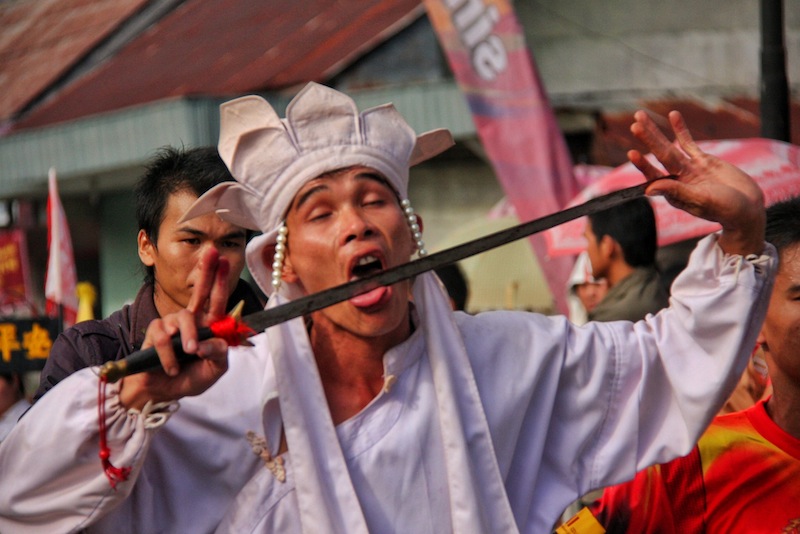

Tatungs
Before you visit West Borneo I recomended you to come at Lunar Year, why ? because The 15th day of the Lunar New Year, or better known here as “Cap Go Meh”, forms the highlight of any Chinese New Year celebrations in Indonesia. This is most elaborately held in areas with a large ethnic Chinese population such as in West Kalimantan, Bangka-Belitung and Palembang or in the Chinatowns of Semarang, Surabaya, Jakarta, Bandung, Manado and Medan.
In West Kalimantan, the Cap Go Meh, which this year falls on 24th February 2013, will be celebrated with a vibrant festival in the exotic city of Singkawang.
More than one month before the event, hotels in the city already report full bookings.
Known for its production of fine Chinese ceramics, Singkawang, known for its hundreds of Chinese temples, will have a lantern parade that will take place on the eve of the Cap Go Meh celebrations. As always, the peak of the festival and of the entire New Year series of celebrations will be highlighted with the parade of the ancient art of Tatung.
Intended to repel misfortunes for the rest of the year, Tatung is the principle medium of the Cap Go Meh ritual to reject evil spirits. During the Tatung rituals, its participants will enter into a trance and perform many unbelievable stunts, such as stepping on a sword, or sticking steel wires or nails into their cheeks. It is quite unbelievable to see that despite such torture, the Tatungs are not wounded or even scarred.

Rumah Radankg Replicant
The indigenous inhabitants of Kalimantan are the Dayak tribes, once notorious for collecting enemy heads as part of their warfare. Those times a long gone; nor do many Dayaks still live in a traditional Longhouse (Rumah Betang, and Radankg). If you have no time to visit a real one, go see the replica in Pontianak.
Rumah Radankg has became one of tourist Destination, which location at Kota Baru, and became one of Community Base camp, you can meet a various of community in Rumah Radankg. such as Photographer, Magic, Movies and many thing.


The Equator Monument1449681193328