
India SpaceTech Market Hits USD 9.9B on IN-SPACe and Private Rocket Surge | Ken Research
The defining shift in India SpaceTech is not coming from ISRO alone. It is coming from a private space ecosystem anchored by Skyroot's Vikram-S launch, Agnikul's 3D-printed engines, Pixxel's hyperspectral satellites, and the INR 1,000 crore IN-SPACe VC Fund. As per Ken Research market modelling, the India SpaceTech Market is valued at approximately USD 9.9 billion in 2024, with satellites as the dominant component. The complete segment forecast, startup share, and Bengaluru hub mapping are in the India SpaceTech Market Report.
This analysis draws on data from Ken Research market modelling, IN-SPACe Indian National Space Promotion and Authorization Centre disclosures, Department of Space policy framework, and independent spacetech sector benchmarking.
USD 9.9B Market with Satellites Dominant and USD 44B 2030 Target Anchor
The growth anchor is government ambition combined with private capital. As tracked by Ken Research modelling, satellites lead the component mix and communications leads the application mix. The Indian government targets growing the space economy from USD 8.4 billion in 2022 to USD 44 billion by 2030, capturing 8-10% of global share. India SpaceTech parallel research projects 11.2% CAGR to USD 20.99 billion by 2030. For investors mapping adjacent aerospace MRO, the Indonesia Aerospace and Defense MRO Market shows the same aerospace value-chain build-out compounding regionally.
- Satellite leadership: Satellites dominate component mix with communications as the leading application.
- Gov target: Space economy from USD 8.4 billion 2022 to USD 44 billion by 2030, targeting 8-10% global share.
- CAGR projection: India SpaceTech at 11.2% CAGR to USD 20.99 billion by 2030 per parallel research.
Skyroot, Agnikul, Pixxel, Dhruva Space and ISRO Anchor India SpaceTech Stack
The map blends public sector and private startups. As estimated by Ken Research, ISRO, NewSpace India Limited (NSIL), and Antrix Corporation anchor the public stack, while Skyroot Aerospace (raised approximately USD 160 million), Pixxel (USD 96 million), Agnikul Cosmos (USD 75 million), Dhruva Space, L&T, Godrej Aerospace, HAL, Tata Advanced Systems, and BEL serve private and defense aerospace. The Union Cabinet approved a INR 1,000 crore Venture Capital Fund in October 2024 under IN-SPACe, per the IN-SPACe Indian National Space Promotion and Authorization Centre portal.
- Private leaders: Skyroot's Vikram-S was India's first private rocket launch.
- Engine tech: Agnikul's semi-cryogenic 3D-printed engine from private Sriharikota launchpad.
- Earth observation: Pixxel's hyperspectral satellites tracking crop health, pollution, and climate.
- Ground services: Dhruva Space received IN-SPACe authorization for Ground Stations as a Service (GSaaS).
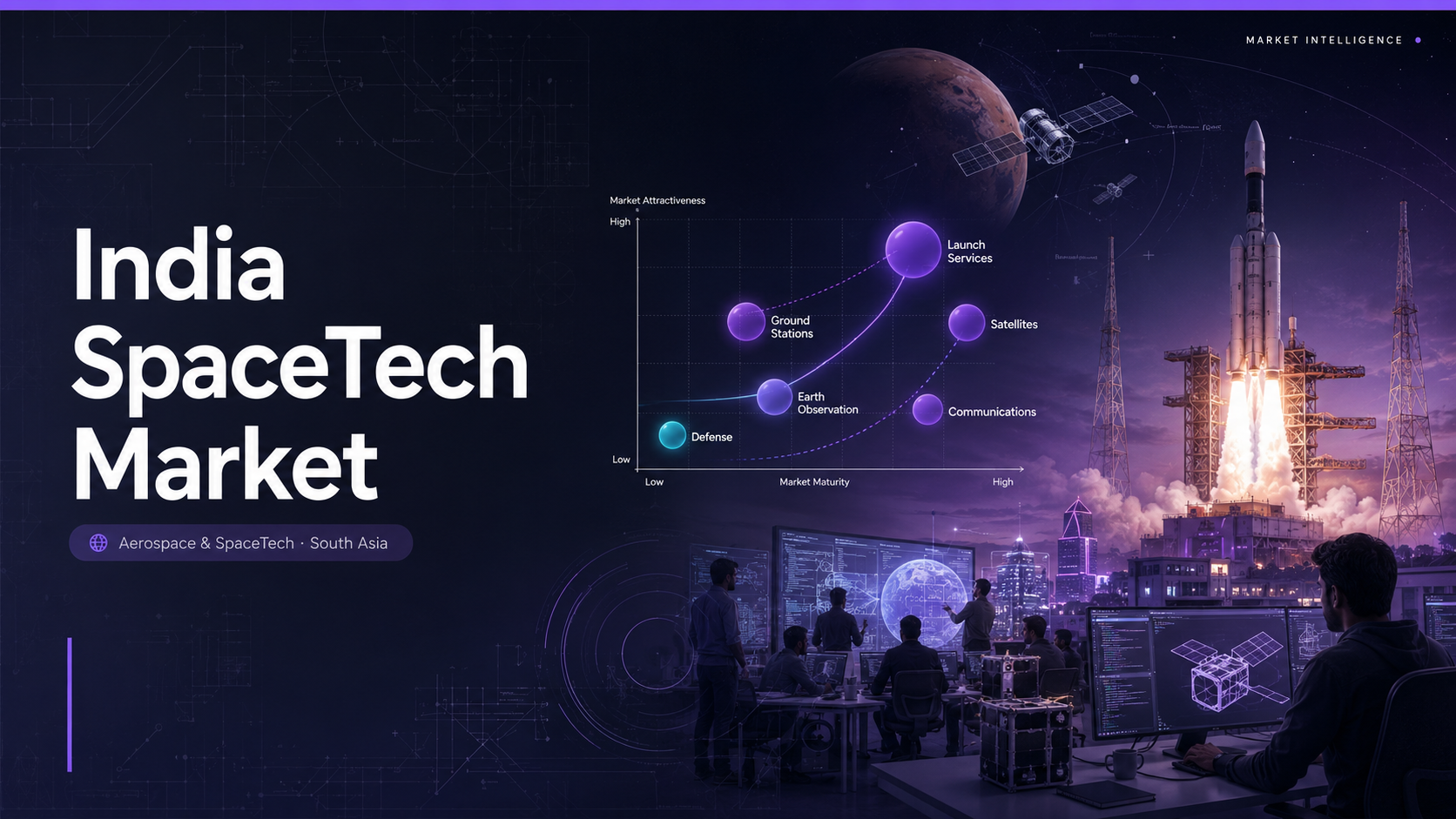
Need the segment-by-segment share across launch, satellites, ground stations, earth observation, and defense plus startup share? Download Sample Report for Bengaluru hub mapping and IN-SPACe pipeline forecast.
Why Is IN-SPACe Reshaping India Private SpaceTech by 2030?
IN-SPACe authorizes private participation across launch, satellites, ground stations, and applications. According to Ken Research analysis, the INR 1,000 crore VC Fund announced October 2024 unlocks growth capital for early-stage spacetech startups, with Bengaluru hosting over 55% of national space startups. The combined effect lifts India's share of the USD 440 billion global space market through 2030.
India SpaceTech Outlook to 2030: USD 9.9B Base, USD 44B Target, and Bengaluru Hub Anchor
Three drivers anchor the forward view. Per Ken Research modelling, IN-SPACe VC Fund, private launch milestones, and earth observation commercialization together compound the spacetech book. For investors mapping adjacent India tech, the India EdTech Market shows the same private-capital-driven scaling thesis compounding across Indian deep tech.
- Gov target: USD 44 billion by 2030 from USD 8.4 billion 2022.
- Private capital: Top 3 (Skyroot, Pixxel, Agnikul) raised over USD 330 million combined.
- Bengaluru hub: 55%+ of national space startups concentrated in Bengaluru.
What Startups, Investors, and Government Bodies Must Do Before IN-SPACe VC Fund Lock
The combined effect of IN-SPACe VC Fund, private launch milestones, and global market opportunity creates a multi-year positioning window. Startups, investors, and government must move before Skyroot, Agnikul, Pixxel, and Dhruva Space lock dominant categories.
- Startups: Apply for IN-SPACe authorization across launch, satellites, ground stations, and applications.
- Investors: Track Skyroot, Pixxel, Agnikul, and Dhruva funding rounds to access INR 1,000 crore VC Fund co-investment.
- Government: Accelerate IN-SPACe authorization to unlock the USD 44 billion 2030 target.
Building an India SpaceTech startup or capturing IN-SPACe authorized contracts? Access the India SpaceTech Market Report for startup share, segment forecasts, and Bengaluru hub mapping.
Conclusion
India SpaceTech has entered a private-capital-led inflection where Skyroot, Agnikul, Pixxel, Dhruva, and IN-SPACe VC Fund compound on the same spacetech stack. The startups that lock IN-SPACe authorization and private capital ahead of the 2030 reset will defend share rather than chase it. For investors and government, the strategic question is no longer whether SpaceTech wins, it is who anchors the next launch or satellite contract. Access the India SpaceTech Market Report for the full landscape.
Frequently Asked Questions
Q1: What is the size of the India SpaceTech Market?
The India SpaceTech Market is valued at approximately USD 9.9 billion in 2024 per Ken Research market modelling, with satellites as the dominant component and communications leading the application mix.
Q2: Who are the key spacetech players in India?
Leading players include ISRO, NSIL, Skyroot Aerospace, Agnikul Cosmos, Pixxel, Dhruva Space, L&T, HAL, Tata Advanced Systems, and BEL. For comparable APAC cloud tech dynamics see the APAC Cloud Professional Services Market.
Q3: Which segment leads India SpaceTech?
Satellites lead the component mix per Ken Research estimates, with launch services, earth observation, and ground stations growing fastest under IN-SPACe authorization.
Q4: What is driving growth in India SpaceTech?
Growth drivers include IN-SPACe's INR 1,000 crore VC Fund (October 2024), Skyroot's Vikram-S private rocket launch, Agnikul's 3D-printed engines, Pixxel's hyperspectral satellites, and India's target of USD 44 billion space economy by 2030.
Q5: How does IN-SPACe affect India SpaceTech?
IN-SPACe authorizes private participation across launch, satellites, ground stations, and applications, with the INR 1,000 crore VC Fund unlocking growth capital for early-stage spacetech startups in Bengaluru and beyond.
For the full competitive benchmarking, startup share, and Bengaluru hub breakdown, access the India SpaceTech Market Report from Ken Research, a leading market intelligence firm covering aerospace and deep tech across South Asia.