
Vietnam Nutritional Health Foods Market Outlook 2024-2030: Growth and Players
Executive Summary
Vietnam's nutritional health foods market is scaling fast as preventive health goes mainstream. An aging population, rising disposable incomes, and e-commerce are pushing the market from USD 2,800 Million in 2024 toward USD 4,830 Million by 2030, drawing local champions and global supplement brands into a premiumizing category.
Key Market Velocity Data
- Current Market Value: USD 2,800 Million in 2024
- Projected Market Value: USD 4,830 Million by 2030
- CAGR: 9.5% during 2025 to 2030
- Largest Segment: dietary supplements at 31.8% of the market
- Primary Growth Catalyst: aging population, preventive health, and e-commerce
What Is Driving Demand in the Vietnam Health Foods Market?
Demand is compounding on three fronts. Vietnam's 60-plus cohort reached 14.2 million in 2024, lifting demand for preventive and functional nutrition, while lifestyle risk is rising as the obesity rate hit 19.5% in 2021. E-commerce, with about USD 25 Billion in retail sales in 2024, is widening access far beyond pharmacies, and dietary supplements already hold 31.8% of the market.
- Demographic shift: a 14.2 million senior cohort drives steady demand for preventive and condition-specific nutrition.
- Lifestyle risk: an obesity rate of 19.5% in 2021 pushes weight management and functional foods.
- Channel change: e-commerce at USD 25 Billion in retail sales moves supplements into mainstream online baskets.
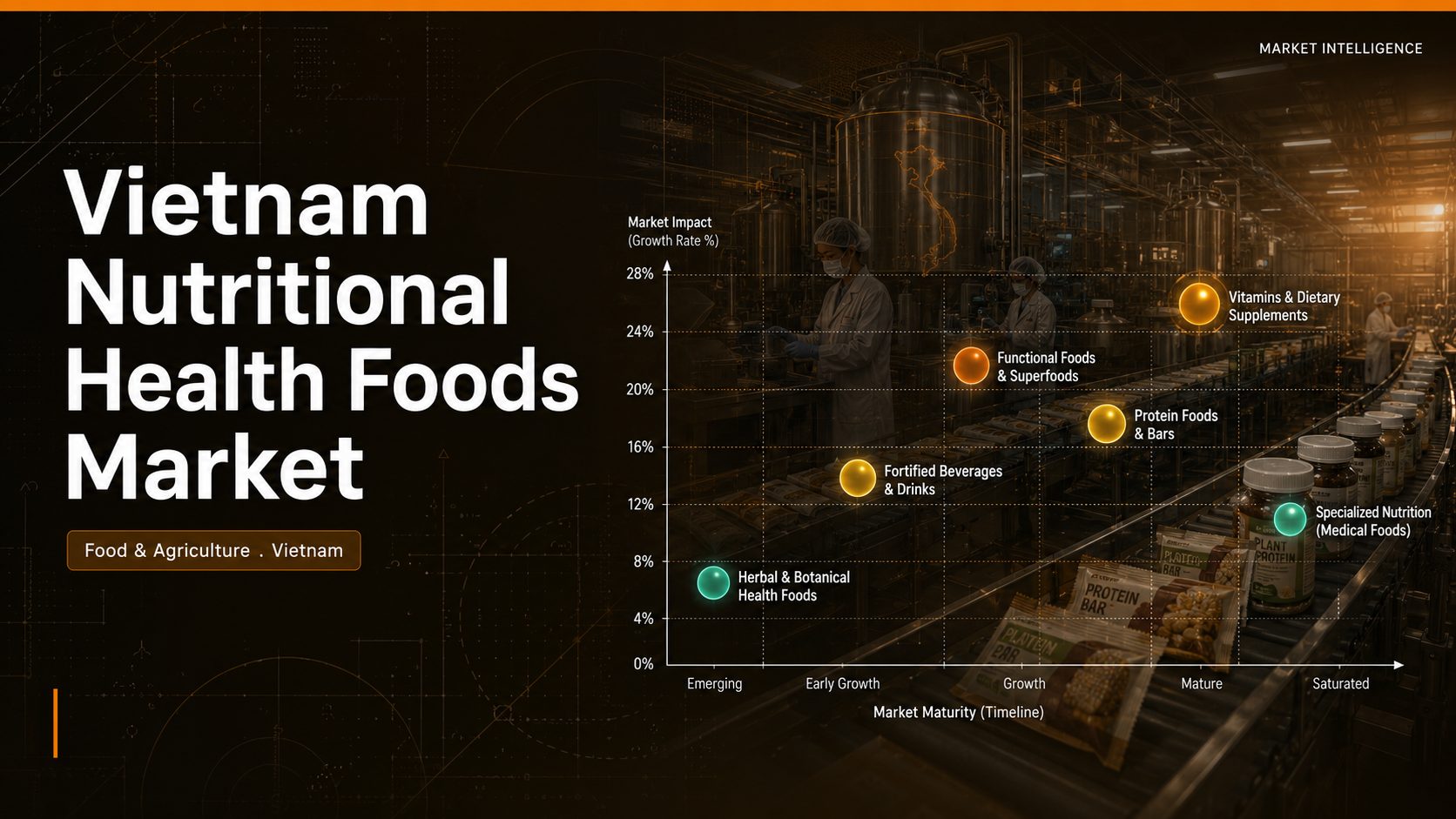
- Segment momentum: sports nutrition is the fastest-growing category at a 14.5% CAGR.
How Do Regulation and Registration Shape the Market?
Regulation is tightening and rewards scale. The Vietnam Food Administration, under the Ministry of Health, oversees the category, with Circular 43/2014 defining functional foods and Decree 15/2018 setting a 21-working-day product declaration process (Vietnam Food Administration). GMP certification is mandatory for production.
New standards raise the bar further. QCVN 20-1:2024/BYT, the national technical regulation on contaminant limits for health supplements, takes effect on August 1, 2025, while a draft decree to replace Decree 15 is expected by July 2026. Compliance cost favors established players over informal sellers and small importers.
Which Companies Are Shaping the Competitive Landscape?
Foreign direct-selling brands lead share. Herbalife holds the largest position at 11.2%, followed by Traphaco at 7.9%, Amway at 5.1%, Nu Skin at 4.9%, and DHG Pharma at 3.6%. Their multi-level distribution and brand trust anchor the premium tier of the market. This direct-selling model gives them deep rural and tier-2 reach that traditional retail struggles to replicate.
Domestic majors are expanding from adjacent categories. Vinamilk and TH True Milk leverage dairy trust to enter functional nutrition, Nutifood scales pediatric and adult formulas, and Nestlé Vietnam adds global R&D. Local players hold close to 70% of volume, while foreign brands command roughly 30%, concentrated in premium price points. The result is a barbell market, with trusted local mass brands below and premium foreign labels above.
What Does This Mean for B2B Decision-Makers?
For manufacturers, importers, and investors, Vietnam is a high-growth but increasingly regulated market, and compliance plus channel reach now decide margin. With the market moving from USD 2,800 Million toward USD 4,830 Million by 2030 at 9.5% CAGR, the runway is strong, but registration timelines and new contaminant standards raise the entry bar. Early compliance is now a competitive moat, not just a cost line.
- For manufacturers: invest in GMP and QCVN 20-1:2024 compliance ahead of the August 2025 deadline.
- For importers: budget for the 21-day Decree 15 registration before launch.
- For brands: target sports nutrition, the fastest segment at a 14.5% CAGR.
- For investors: back local players holding close to 70% of volume as the category formalizes.
Which Segments and Channels Lead the Vietnam Health Foods Market?
Segment economics favor dietary supplements and fast-rising sports nutrition. Dietary supplements lead at 31.8%, sports nutrition grows fastest at a 14.5% CAGR, and infant and baby nutrition lags at a 3.2% CAGR. Ho Chi Minh City and Hanoi remain the primary commercial hubs, while online channels widen national reach steadily. Premium imported supplements anchor the high-value end of consumer demand.
- Product mix: dietary supplements lead at 31.8%, with functional foods and probiotics filling the mid tier.
- Fastest segment: sports nutrition expands at a 14.5% CAGR on younger, urban demand.
- Geographic hubs: Ho Chi Minh City and Hanoi anchor demand, with 8 new entrants in five years.
Ken Research Strategic Outlook
The decisive lever in Vietnam health foods is regulation, not demand. As QCVN 20-1:2024/BYT and a new Decree 15 successor tighten standards, compliant scaled players will capture share from informal sellers, and margin will migrate toward brands that pair GMP-grade manufacturing with direct-selling and e-commerce reach. Expect domestic majors to defend their 70% volume base while foreign brands hold the premium tier. Consolidation will accelerate as registration and contaminant rules squeeze unbranded supply.
Data Source and Full Analysis
For deeper segment-level analysis, access the full Ken Research report here: Vietnam Nutritional Health Foods Market Report