
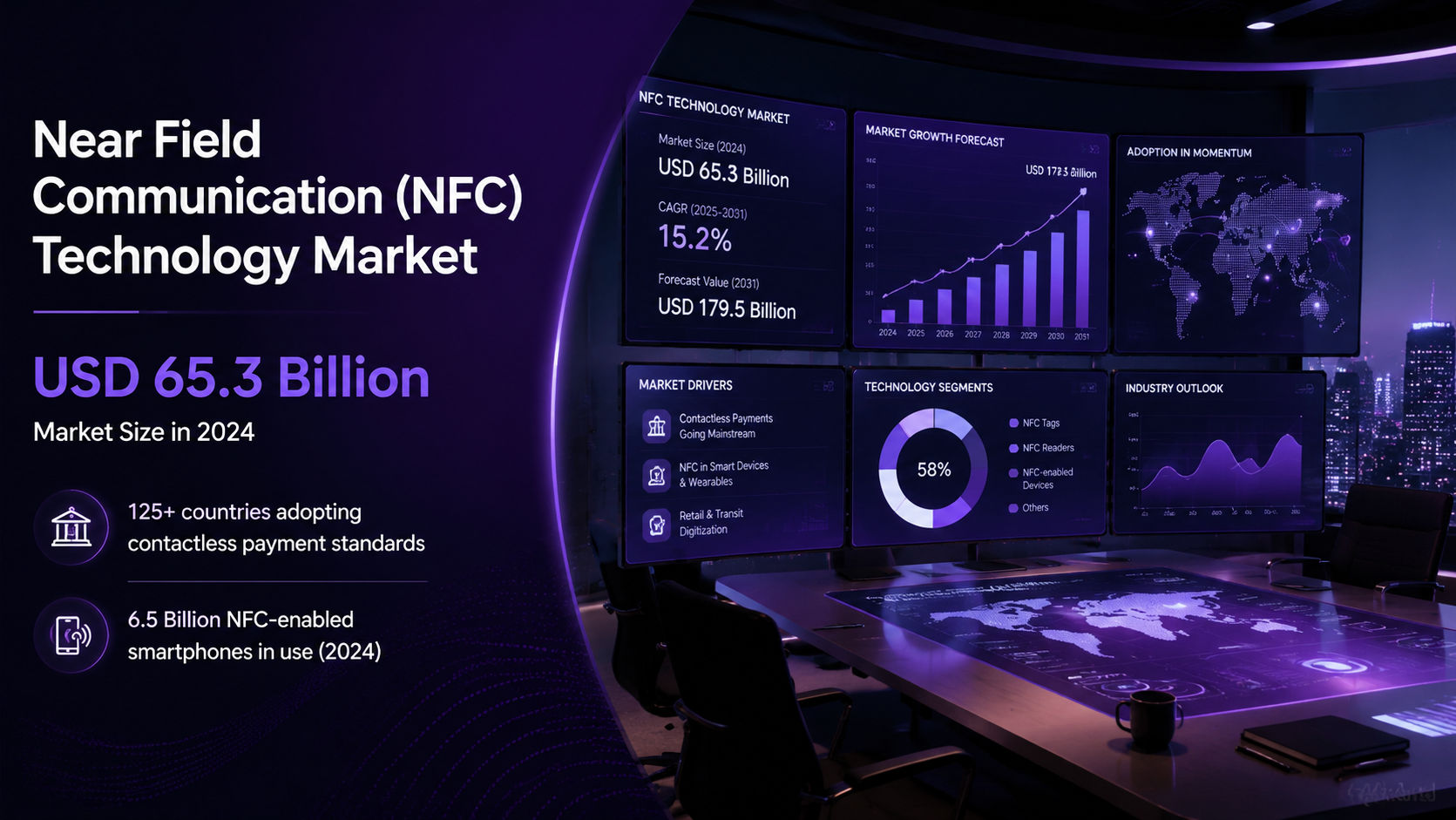
Near Field Communication (NFC) Technology Market Nears USD 56.2 Billion as Security-Integration Race Intensifies
According to Ken Research, the Near Field Communication (NFC) Technology Market was valued at approximately USD 31.1 billion in 2023 and is projected to reach nearly USD 56.2 billion by 2028. This implies a directional compound annual growth rate of approximately 12.6%, supported by the expansion of contactless payments, NFC-enabled smartphones, access-control systems, connected vehicles, healthcare identification and Internet of Things applications. The strategic challenge is shifting from basic NFC availability to secure, interoperable and commercially scalable implementation across fragmented device and service ecosystems.
Research Basis: Ken Research market sizing, component and application segmentation, NFC supplier mapping, connected-device analysis, contactless-payment statistics and regulatory ecosystem assessment.
Key Takeaways
- Market Size: The global market was valued at approximately USD 31.1 billion in 2023 and is projected to reach USD 56.2 billion by 2028.
- Growth Rate: The forecast implies a directional CAGR of approximately 12.6%, reflecting sustained investment in contactless transactions and connected-device infrastructure.
- Leading Component: NFC chips represent the leading component category because they are increasingly embedded in smartphones, payment cards, wearables, vehicles and industrial devices.
- Leading Device: Smartphones remain the leading device type, providing a widely distributed platform for wallets, authentication, information sharing and device pairing.
- Leading Region: Asia-Pacific leads the market, supported by electronics manufacturing, mobile-payment adoption, public-transport digitization and expanding connected-device ecosystems.
- Strategic Constraint: Security, certification, implementation cost and cross-platform interoperability are becoming greater barriers than basic consumer awareness.
Market At A Glance
Global NFC Technology Market Snapshot
- Base-Year Valuation: Approximately USD 31.1 billion in 2023.
- Forecast Valuation: Approximately USD 56.2 billion by 2028.
- Leading Application: Contactless payments, followed by information sharing, access control, healthcare and other connected applications.
- Leading Technology Models: Secure Element, Host Card Emulation and broader NFC integration within IoT environments.
- Competitive Focus: Transaction security, power efficiency, reader compatibility, form-factor flexibility and developer integration.
- Market Implication: Suppliers that combine chips, software, certification support and ecosystem partnerships are positioned more strongly than component-only providers.
Market Size and Growth
Ken Research estimates that the market will expand from approximately USD 31.1 billion in 2023 to nearly USD 56.2 billion by 2028. This growth reflects NFC's transition from a predominantly payment-focused interface into a broader proximity-based connectivity layer used for authentication, ticketing, digital identity, product interaction, healthcare tracking and device commissioning.
Contactless Payments Continue to Anchor Commercial Adoption
Contactless payments remain the largest visible demand engine because NFC offers consumers a familiar tap-based experience while allowing banks, wallet providers and merchants to use established card and mobile-device infrastructure. European Central Bank statistics show that the euro area recorded 29.6 billion contactless card payments during the first half of 2025, an increase of 12.8% from the corresponding period a year earlier. Their total value reached approximately EUR 0.8 trillion. Contactless transactions represented 83% of non-remote card-payment volume and 67% of its value, demonstrating how tap-based behavior is becoming standard rather than experimental.
This transaction growth raises the commercial importance of NFC controllers, secure elements, readers, payment terminals and tokenization systems. It also shifts supplier competition toward latency, security certification, power consumption and compatibility across cards, smartphones and wearables.
Mobile-Device Scale Expands NFC's Addressable Base
The International Telecommunication Union reports that more than four in five people worldwide own a mobile phone and almost three-quarters of the global population are online. This installed base gives NFC developers a scalable distribution channel for payment wallets, digital credentials, transit passes, access keys and connected-product experiences without requiring consumers to purchase a dedicated device.
However, mobile-phone ownership does not automatically translate into active NFC usage. Adoption depends on whether devices include enabled NFC hardware, whether banks and public agencies issue compatible credentials, and whether merchants, transport operators and building owners maintain acceptance infrastructure. The market opportunity therefore extends beyond semiconductor shipment volumes into software enablement, certification, reader deployment and lifecycle management.
IoT Integration Is Expanding NFC Beyond Transactions
NFC is increasingly used as a low-friction interface for commissioning connected products, transferring limited information, confirming product authenticity and linking physical objects to digital services. A user can tap a smartphone against an appliance, medical device, industrial asset or smart-home product to initiate pairing, retrieve instructions or authenticate an interaction without manually entering network credentials.
This role is commercially important because NFC does not need to replace Bluetooth, Wi-Fi or cellular connectivity. Instead, it can simplify the first interaction between a user and a connected product. Manufacturers that treat NFC as an onboarding and authentication layer can reduce setup friction while creating new post-sale engagement opportunities.
Security Is Becoming the Binding Constraint
As NFC moves into payments, identity documents, vehicle access and healthcare workflows, implementation quality becomes more important than the presence of an NFC chip. Ecosystem participants must manage risks related to credential storage, relay attacks, unauthorized reading, insecure application design, outdated terminals and inconsistent authentication requirements.
Secure Element architectures can isolate sensitive credentials within protected hardware, while Host Card Emulation can provide software flexibility and easier service deployment. The strategic decision is not whether one architecture is universally superior, but which balance of security, cost, control and deployment speed fits a specific use case.
Competitive Landscape
Semiconductor and NFC Controller Leaders
- Companies: NXP Semiconductors, STMicroelectronics, Infineon Technologies, Broadcom and Qualcomm Technologies.
- Strategic Position: These companies compete through integrated circuits, controllers, secure connectivity, processing efficiency and relationships with device manufacturers.
- Opportunity: Demand is expanding for integrated solutions that combine NFC with security, Bluetooth, ultra-wideband or broader connectivity capabilities.
- Risk: Design cycles are lengthy, certification requirements are demanding and customer concentration among major device manufacturers can increase commercial exposure.
Device and Consumer-Ecosystem Participants
- Companies: Apple, Samsung Electronics, Sony Corporation and other smartphone, wearable and consumer-electronics manufacturers.
- Strategic Position: Device manufacturers control the user interface through which consumers activate wallets, credentials, digital keys and tap-based experiences.
- Opportunity: Integrating NFC into operating systems and wearable ecosystems can increase consumer retention and service usage.
- Risk: Restricted platform access or inconsistent application-programming interfaces can limit innovation by external developers and service providers.
Identity, Access and Tagging Specialists
- Companies: Thales Group, HID Global, Identiv, Avery Dennison, Smartrac and Verimatrix.
- Strategic Position: These suppliers connect NFC hardware with secure credentials, access systems, tags, identity management and product-level authentication.
- Opportunity: Enterprise access, digital identity, pharmaceutical traceability and brand protection create higher-value use cases beyond basic payment transactions.
- Risk: Customers increasingly expect end-to-end implementation and cloud-based credential management rather than standalone tags or readers.
Smartphones Lead While Wearables Expand Interaction Frequency
Smartphones lead NFC device demand because they combine a display, secure processing, network connectivity and application ecosystem in a single platform. A smartphone can act as a payment instrument, ticket, hotel key, workplace credential, identity-verification tool and reader for NFC-tagged products.
Wearables are expanding interaction frequency by moving credentials from a device stored in a pocket to a watch, ring or other form factor that is immediately accessible. This creates opportunities in payments, fitness facilities, events, hospitality and closed-loop workplace systems. The commercial challenge is maintaining battery efficiency, secure credential provisioning and consistent acceptance across reader environments.
Asia-Pacific Leads the Market's Manufacturing and Deployment Base
Ken Research identifies Asia-Pacific as the leading regional market in 2023, supported by electronics manufacturing, large smartphone populations, mobile-payment usage and investment in smart transportation. China, Japan, South Korea and India contribute through different combinations of semiconductor production, handset manufacturing, digital wallets, transit systems and government-backed digitization initiatives.
India's RuPay Contactless framework is aligned with the National Common Mobility Card program, illustrating how NFC-enabled cards can support payments across retail and public-transport environments. This model strengthens the business case for interoperable credentials that can function across metro systems, buses, parking, tolling and conventional merchant terminals.
- Regional smartphone manufacturing supports high-volume NFC chip integration.
- Public-transport digitization creates recurring demand for readers, cards and mobile credentials.
- Large unbanked and underbanked populations create opportunities for affordable contactless products.
- Fragmented standards and implementation costs can slow adoption outside major urban markets.
Which NFC suppliers are best positioned across chips, secure elements, readers and tags? Download the NFC Technology Market Report for company profiling, segmentation analysis and strategic opportunity mapping.
Access Control and Digital Identity Create the Next Growth Layer
NFC-based access credentials are moving from plastic cards toward smartphones and wearables. Offices, hotels, universities, residential buildings and events can provision, suspend and update digital credentials remotely, reducing dependence on physical-card issuance while improving auditability.
Digital identity applications may create an even larger opportunity because NFC can facilitate communication with electronic identity documents, secure credentials and government-issued cards. The market will favor providers that can combine privacy protection, user consent, credential verification and compatibility across public and private infrastructure.
- Hospitality operators can issue mobile room keys before guest arrival.
- Enterprises can integrate building access with employee identity systems.
- Universities can combine identification, attendance, payments and library access.
- Governments can use secure NFC credentials for citizen-service authentication.
Healthcare Adoption Depends on Workflow Integration
Healthcare represents a growing NFC application area across patient identification, medication verification, medical-device configuration and equipment tracking. NFC wristbands or cards can connect a patient to authorized records, while tagged pharmaceutical packaging can provide instructions, batch information or authenticity checks.
The value proposition is strongest when NFC reduces a specific workflow risk rather than merely replacing a barcode. Healthcare buyers require clear evidence that a solution improves identification accuracy, reduces manual entry, integrates with clinical systems and protects sensitive data. Vendors capable of supporting secure deployment and regulatory documentation will therefore carry an advantage over low-cost tag suppliers.
Implementation Cost Restrains Small-Business Adoption
The NFC chip itself may represent only a small portion of total implementation cost. Businesses must also account for readers, terminals, software integration, security testing, certification, employee training and device maintenance. These costs can slow adoption among small merchants and organizations operating legacy systems.
Cloud-based management, software development kits and modular NFC readers can lower deployment barriers. Suppliers that provide pre-certified reference designs and integration support can shorten customer implementation cycles while reducing the risk of incompatible hardware and software.
Analyst View
The market's next phase will be determined by whether suppliers can convert NFC from a device feature into a trusted service layer. Payment adoption has already demonstrated the appeal of tap-based interaction, but future growth will increasingly come from access control, digital identity, connected-product onboarding, healthcare and automotive applications.
The strongest companies will not compete solely on chip price. They will combine secure hardware, software tools, certification expertise and partnerships with banks, device manufacturers, transport authorities and enterprise platforms. As the market approaches USD 56.2 billion, interoperability and security will become commercial differentiators rather than technical compliance exercises.
Strategic Implications by Stakeholder
- For Semiconductor Suppliers: Integrating security and complementary connectivity features can improve design-win durability.
- For Banks and Wallet Providers: Tokenization, fraud controls and device-level authentication must scale alongside transaction volumes.
- For Device Manufacturers: Open but secure developer access can expand the number of valuable NFC use cases.
- For Enterprises: NFC deployments should be evaluated on workflow improvement, not simply hardware cost.
- For Investors: Companies controlling credential management, certification or ecosystem integration may capture more durable value than commodity component suppliers.
Strategic Outlook
Through 2028, market growth will concentrate around contactless-payment expansion, digital credentials, connected-product onboarding and embedded NFC functionality across smartphones, wearables, vehicles and industrial equipment. Asia-Pacific will remain strategically important because of its manufacturing base and deployment scale, while Europe will continue to influence payment, identity and data-protection requirements.
For adjacent opportunity assessment, decision-makers can compare NFC development with broader technology and telecommunications market intelligence and competition benchmarking studies.
Planning an NFC product launch, investment or market-entry strategy? Request an NFC Technology Market Assessment to evaluate application demand, supplier positioning, security requirements and regional deployment opportunities.
Frequently Asked Questions
Q1: What is the size of the global NFC technology market?
The global NFC technology market was valued at approximately USD 31.1 billion in 2023 and is projected to reach nearly USD 56.2 billion by 2028, implying a directional CAGR of around 12.6%.
Q2: What is driving NFC technology market growth?
Growth is being driven by contactless payments, NFC-enabled smartphones and wearables, digital access credentials, IoT device onboarding, public-transport ticketing and demand for fast proximity-based authentication.
Q3: Which component leads the NFC market?
NFC chips lead the component segment because they are integrated into smartphones, smart cards, wearables, readers, vehicles and connected devices. Readers and tags also represent important opportunities as acceptance infrastructure and product-level NFC applications expand.
Q4: Which region leads the NFC technology market?
Asia-Pacific leads the global market, supported by its electronics-manufacturing ecosystem, large smartphone base, mobile-payment adoption and investment in smart transportation and connected infrastructure.
Q5: Who are the major companies in the NFC technology market?
Major companies include NXP Semiconductors, Broadcom, STMicroelectronics, Infineon Technologies, Qualcomm Technologies, Samsung Electronics, Sony Corporation, Apple, Texas Instruments, Thales Group, Avery Dennison, Identiv, Verimatrix and HID Global.
Q6: What is the biggest strategic risk facing NFC adoption?
The largest strategic risk is insecure or fragmented implementation. A poorly integrated NFC service can expose credentials, create compatibility failures or deliver an inconsistent user experience. Suppliers must therefore address secure credential storage, authentication, certification and reader compatibility alongside hardware cost.
Data Source
Market sizing, segmentation and competitive interpretation are based on Ken Research analysis and cross-referenced with official contactless-payment, mobile-connectivity and public-transport payment information.
This analysis of the Near Field Communication Technology Market is based on the Ken Research NFC Technology Market report, supplemented by information from the European Central Bank, the International Telecommunication Union and the National Payments Corporation of India.