
The aquaculture industry has become a major contributor to global food production, supplying billions of people with nutritious seafood products every year. As consumer demand for fish continues to rise, producers are seeking more efficient and sustainable methods of farming. Among the many factors that influence aquaculture success, feed quality remains one of the most critical. High-quality feed supports rapid growth, improves fish health, reduces waste, and ultimately increases farm profitability.
In modern fish farming, feed often accounts for more than half of total production costs. Therefore, improving feed efficiency has become a primary objective for both fish farmers and feed manufacturers. Advances in feed processing technology have made it possible to produce nutritionally balanced pellets with excellent digestibility and water stability. At the center of this technological progress is the extrusion process, particularly the use of the wet type fish feed extruder.
Fish feed production begins with the selection of suitable raw materials. Protein-rich ingredients such as fish meal, soybean meal, rapeseed meal, and corn gluten meal are commonly used to provide essential amino acids for fish growth. Additional ingredients, including wheat flour, rice bran, fish oil, vitamins, minerals, and feed additives, are incorporated to create a complete and balanced nutritional profile.
Once the ingredients are selected, they undergo a grinding process. Fine grinding is important because it improves ingredient uniformity and allows nutrients to be distributed evenly throughout the feed. Smaller particle sizes also contribute to better pellet quality during extrusion.
The ground materials are then transferred to a mixing system where they are blended according to a carefully designed formulation. Precision mixing ensures that every pellet contains the correct proportion of nutrients, helping fish achieve consistent growth performance.
After mixing, the feed enters the conditioning stage. Steam is introduced into the material to increase temperature and moisture content. This step softens the feed mixture, enhances starch gelatinization, and improves the binding characteristics of the ingredients. Proper conditioning is essential for achieving optimal extrusion performance.
The conditioned feed is then processed through a wet type fish feed extruder. Unlike dry extrusion systems, wet extrusion utilizes external steam to create ideal processing conditions. The combination of moisture, pressure, temperature, and mechanical shear transforms the feed mixture into a homogeneous mass.

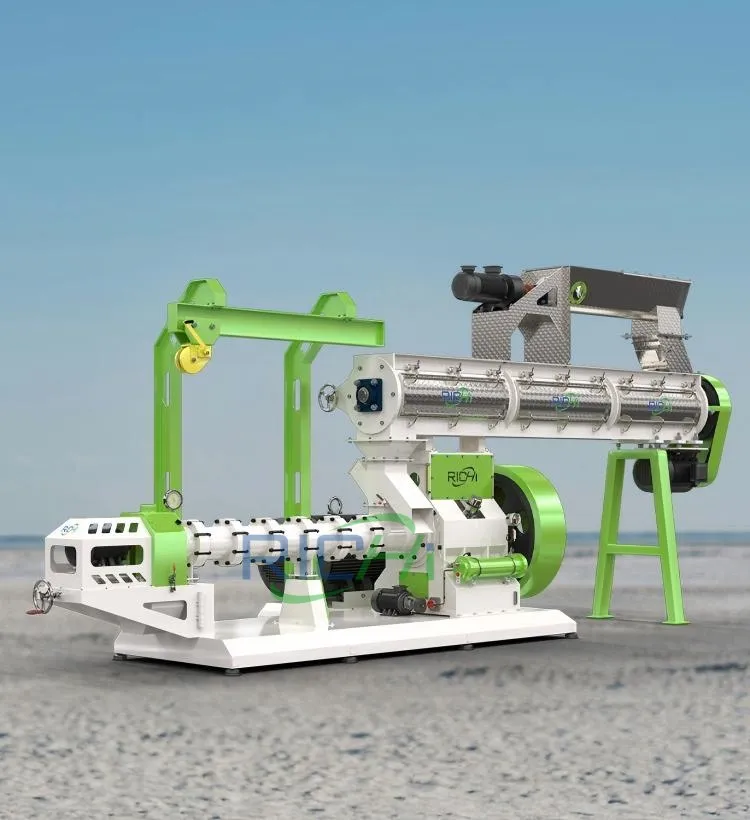
Inside the extruder barrel, rotating screws move the material forward while applying compression and heat. As the feed exits through the die opening, a rapid pressure drop causes moisture within the material to expand. This expansion creates a porous structure that can be controlled to produce either floating or slow-sinking pellets.
One of the greatest advantages of the wet type fish feed extruder is its ability to produce floating feed. Floating pellets allow fish farmers to observe feeding behavior directly and adjust feeding rates accordingly. This minimizes feed waste and improves feed conversion efficiency, which is a major factor in reducing production costs.
The extrusion process also improves nutrient utilization. Heat and pressure break down complex starch molecules and modify protein structures, making nutrients easier for fish to digest. Better digestibility means that fish can absorb more nutrients from the same amount of feed, resulting in faster growth and improved overall performance.
Another important benefit is enhanced feed safety. The high-temperature environment inside the extruder helps eliminate harmful microorganisms that may be present in raw materials. This contributes to healthier fish populations and reduces the risk of disease outbreaks.
Modern aquaculture operations often require feed for multiple species and growth stages. The wet type fish feed extruder offers excellent flexibility because operators can adjust processing parameters to produce pellets of different sizes, densities, and buoyancy levels. This allows manufacturers to serve a wide range of aquaculture markets with a single production system.

After extrusion, the pellets are transferred to a dryer. Drying reduces moisture content to levels suitable for long-term storage. Proper drying is essential for preventing mold growth and maintaining pellet quality during transportation and handling.
The dried pellets then pass through a cooling system. Cooling stabilizes the pellet structure, increases hardness, and reduces the likelihood of breakage. Strong pellets are especially important for maintaining product quality throughout the distribution process. (Learn more about industrial belt dryer for sale)
In many modern feed plants, oil coating systems are installed after cooling. These systems apply fish oil, vitamins, attractants, and other nutritional additives to the pellet surface. Vacuum coating technology allows these ingredients to penetrate deeply into the pellets, enhancing nutritional value without compromising structural integrity.
Quality control procedures are implemented throughout the production process. Feed manufacturers regularly test pellet durability, moisture content, protein levels, fat content, water stability, and floating performance. Consistent quality is essential for maintaining customer satisfaction and achieving reliable results in fish farming operations.
Automation has significantly improved the efficiency of modern feed production facilities. Advanced control systems monitor key processing parameters such as temperature, pressure, moisture content, and production rate. These systems help operators maintain stable conditions and optimize performance while reducing labor requirements.
Environmental sustainability is becoming increasingly important in aquaculture. Efficient feed production technologies help reduce waste generation and improve nutrient utilization. The wet type fish feed extruder contributes to these goals by producing highly digestible pellets that minimize nutrient losses in aquatic environments.
Global demand for aquaculture feed is expected to continue growing as fish farming expands worldwide. Countries in Asia, Africa, and South America are investing heavily in feed manufacturing infrastructure to support their aquaculture industries. This trend is driving increased adoption of advanced processing technologies and high-performance equipment.
The wet type fish feed extruder has become a preferred solution for many commercial feed producers because of its ability to deliver consistent quality, high output, and excellent nutritional performance. Its versatility allows manufacturers to produce feed for a wide variety of species, including tilapia, catfish, carp, trout, salmon, shrimp, and ornamental fish.
Technological innovation continues to improve extrusion systems. New machine designs focus on increasing production capacity, reducing energy consumption, and simplifying maintenance. Intelligent monitoring systems provide real-time operational data, helping manufacturers maximize efficiency and minimize downtime.
As aquaculture continues to play a growing role in global food security, the importance of high-quality feed production cannot be overstated. Reliable feed manufacturing technologies help ensure healthy fish growth, efficient resource utilization, and sustainable industry development.
In conclusion, advanced feed processing has become essential for modern aquaculture success. The wet type fish feed extruder is a key component of this process, enabling the production of durable, nutritious, and highly digestible feed pellets. By improving feed quality, supporting fish health, and enhancing production efficiency, this technology continues to drive the evolution of the global aquaculture industry. (Richi Machinery)