
Malaysia Warehousing Market Hits USD 700M by 2028 at 7% CAGR on E-Commerce | Ken Research
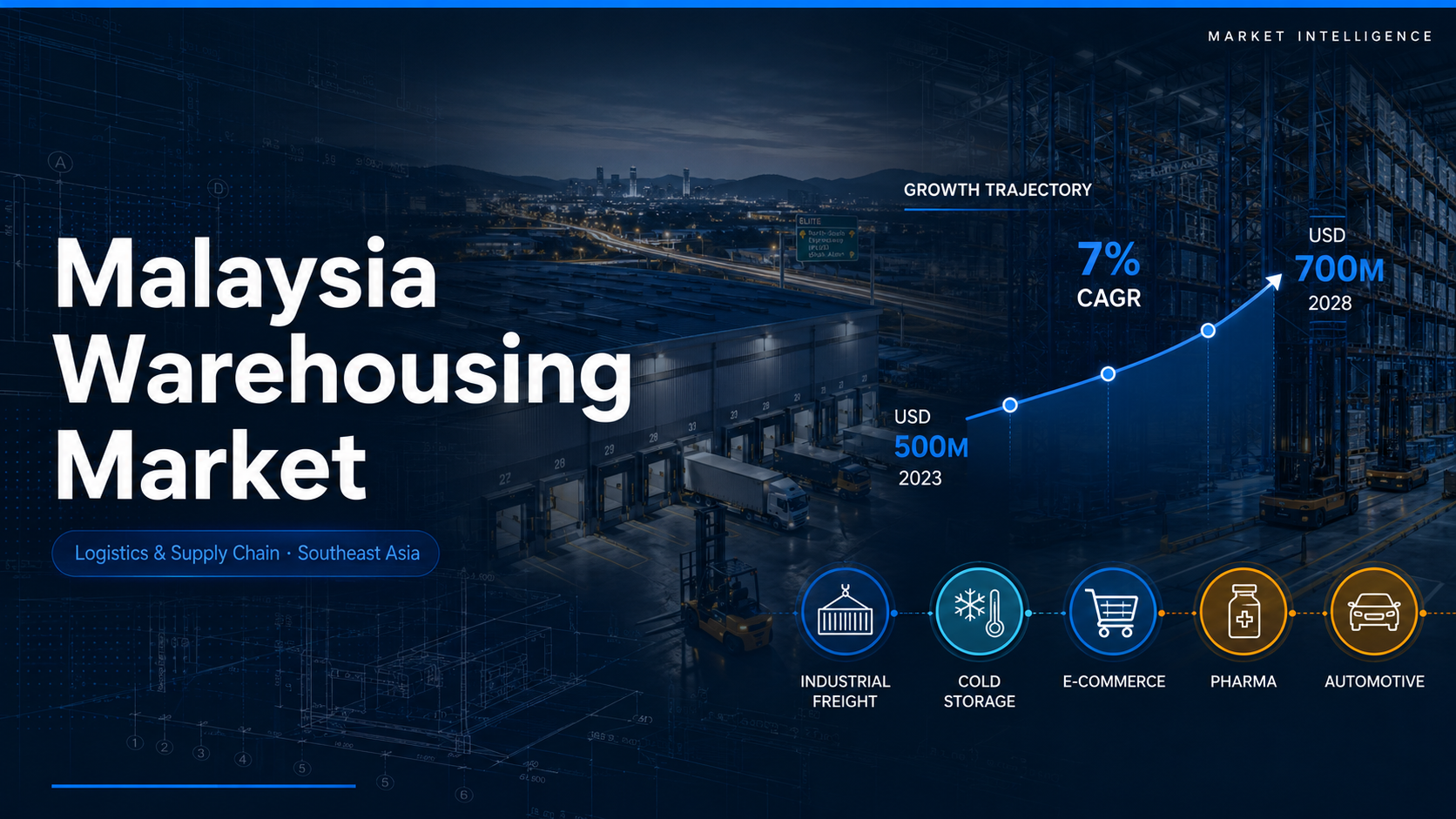
Malaysia's warehousing sector is not growing uniformly: supply chain consolidation is happening fastest in Selangor and Johor, where RCEP-driven trade growth and e-commerce fulfillment demand are outpacing the national average. As per Ken Research market modelling, the Malaysia Warehousing Market is valued at USD 500 million in 2023 and is projected to reach USD 700 million by 2028 at a 7% CAGR, driven by e-commerce expansion, RCEP free trade framework benefits, and government infrastructure investment including the East Coast Rail Link. The full competitive landscape, forecasts, and segment analysis are available in the Malaysia Warehousing Market Report.
This analysis draws on data from Ken Research market modelling, Malaysia Digital Economy Corporation disclosures, DOSM trade statistics, and independent logistics operator benchmarking.
Industrial Freight Leads at 40% Share as Selangor Captures 35% of National Warehousing Stock
Industrial freight and retail warehousing account for an estimated 40% of total market revenue, anchored by Selangor with an estimated 35% of national warehousing stock. Industrial land in Selangor trades at MYR 60 to MYR 200 per sq ft, creating supply chain consolidation incentives for 3PL outsourcing operators displacing owned-warehouse models. Malaysia's e-commerce market, supported by 29.5 million active internet users, drives Grade A warehouse demand across Klang Valley and Johor Bahru. The UAE 3PL Warehousing and Contract Logistics Market shows 3PL outsourcing penetration grows 2-3x faster where industrial land costs make owned-warehouse ROI negative for mid-tier shippers.
- Industrial Freight: Selangor holds an estimated 35% of national warehousing stock, with DHL Supply Chain, Kerry Logistics, and YCH Group anchoring Grade A capacity at MYR 60-200/sqft land valuations.
- Cold Storage: Pharmaceutical and food cold chain demand is driving 12-15% annual growth in cold storage capacity, the fastest segment in the Malaysia warehousing market.
- E-Commerce Warehousing: Last-mile fulfillment demand from Shopee, Lazada, and TikTok Shop is creating Grade A sub-5,000 sqm micro-fulfillment center demand in Klang Valley and Johor Bahru.
RCEP and East Coast Rail Link Create USD 700M Path Through 2028 for 3PL Operators
RCEP positioned Malaysia as a preferred transshipment hub between ASEAN and Northeast Asian manufacturing corridors, adding an estimated 8-12% annual incremental warehousing demand from shipper re-routing decisions. The East Coast Rail Link, a MYR 50 billion infrastructure project, creates new logistics nodes in Pahang and Terengganu. The Saudi Arabia Logistics Real Estate and Cold Storage Market shows government infrastructure investment of comparable scale generated 3x CAGR acceleration in logistics real estate absorption within five years of rail completion.
- RCEP Transshipment: Malaysia's RCEP membership drives an estimated 8-12% incremental warehousing demand annually as multinationals route ASEAN-China logistics through Malaysian free trade zones.
- East Coast Rail: The MYR 50 billion ECRL creates logistics nodes in Pahang and Terengganu, expanding the warehousing addressable market beyond the existing Klang Valley and Johor concentration.
Which Malaysia warehousing segment is capturing the highest 3PL outsourcing demand in 2026? Download Sample Report to access segment-level data and competitive benchmarking.
Why Is Malaysia Warehousing Growing at 7% CAGR When Industrial Land Costs Are Rising 15% Annually?
Rising land costs are accelerating rather than suppressing warehousing demand by forcing the transition from owner-occupied to 3PL contract logistics models. With industrial land pricing up an estimated 15% annually in Selangor, the break-even ROI on owned warehouses is extending beyond 12 years for mid-tier shippers, making 3PL outsourcing the economically rational choice. Per Malaysia's Department of Statistics Malaysia trade data, Malaysia's goods exports grew at over 6% annually through 2025, sustaining freight forwarding margins at levels that incentivize warehousing capacity expansion despite land cost pressures.
Malaysia Warehousing Outlook to 2028: Grade A Vacancy Tightens as E-Commerce Grows
The market tracks to USD 700 million by 2028, with Grade A vacancy tightening to an estimated 5-8% in Selangor as e-commerce absorption outpaces new supply. Cold storage remains the highest-growth segment at 12-15% annual expansion as pharmaceutical cold chain mandates and F&B e-commerce require temperature-controlled logistics integration. Maple Tree Logistics and LOGOS are expanding with multi-tenanted Grade A facilities targeting 3PL outsourcing contracts.
- Grade A Vacancy: Selangor's Grade A warehousing vacancy is tightening to an estimated 5-8% as e-commerce fulfillment absorption exceeds new supply completion timelines.
- Cold Chain: Cold storage expansion at 12-15% annually is driven by GMP-compliant pharma logistics mandates and the growth of cold-chain F&B e-commerce in the Klang Valley corridor.
- Multi-Storey Adoption: Grade A multi-storey warehouse adoption in Malaysia is growing as urban industrial land scarcity forces developers to maximize sq ft utilization per plot.
Want segment forecasts, 3PL competitive positioning, and RCEP impact analysis for Malaysia warehousing? Malaysia Warehousing Market Report delivers full competitive intelligence.
What 3PL Operators, Developers, and Investors Must Do Before 2028 Tightening Closes
Malaysia's warehousing vacancy is tightening at 5-8% in Selangor, ECRL logistics nodes are coming online by 2027, and Grade A cold storage capacity is insufficient for forecast pharma demand. Three stakeholder groups face distinct 2026-2028 windows.
- 3PL Operators: Lock multi-year contracts in Selangor Grade A facilities now before 5-8% vacancy eliminates negotiating leverage and drives lease rates above current MYR 60-200/sqft land cost baselines.
- Developers: Accelerate cold storage and multi-storey Grade A development in Klang Valley and Johor where 12-15% cold chain growth and e-commerce last-mile demand both favor mixed-use logistics real estate.
- Investors: The USD 500M to USD 700M trajectory at 7% CAGR represents a clean logistics real estate play amplified by RCEP transshipment upside and ECRL-driven east coast warehouse node development.
Conclusion
Malaysia's warehousing market is at a USD 500M to USD 700M inflection with two catalysts converging: RCEP-driven trade growth and ECRL logistics infrastructure. The 7% CAGR trajectory and tightening Grade A vacancy in Selangor create a 2026-2028 window where supply chain consolidation into 3PL models will reward first-movers in cold storage and multi-storey Grade A development.
Frequently Asked Questions
Q1: What is the size of the Malaysia Warehousing Market?
The Malaysia Warehousing Market is valued at USD 500 million in 2023 and projected to reach USD 700 million by 2028 at a 7% CAGR per Ken Research modelling, driven by RCEP trade growth, East Coast Rail Link infrastructure, and e-commerce fulfillment demand across Selangor, Johor, and Penang.
Q2: Who are the key players in the Malaysia warehousing market?
Leading operators include Tiong Nam, Maple Tree Logistics, TASCO Bhd, PKT Group, YCH Group, Kerry Logistics Network, Kuehne + Nagel, and DHL Supply Chain. Selangor and Johor account for the majority of Grade A capacity, with industrial land at MYR 60-200 per sqft anchoring development economics for multi-tenanted facilities.
Q3: Which segment leads Malaysia's warehousing market?
Industrial freight and retail warehousing lead at approximately 40% of total revenue, followed by cold storage at 12-15% annual growth. For benchmarking Malaysia's 3PL outsourcing dynamics against comparable Gulf logistics markets, the Qatar Logistics Warehouse Robotics and AMR Integrations Market maps how automation investment is compressing labor costs by 20-25% in comparable contract logistics environments.
Q4: What is driving growth in Malaysia's warehousing market?
RCEP adds an estimated 8-12% incremental warehousing demand annually, the MYR 50 billion East Coast Rail Link creates east coast logistics nodes, and e-commerce fulfillment from 29.5 million internet users drives Grade A absorption. Cold chain pharma mandates add 12-15% annual cold storage expansion.
Q5: How does RCEP affect Malaysia's warehousing investment landscape?
RCEP positions Malaysia as a preferred transshipment hub, driving an estimated 8-12% annual incremental warehousing demand as multinationals route logistics through Malaysian free trade zones. This accelerates Grade A absorption in Selangor to 5-8% vacancy, tightening lease pricing ahead of the 2028 ECRL logistics node expansion.
For the full competitive benchmarking, segment-level forecasts, and regional breakdown, access the Malaysia Warehousing Market Report from Ken Research, a leading market intelligence firm covering logistics and supply chain across Southeast Asia.